
English, French or German: which language to choose for school
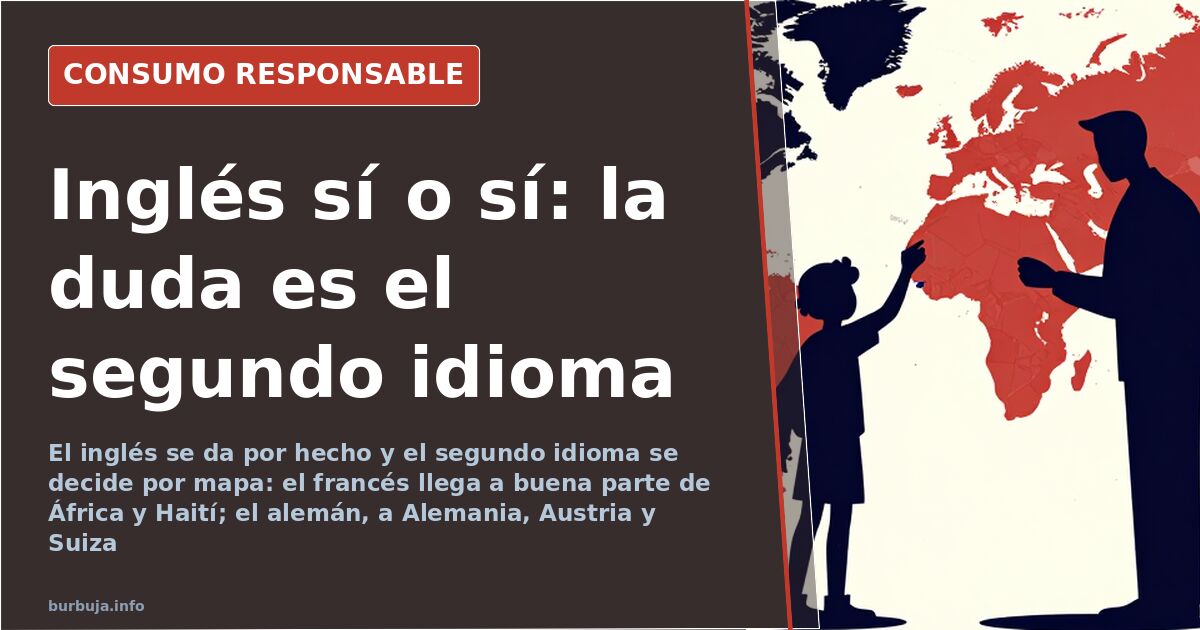
English is taken for granted and the second language is decided by map: French reaches much of Africa and Haiti; German covers Germany, Austria and Switzerland
English · Original discussion in Spanish · Published
Which language to choose for school: English is non-negotiable
Some family decisions leave no room for trial and error, and the language a child will study in is one of them. The question is put bluntly: school in English, French or German. And the most common answer comes before anyone offers a single fact: English isn't chosen, it's taken for granted. On that common ground, the debate shifts to the second language. That's where the real disagreement begins.
Why is English taken for granted?
The dominant reasoning is that English works as a baseline, not as a bonus: the child will learn it anyway, inside or outside the classroom, so building the whole decision around it seems almost redundant. With that as the base, the discussion is about what to put alongside it. One particularly blunt formulation: with no data on the table, French seems more widespread than German. Others break out of the European frame and bet on Mandarin or Arabic as the languages of the future. And someone throws the question back with a pertinent point: are we talking about a Spanish bilingual school or a genuinely foreign school? Because they are not the same thing, not by a long shot.
The map matters more than grammar
The most repeated argument in favour of French has nothing to do with culture or how it sounds: it's geography. People point out that French isn't only useful in France, but also in much of Africa and in Haiti. German, by contrast, is associated with Germany and a handful of nearby countries, Austria and Switzerland among them. Choosing based on potential speakers and markets is as pragmatic as it is debatable, but it has its logic. Nobody puts a figure on the table. Catalan and Basque also come up as options, along with one ironic suggestion: Zulu as the language of the future.
Bilingual school or a genuinely foreign school
Here lies the nuance that reframes the whole question. A Spanish bilingual school and a foreign school are not playing in the same league. The most detailed account describes a highly exclusive school attended by hardly any students of one particular nationality —the girl has dual nationality— and a level the storyteller describes as in a league of its own: at 11 and 12 years old she was trinc films in French, English, German or Russian and understanding them, and was already working on integrals and derivatives. The price of that level, according to the same account, is pure discipline: study time is measured at 100% concentration. It's one specific experience, not a report, but it explains that the question about language hides an earlier one: which school model.
Where the decision gets stuck
In the end, English appears as the baseline in almost every answer, and the second language is split between French, German, Chinese, Catalan, Basque and the odd joke. Nobody doubts the child will end up speaking languages. The sticking point comes earlier: deciding which school, with what method, and for what purpose.
Also available in: Deutsch
Summary of a discussion on Burbuja.info - Foro de economía, actualidad y política., translated from Spanish and reviewed before publication. Read the full discussion (15 replies).
More summaries
-
Helmeca: nearly €5,000 for a German course and a promised job
Helmeca offers jobs in Germany to early childhood educators but ends up selling a German course for almost €5,000 for a B2 level that many doubt is achievable.
-
Hussars: quality menswear or just posturing?
Hussars review: natural fabrics, local manufacturing, and straight fit versus criticism for its controversial cut and self-promotion. Is it worth the price?
-
Purebred dogs live shorter and cost more, owners say
Owners' stories suggest purebred dogs fall ill earlier and cost more: up to €20,000 for a French bulldog, according to its owner
-
WhatsApp without a smartphone: three ways to use it from your PC
Three methods to use WhatsApp without a smartphone or a data plan: Android emulator, SDK or terminal. One number, one single device.
-
BQ Aquaris won't turn on: the volume button trick that revived it
A BQ Aquaris that wouldn't turn on or charge came back to life by pressing volume and power together. The Spanish brand's customer service divides opinion: quick replacements versus recurring faults.
-
Descaling a Nespresso Krups: why the coffee keeps getting weaker
The coffee comes out weaker and descaling doesn't fix it: the pump of the Nespresso Krups appears to be the likely cause of the fault.