
Father offers six daughters in exchange for lifelong support
Viral ad claims a father seeks husbands for his six daughters, demanding the suitor financially support him for life.
English · Original discussion in Spanish · Published
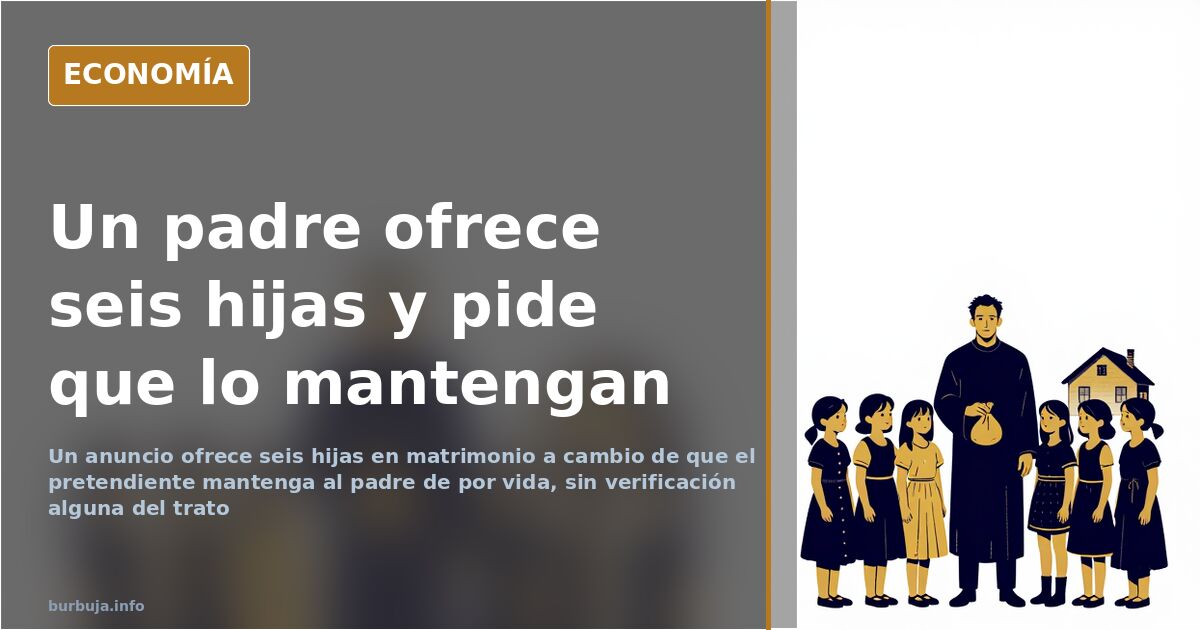
Six daughters offered in marriage for financial support
A widely shared message attributes to a father an offer of his six daughters with one condition: whoever marries any of them must support him economically. Framed as a business deal, the ad is a reverse dowry: instead of the bride's family paying, the groom is required to pay. The message circulates amid responses placing it in an Amazonian region and has triggered a cascade of comments mixing jokes, domestic arithmetic, and harsh insults. What has not appeared anywhere is verification: no one has confirmed that the six daughters exist, accept the deal, or even know they are being offered.
What the ad demands and what remains unknown
The key requirement is the father-in-law's maintenance. In the circulated text, there is no price, term, or exit condition: the son-in-law pays and the father collects. A quick read dismisses this as posturing; another, more uncomfortable, reads it as a textbook marriage contract where women function as assets and men as payers.
On the ground, nothing is firm: the material does not identify the daughters, set ages, or detail if all six share the criteria. There is no independent verification of any aspect: neither the existence of the six women, nor the father's authority to offer anything, nor whether the text is literal or a social media performance. Any economic reading of the case relies on the statement and reactions, not verified facts.
How much does it cost to support a father-in-law?
The calculation dominating responses is barter-based. One suggests renting a daughter in exchange for maintenance, recalling the price could have been set at three horses, though "times have changed." The joke has substance: in a moneyless economy, a pack animal served as a unit of account and solvency guarantee.
Another line argues the father raised six women specifically to monetize the investment later, akin to a pension plan with daughters as underlying assets. The flaw in this reasoning is that lifetime maintenance is not income: it is a liability without maturity date. Whoever signs inherits fixed costs, not a dowry. No one has calculated how many years or at what cost the agreement sustains itself.
Conquest as a comparison frame
Much commentary jumped to the 16th century. The most repeated idea is that the ad resembles what Spaniards found 500 years ago, with an ex-goatherd from Extremadura enrolled in Cortés' expedition as the imaginary protagonist. The comparison is historically crude and remains forum chatter.
In that same vein appears the most curious detail. The name Venezuela originates, according to versions repeated in responses, from the impression caused by palafitic dwellings described: huts over water reminiscent of a small Venice. The anecdote slips among jokes to remind us the continent had names, cities, and economies before anyone arrived offering daughters.
Polygamy, tribal hierarchy, and beauty standards
Some argue the ad is not an anthropological rarity, because in many Amazonian communities tribal chiefs accumulate multiple wives and equivalent numbers of sons. This claim lacks sources and generalizes an entire continent but serves to place the offer within alliance and prestige logic, not romantic love.
From there, the discussion slid toward physical appearance and beauty canons. Part of the responses openly insulted indigenous women with expressions this outlet will not reproduce. Others defended the opposite: antiestéticatures that do not meet the thin model standard are not defects. Meanwhile, the debate drifted into gym talk—claiming extreme thinness is a recent canon and curves always won—more suited to casual chat than demographics.
The deal no one has signed yet
If the ad is taken literally, the first marriage would close a lifetime maintenance contract whose cost no one has broken down. If it is a joke, it worked well enough: generating dozens of responses, reviving old debates on dowries and interest-based marriages, and making an Amazonian father the best salesman of his own daughters. It likely neither exists nor needs to. But next time someone claims marriage is no longer a market, remember someone put a price tag, on paper, on six brides and a father-in-law for life.
A widely shared message attributes to a father an offer of his six daughters with one condition: whoever marries any of them must support him economically. Framed as a business deal, the ad is a reverse dowry: instead of the bride's family paying, the groom is required to pay. The message circulates amid responses placing it in an Amazonian region and has triggered a cascade of comments mixing jokes, domestic arithmetic, and harsh insults. What has not appeared anywhere is verification: no one has confirmed that the six daughters exist, accept the deal, or even know they are being offered.
What the ad demands and what remains unknown
The key requirement is the father-in-law's maintenance. In the circulated text, there is no price, term, or exit condition: the son-in-law pays and the father collects. A quick read dismisses this as posturing; another, more uncomfortable, reads it as a textbook marriage contract where women function as assets and men as payers.
On the ground, nothing is firm: the material does not identify the daughters, set ages, or detail if all six share the criteria. There is no independent verification of any aspect: neither the existence of the six women, nor the father's authority to offer anything, nor whether the text is literal or a social media performance. Any economic reading of the case relies on the statement and reactions, not verified facts.
How much does it cost to support a father-in-law?
The calculation dominating responses is barter-based. One suggests renting a daughter in exchange for maintenance, recalling the price could have been set at three horses, though "times have changed." The joke has substance: in a moneyless economy, a pack animal served as a unit of account and solvency guarantee.
Another line argues the father raised six women specifically to monetize the investment later, akin to a pension plan with daughters as underlying assets. The flaw in this reasoning is that lifetime maintenance is not income: it is a liability without maturity date. Whoever signs inherits fixed costs, not a dowry. No one has calculated how many years or at what cost the agreement sustains itself.
Conquest as a comparison frame
Much commentary jumped to the 16th century. The most repeated idea is that the ad resembles what Spaniards found 500 years ago, with an ex-goatherd from Extremadura enrolled in Cortés' expedition as the imaginary protagonist. The comparison is historically crude and remains forum chatter.
In that same vein appears the most curious detail. The name Venezuela originates, according to versions repeated in responses, from the impression caused by palafitic dwellings described: huts over water reminiscent of a small Venice. The anecdote slips among jokes to remind us the continent had names, cities, and economies before anyone arrived offering daughters.
Polygamy, tribal hierarchy, and beauty standards
Some argue the ad is not an anthropological rarity, because in many Amazonian communities tribal chiefs accumulate multiple wives and equivalent numbers of sons. This claim lacks sources and generalizes an entire continent but serves to place the offer within alliance and prestige logic, not romantic love.
From there, the discussion slid toward physical appearance and beauty canons. Part of the responses openly insulted indigenous women with expressions this outlet will not reproduce. Others defended the opposite: antiestéticatures that do not meet the thin model standard are not defects. Meanwhile, the debate drifted into gym talk—claiming extreme thinness is a recent canon and curves always won—more suited to casual chat than demographics.
The deal no one has signed yet
If the ad is taken literally, the first marriage would close a lifetime maintenance contract whose cost no one has broken down. If it is a joke, it worked well enough: generating dozens of responses, reviving old debates on dowries and interest-based marriages, and making an Amazonian father the best salesman of his own daughters. It likely neither exists nor needs to. But next time someone claims marriage is no longer a market, remember someone put a price tag, on paper, on six brides and a father-in-law for life.
Summary of a discussion on Burbuja.info - Foro de economía, actualidad y política., translated from Spanish and reviewed before publication. Read the full discussion (181 replies).
More summaries
-
iPhone stolen in Spain drains €20,000 via Trade Republic
Thieves stole an iPhone in Marbella and drained €20,000 from accounts in 12 hours. Analysis of security flaws in neobanks like Trade Republic.
-
Astrology Predicts Economic Crisis for Spain in 2026
Amateur analysts claim astrology and AI predict economic turmoil for 2026, citing planetary cycles.
-
Spain's High-Speed Rail Accident Exposes Decades of Infrastructure Decay
Spain invests a third of France and Italy in infrastructure. Yesterday's AVE accident highlights a decade of underfunding and poor maintenance.
-
Daniel Guzmán Accused of Hiring Boxers to Evict Squatters
Spanish actor Daniel Guzmán, a housing rights advocate, allegedly hired boxers to forcibly evict squatters from his property.
-
Trump supporters: Are you truly complicit?
Cheap US gas at €0.70 vs $2,800 hospital bills: analyzing why some Spaniards back Trump's Venezuela intervention.
-
Spain rental listings drop 8.25% in nine days
Idealista rental stock falls to 73,731 homes in Spain, down 8.25%. Barcelona leads the shift as 70% of supply becomes short-term.