
Father borrows €30,000 at son's birth to invest for 25 years
A father plans to borrow €30,000 when his son is born to invest it for 25 years, aiming for €350,000. Forum users question the projected returns.
English · Original discussion in Spanish · Published
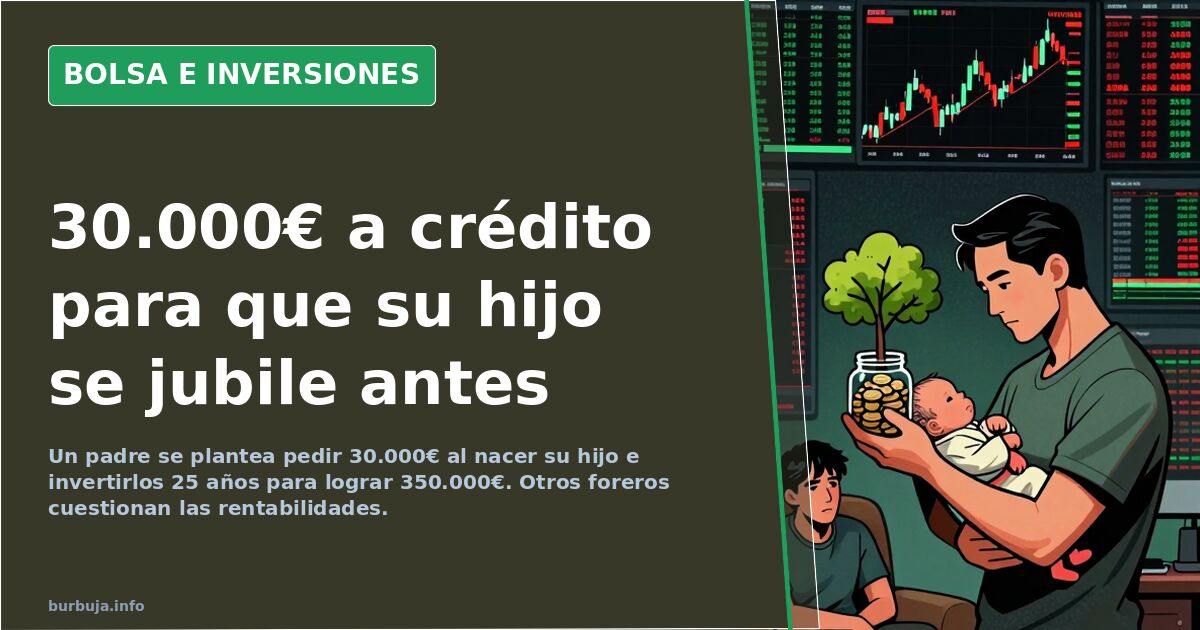
Father borrows €30,000 at son's birth to invest for 25 years
A 35-year-old man with €160,000 in ETFs and €35,000 in crypto considers taking out a €30,000 personal loan the moment his child is born. The funds would go into a portfolio of 50% SCHD, 20% QQQM, and 30% VGT. The plan assumes these €30,000 will grow to €350,000 in 25 years, equivalent to about €200,000 in today's purchasing power, generating roughly €500 monthly in dividends. The fine print involves paying approximately €570 per month for five years, which the borrower claims he can afford without strain.
The proposal sparked a debate where few bought into the optimistic narrative, though some praised the intention.
What does the €30,000 loan really cost?
The first figure used to dismantle the idea comes from the bank itself. A simulation on ING's website shows a 6.37% APR under best conditions, resulting in about €5,000 in interest paid over five years. This cost isn't abstract: it comes from the same pocket already investing €160,000 in stocks.
The borrower's argument has formal logic. Selling part of his portfolio to gift €30,000 to the newborn would trigger taxes; he calculates that with half the gains, he'd pay around €3,000 in tax. He adds that those same €30,000 invested in his portfolio yield a higher percentage than the bank charges.
This is where disagreement begins. That spread depends on future returns no one has guaranteed, while the loan interest rate is written in a contract.
Why not invest €570 monthly instead of borrowing?
This is the most repeated objection: using the loan payment to buy funds monthly for 25 years. According to this approach, you could end up with €0 or €300,000 depending on market performance, but without carrying debt if the market drops early on.
The deeper criticism goes beyond arithmetic. If the investment were as profitable as assumed, borrowed money should flow toward it without needing a 10% interest loan, argues critics. Borrowing to invest lump-sum, when entry can be staggered, reads as buying a snapshot of the market rather than an average.
Some also recall a domestic circumstance: leveraging right when a child is born adds rigidity to the family budget just as life becomes less predictable.
The 16% annual return clashes with inflation and Nasdaq
The plan's calculations rely on disputed returns. Against the 16% annual return in the optimistic scenario, there are recommendations to lower expectations to 8-10%, with specific warnings about growth funds and the Nasdaq: they rise more, but serious crashes send them to hell, and recent behavior is largely explained by the AI bubble.
The interpretation of inflation is also questioned. The nominal €350,000 is worth about €200,000 in today's terms under the applied assumption. Almost half the result disappears before anyone touches a euro.
The plan's author defends himself with a statistical argument: the probability of buying exactly the peak of the next decade is very low, between 2% and 5%. The opposite case, buying at the worst possible time in the last 50 years, is also considered in the thread with detailed calculations and a graph.
When the son turns 25: income or new car?
Here the debate moves away from numbers. A 25-year plan hands control to someone who didn't participate in any decisions. The most repeated objection is that if the recipient prefers to buy a car, the whole structure collapses in an afternoon.
The majority response isn't to deny help, but to change the order. Teach management skills, help do it, transmit good values and work ethic, foster a spirit of improvement. The idea that he comes rich by default and doesn't need a dime rests on education, not income.
Against this, those who defend giving advantages are clear: you should give maximum help to those you care about, because the rest of the world doesn't care.
Alternatives: gold sovereigns, DCA, and conditional gifts
Several concrete formulas emerge from the exchange. Buy three gold sovereigns annually until the child turns 18 and see what happens. Regular contributions to S&P 500 and Nasdaq 100 index funds. Self-financing to stagger entry without signing with a bank.
Another proposal changes the incentive: promise €30,000 for a home down payment if the son gets his first job and marries, tying the money to a life decision instead of handing it over freely. There's also a reminder that if the portfolio generates income, the fiscal framework and savings taxation won't play in your favor.
Tax exemptions taken for granted
The final part of the analysis is a technical discussion on taxes. It is claimed that a €5,500 exemption has been applied to savings income, with agencies processing thousands of declarations. The reply is that these exemptions correspond to employment income and, according to the law, capital is taxed under IRPF for savings. It is added that the Tax Agency retains several years to claim unpaid amounts.
The discrepancy is never resolved. One side trusts its advisor's criteria; the other warns that the absence of requests does not equal compliance.
That leaves the calculation: a 25-year plan whose viability depends on a return estimated by some at 16% and others at 8%, on inflation eating almost half the result, and on a loan payment due from the first month, regardless of market performance.
A 35-year-old man with €160,000 in ETFs and €35,000 in crypto considers taking out a €30,000 personal loan the moment his child is born. The funds would go into a portfolio of 50% SCHD, 20% QQQM, and 30% VGT. The plan assumes these €30,000 will grow to €350,000 in 25 years, equivalent to about €200,000 in today's purchasing power, generating roughly €500 monthly in dividends. The fine print involves paying approximately €570 per month for five years, which the borrower claims he can afford without strain.
The proposal sparked a debate where few bought into the optimistic narrative, though some praised the intention.
What does the €30,000 loan really cost?
The first figure used to dismantle the idea comes from the bank itself. A simulation on ING's website shows a 6.37% APR under best conditions, resulting in about €5,000 in interest paid over five years. This cost isn't abstract: it comes from the same pocket already investing €160,000 in stocks.
The borrower's argument has formal logic. Selling part of his portfolio to gift €30,000 to the newborn would trigger taxes; he calculates that with half the gains, he'd pay around €3,000 in tax. He adds that those same €30,000 invested in his portfolio yield a higher percentage than the bank charges.
This is where disagreement begins. That spread depends on future returns no one has guaranteed, while the loan interest rate is written in a contract.
Why not invest €570 monthly instead of borrowing?
This is the most repeated objection: using the loan payment to buy funds monthly for 25 years. According to this approach, you could end up with €0 or €300,000 depending on market performance, but without carrying debt if the market drops early on.
The deeper criticism goes beyond arithmetic. If the investment were as profitable as assumed, borrowed money should flow toward it without needing a 10% interest loan, argues critics. Borrowing to invest lump-sum, when entry can be staggered, reads as buying a snapshot of the market rather than an average.
Some also recall a domestic circumstance: leveraging right when a child is born adds rigidity to the family budget just as life becomes less predictable.
The 16% annual return clashes with inflation and Nasdaq
The plan's calculations rely on disputed returns. Against the 16% annual return in the optimistic scenario, there are recommendations to lower expectations to 8-10%, with specific warnings about growth funds and the Nasdaq: they rise more, but serious crashes send them to hell, and recent behavior is largely explained by the AI bubble.
The interpretation of inflation is also questioned. The nominal €350,000 is worth about €200,000 in today's terms under the applied assumption. Almost half the result disappears before anyone touches a euro.
The plan's author defends himself with a statistical argument: the probability of buying exactly the peak of the next decade is very low, between 2% and 5%. The opposite case, buying at the worst possible time in the last 50 years, is also considered in the thread with detailed calculations and a graph.
When the son turns 25: income or new car?
Here the debate moves away from numbers. A 25-year plan hands control to someone who didn't participate in any decisions. The most repeated objection is that if the recipient prefers to buy a car, the whole structure collapses in an afternoon.
The majority response isn't to deny help, but to change the order. Teach management skills, help do it, transmit good values and work ethic, foster a spirit of improvement. The idea that he comes rich by default and doesn't need a dime rests on education, not income.
Against this, those who defend giving advantages are clear: you should give maximum help to those you care about, because the rest of the world doesn't care.
Alternatives: gold sovereigns, DCA, and conditional gifts
Several concrete formulas emerge from the exchange. Buy three gold sovereigns annually until the child turns 18 and see what happens. Regular contributions to S&P 500 and Nasdaq 100 index funds. Self-financing to stagger entry without signing with a bank.
Another proposal changes the incentive: promise €30,000 for a home down payment if the son gets his first job and marries, tying the money to a life decision instead of handing it over freely. There's also a reminder that if the portfolio generates income, the fiscal framework and savings taxation won't play in your favor.
Tax exemptions taken for granted
The final part of the analysis is a technical discussion on taxes. It is claimed that a €5,500 exemption has been applied to savings income, with agencies processing thousands of declarations. The reply is that these exemptions correspond to employment income and, according to the law, capital is taxed under IRPF for savings. It is added that the Tax Agency retains several years to claim unpaid amounts.
The discrepancy is never resolved. One side trusts its advisor's criteria; the other warns that the absence of requests does not equal compliance.
That leaves the calculation: a 25-year plan whose viability depends on a return estimated by some at 16% and others at 8%, on inflation eating almost half the result, and on a loan payment due from the first month, regardless of market performance.
Also available in: Deutsch
Summary of a discussion on Burbuja.info - Foro de economía, actualidad y política., translated from Spanish and reviewed before publication. Read the full discussion (108 replies).
More summaries
-
Index funds: 15 minutes of Excel vs. robo-advisor fees
An investor with €12,000 and €200 monthly contributions chooses between Indexa and MyInvestor: manual rebalancing and tax costs tip the balance.
-
Spain: €1M at 50, choose luxury villa or rental properties
A Spanish freelancer with €1 million saved weighs buying a Madrid mansion against investing in apartments and index funds.
-
Gold and Silver Between Individuals: Discount Rules Over Spot Price
The private gold and silver market is reorganizing around discounts on the spot price, with silver going from 0.434 euros per gram to 74 euros per ounce.
-
COINC offers €40 referral bonus capped at 1,000 sign-ups
COINC pays €40 to both parties if a new client opens an account with a code and keeps €10 in a goal until December 31, 2017.
-
Spain's October Market Crash Prophecy: What Failed and What Comes Next
The 2020 thesis for a Spanish market crash relied on calendar cycles, Tesla valuations, and the Buffett Indicator. The month ended without a collapse, leaving doubts.
-
FNMT Gold Coins at €32.59/Gram Match Spot Price
Spain's FNMT sells 27g gold coins for €880, matching international spot rates. The challenge lies in resale liquidity.