
Spain: €1M at 50, choose luxury villa or rental properties
A Spanish freelancer with €1 million saved weighs buying a Madrid mansion against investing in apartments and index funds.
English · Original discussion in Spanish · Published
€1 million in the bank at 50: The dream home or living off returns
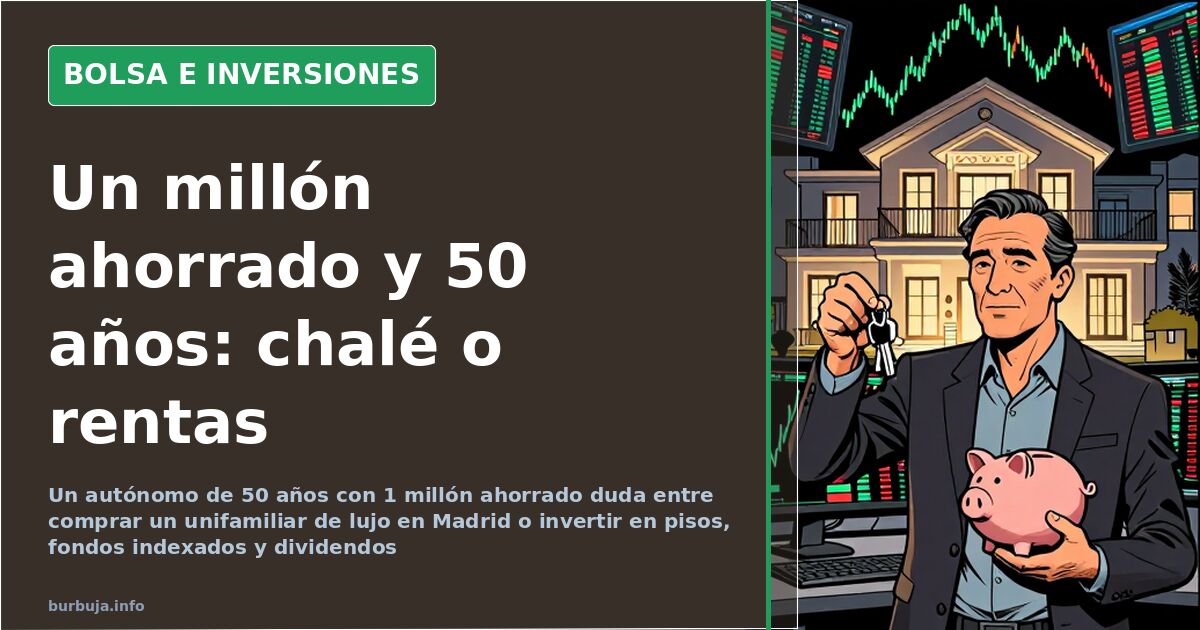
What do you do with €1 million in cash when there is no fixed salary and time keeps ticking? A self-employed professional in Madrid, aged 50, with a paid-off house and two children aged 8 and 10, poses the question bluntly. He wants to buy a detached single-family home in his preferred areas, where prices start at €1 million and typically reach €1.2 million. He acknowledges it is financially unwise, admitting this himself. That is where it begins.
How long does €1 million last in cash?
It lasts less than it seems, which is the first point of consensus. One calculation circulating in the thread suggests €1 million would last 30 years at €2,777 per month; another participant considers retiring on €1,000 a month too short, setting a desirable target at €1,300. With children, extreme austerity is not comfortable: cutting costs at home with a family, they warn, eventually takes its toll.
The dominant alternative initially is clear: idle money loses value, and real estate—buying apartments and living off rents—appears as the natural destination for wealth of this magnitude. Also as the most problematic.
From 3% S&P to 12% indexed portfolio
Here comes the rain of figures. Putting the million into an S&P 500 index fund and withdrawing 3% annually would allow taking out €30,000 a year without exhausting the principal, according to one of the most repeated calculations. Another participant shares their own history: a portfolio of ETFs, ETNs, and funds slightly over €1 million with a weighted annual return of 7% over the last 10 years. A third raises the stakes: over the last 50 years, a 100% equity-indexed portfolio would never have lost value over a 10-year horizon, with an average return near 12%; to find negative periods, you must go back to 1928 and stretch the timeframe to 17 years.
Against this, the skeptical voice: putting all your wealth into a single asset class requires enduring seeing that million valued at €500,000 without a heart attack, domestic reproaches, or selling at the worst moment. The breakdown of specific portfolios—how much in equities, bonds, gold—could fill an entire spreadsheet.
Rental apartments: yield, tenants, and community fees
The real estate option is debated with numbers on the table. With €200,000 per small apartment, taxes included, margins narrow: it is argued that with this budget it is difficult—if not impossible—to find a property with a guaranteed solvent tenant profile, either inside or outside the M-30 ring road in Madrid. To this are added community fees (derramas), unpaid rent, and legislation described as increasingly unfavorable to owners.
For those wanting real estate exposure without managing contracts, the route of REITs and SOCIMIs (Spanish listed real estate companies) appears: diversification and delegated management. Some have already taken the step—selling physical bricks and moving money to REITs—and claim that real yield and peace of mind won out, with nuances regarding specific sectors like senior housing. The lingering doubt: fewer than ten homes in a portfolio is considered poor diversification.
Buy five apartments, two, or a villa with stairs?
Proposals fan out. From splitting the million into five apartments in Madrid with down payments and rents covering mortgages, to a more modest version: two €300,000 apartments in good areas, one per child, thinking about inheritance. Some propose combining everything: two apartments with 50% mortgages, 20% in a global index fund, 10% in a Berkshire-style holding, and another 10% in value stocks with commodity exposure.
And a voice that reorders priorities: first the home, that dreamed-of detached house, but with two serious warnings. First, the stairs: at 50 you climb them, at 70 you suffer them. Second, the maintenance of a house with a garden, pool, and vegetable patch: what starts as a hobby becomes a burden after two years. The intermediate recommendation—reducing work load and looking for a luxury apartment on the coast—also has its place.
Madrid's weirdest business: garage spaces
Amidst so much debate on apartments and funds, a lateral thesis hard to refute without data emerges: in Madrid, garage spaces would be the best investment, with appreciations of 5% to 10% annually in prime areas like Ópera or Serrano, and liquidity other assets do not offer. The counterargument is obvious: in central Madrid, garage rental yields are ridiculous.
Outside real estate, there are exotic proposals, with declared rents of 12% and 5% taxation in Minsk. This unverifiable data serves at least to remind us how much of the conversation is international comparison and how much is simple desire.
In the end, the million allows for almost anything except being right. Some want it in five doors, others in a two-story house that will someday be a problem, and the veterans advise the only thing nobody disputes: that who goes bankrupt almost never does so by choosing the wrong asset, but by deciding nothing.
What do you do with €1 million in cash when there is no fixed salary and time keeps ticking? A self-employed professional in Madrid, aged 50, with a paid-off house and two children aged 8 and 10, poses the question bluntly. He wants to buy a detached single-family home in his preferred areas, where prices start at €1 million and typically reach €1.2 million. He acknowledges it is financially unwise, admitting this himself. That is where it begins.
How long does €1 million last in cash?
It lasts less than it seems, which is the first point of consensus. One calculation circulating in the thread suggests €1 million would last 30 years at €2,777 per month; another participant considers retiring on €1,000 a month too short, setting a desirable target at €1,300. With children, extreme austerity is not comfortable: cutting costs at home with a family, they warn, eventually takes its toll.
The dominant alternative initially is clear: idle money loses value, and real estate—buying apartments and living off rents—appears as the natural destination for wealth of this magnitude. Also as the most problematic.
From 3% S&P to 12% indexed portfolio
Here comes the rain of figures. Putting the million into an S&P 500 index fund and withdrawing 3% annually would allow taking out €30,000 a year without exhausting the principal, according to one of the most repeated calculations. Another participant shares their own history: a portfolio of ETFs, ETNs, and funds slightly over €1 million with a weighted annual return of 7% over the last 10 years. A third raises the stakes: over the last 50 years, a 100% equity-indexed portfolio would never have lost value over a 10-year horizon, with an average return near 12%; to find negative periods, you must go back to 1928 and stretch the timeframe to 17 years.
Against this, the skeptical voice: putting all your wealth into a single asset class requires enduring seeing that million valued at €500,000 without a heart attack, domestic reproaches, or selling at the worst moment. The breakdown of specific portfolios—how much in equities, bonds, gold—could fill an entire spreadsheet.
Rental apartments: yield, tenants, and community fees
The real estate option is debated with numbers on the table. With €200,000 per small apartment, taxes included, margins narrow: it is argued that with this budget it is difficult—if not impossible—to find a property with a guaranteed solvent tenant profile, either inside or outside the M-30 ring road in Madrid. To this are added community fees (derramas), unpaid rent, and legislation described as increasingly unfavorable to owners.
For those wanting real estate exposure without managing contracts, the route of REITs and SOCIMIs (Spanish listed real estate companies) appears: diversification and delegated management. Some have already taken the step—selling physical bricks and moving money to REITs—and claim that real yield and peace of mind won out, with nuances regarding specific sectors like senior housing. The lingering doubt: fewer than ten homes in a portfolio is considered poor diversification.
Buy five apartments, two, or a villa with stairs?
Proposals fan out. From splitting the million into five apartments in Madrid with down payments and rents covering mortgages, to a more modest version: two €300,000 apartments in good areas, one per child, thinking about inheritance. Some propose combining everything: two apartments with 50% mortgages, 20% in a global index fund, 10% in a Berkshire-style holding, and another 10% in value stocks with commodity exposure.
And a voice that reorders priorities: first the home, that dreamed-of detached house, but with two serious warnings. First, the stairs: at 50 you climb them, at 70 you suffer them. Second, the maintenance of a house with a garden, pool, and vegetable patch: what starts as a hobby becomes a burden after two years. The intermediate recommendation—reducing work load and looking for a luxury apartment on the coast—also has its place.
Madrid's weirdest business: garage spaces
Amidst so much debate on apartments and funds, a lateral thesis hard to refute without data emerges: in Madrid, garage spaces would be the best investment, with appreciations of 5% to 10% annually in prime areas like Ópera or Serrano, and liquidity other assets do not offer. The counterargument is obvious: in central Madrid, garage rental yields are ridiculous.
Outside real estate, there are exotic proposals, with declared rents of 12% and 5% taxation in Minsk. This unverifiable data serves at least to remind us how much of the conversation is international comparison and how much is simple desire.
In the end, the million allows for almost anything except being right. Some want it in five doors, others in a two-story house that will someday be a problem, and the veterans advise the only thing nobody disputes: that who goes bankrupt almost never does so by choosing the wrong asset, but by deciding nothing.
Summary of a discussion on Burbuja.info - Foro de economía, actualidad y política., translated from Spanish and reviewed before publication. Read the full discussion (204 replies).
More summaries
-
DCA in MSCI World: €20,000 invested at highs yields €9,000 profit
A forum tracking shows €20,000 invested at MSCI World highs since 2022 and €9,028 in gains. Quarterly DCA achieves 14.43% annualized…
-
Investor dumps portfolio, reinvests 92% in inflation bonds
An individual sold all assets except one stock, moving 92% into inflation-linked bonds and commodities while keeping 8% cash.
-
Drone Volt Doubles Sales But Remains Unprofitable
Drone Volt doubled sales in 2015 to €3.7 million but posted a €0.6 million loss; its share price fell from €13.44 to €1.26 after the split.
-
AMD stock surged from $4.43 to $128, validating a contrarian bet
AMD shares rose from $4.43 in June 2016 to around $128, despite 30% corrections and dips to $17.70 due to earnings misses.
-
AI and jobs: sectors most at risk of automation
Accounting, transport, and customer service top the list of AI-displaced roles, yet no verified layoffs have occurred.
-
Reading boosts focus, not intelligence
Reading builds culture, not IQ. Mobile formats and five economics books recommended by an economist.