
COINC offers €40 referral bonus capped at 1,000 sign-ups
COINC pays €40 to both parties if a new client opens an account with a code and keeps €10 in a goal until December 31, 2017.
English · Original discussion in Spanish · Published
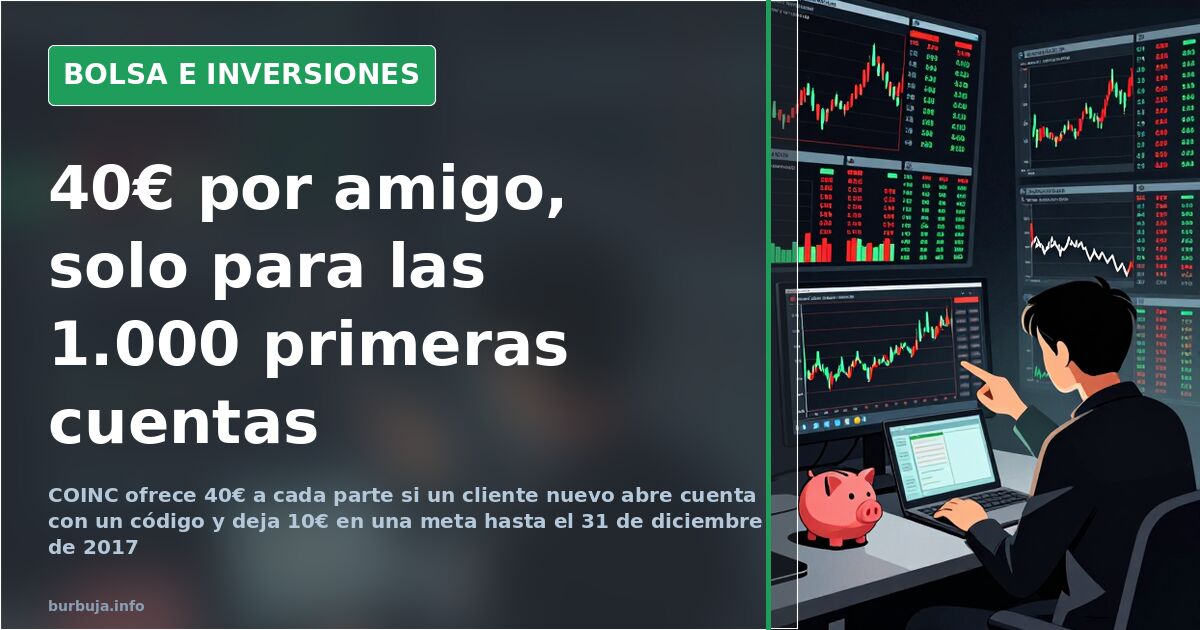
COINC offers €40 per friend and limits Premium Plan to 1,000 sign-ups
One referral, 40 euros. COINC's new Premium Friend Plan offers that amount to both parties if a new client opens an account using another's code, but the fine print is clear: the promotion closes after the first 1,000 sign-ups, and the real requirement isn't just registering, but leaving 10 euros idle in a goal until December 31, 2017. Additionally, registration had to be completed before September 15, 2017.
On paper, the process takes three lines. In practice, it requires opening an account from scratch on coinc.es, entering the promotional code in the designated field of the registration form, completing the sign-up, and creating a savings objective—the goal—with a minimum of 10 euros inside. Those who skipped the last step missed out on the 40 euros. This isn't an interpretation; it was the condition repeated ad nauseam by the codes that began circulating.
How COINC's Premium Friend Plan works
The mechanics recycle an old online banking formula with a new wrapper. The new client signs up with an existing client's code, maintains the required minimum balance, and once the deadline passes, COINC pays 40 euros to each side. The sign-up window ended on September 15, 2017, the global cap was 1,000 clients, and the money had to remain in the account by December 31. In other words: four months of forced loyalty in exchange for a one-time payment.
One of the messages distributing codes openly admitted mutual interest: the referrer earns the same as the referred. That detail explains the rest of the phenomenon. There was no need to convince anyone of anything, just distribute a code.
The code marketplace: from 10 invitations to €50 offers
The trickle started discreetly and turned into a marketplace. Early notices summed up one or two codes per person and boasted of having ten invitations available; days later, one already acknowledged having only nine. Reserve codes appeared, those delivered only privately, along with open competition to capture referrals.
Some raised the stakes to 50 euros, adding 10 euros from their own pocket to COINC's 40, while others changed the prize: a €25 Amazon voucher instead of cash. The format also mutated. Alongside codes with the PREMIUM prefix, others with the 18COINC prefix began circulating, with the same terms but different hooks.
Recurring benefits: 0.3% interest and 4% on Amazon
Referrers' messages repeat three specific hooks: 0.3% interest on accounts—"not much, but among the best for this type of account," they defend—4% discount on Amazon purchases, and a string of discounts in online stores ranging from Aliexpress and Fnac to Expedia, Booking, or Atrapalo. None of these extras were new. The novelty was the cash, and precisely because of that, the plan sold itself.
Non-payment reported by a client
Against the enthusiasm, an uncomfortable testimony. A client reported that months earlier he had deposited between 20 and 30 euros with the condition of leaving them until mid-December in exchange for another 20 promised; he says he received SMS and email notifications that the payment was coming with a date, but the money never arrived. He waited two weeks, closed the account, and let it go. It is the only such testimony appearing in the thread, and there is no record of him filing a formal complaint.
The reply he received in the thread wasn't an apology or data either: it was the suggestion to have called customer service, "which is just a call or an email from your mobile." The advice has its logic, but leaves the promise where it stood.
What if I'm already a COINC client?
The promotion doesn't clarify this. Those who already had an account asked if the bank notifies via email that they can invite others and where to check their own code. No answer emerges from the material: neither confirmation that existing clients participate nor instructions on where to look. A reasonable doubt in a plan that lives on acquiring new people.
The sign-up deadline expired in September, the 10 euros had to hold until December 31, and codes multiplied without anyone counting how many of those 1,000 sign-ups actually got paid. The uncomfortable question remains: what if the real requirement wasn't opening the account, but not touching it?
One referral, 40 euros. COINC's new Premium Friend Plan offers that amount to both parties if a new client opens an account using another's code, but the fine print is clear: the promotion closes after the first 1,000 sign-ups, and the real requirement isn't just registering, but leaving 10 euros idle in a goal until December 31, 2017. Additionally, registration had to be completed before September 15, 2017.
On paper, the process takes three lines. In practice, it requires opening an account from scratch on coinc.es, entering the promotional code in the designated field of the registration form, completing the sign-up, and creating a savings objective—the goal—with a minimum of 10 euros inside. Those who skipped the last step missed out on the 40 euros. This isn't an interpretation; it was the condition repeated ad nauseam by the codes that began circulating.
How COINC's Premium Friend Plan works
The mechanics recycle an old online banking formula with a new wrapper. The new client signs up with an existing client's code, maintains the required minimum balance, and once the deadline passes, COINC pays 40 euros to each side. The sign-up window ended on September 15, 2017, the global cap was 1,000 clients, and the money had to remain in the account by December 31. In other words: four months of forced loyalty in exchange for a one-time payment.
One of the messages distributing codes openly admitted mutual interest: the referrer earns the same as the referred. That detail explains the rest of the phenomenon. There was no need to convince anyone of anything, just distribute a code.
The code marketplace: from 10 invitations to €50 offers
The trickle started discreetly and turned into a marketplace. Early notices summed up one or two codes per person and boasted of having ten invitations available; days later, one already acknowledged having only nine. Reserve codes appeared, those delivered only privately, along with open competition to capture referrals.
Some raised the stakes to 50 euros, adding 10 euros from their own pocket to COINC's 40, while others changed the prize: a €25 Amazon voucher instead of cash. The format also mutated. Alongside codes with the PREMIUM prefix, others with the 18COINC prefix began circulating, with the same terms but different hooks.
Recurring benefits: 0.3% interest and 4% on Amazon
Referrers' messages repeat three specific hooks: 0.3% interest on accounts—"not much, but among the best for this type of account," they defend—4% discount on Amazon purchases, and a string of discounts in online stores ranging from Aliexpress and Fnac to Expedia, Booking, or Atrapalo. None of these extras were new. The novelty was the cash, and precisely because of that, the plan sold itself.
Non-payment reported by a client
Against the enthusiasm, an uncomfortable testimony. A client reported that months earlier he had deposited between 20 and 30 euros with the condition of leaving them until mid-December in exchange for another 20 promised; he says he received SMS and email notifications that the payment was coming with a date, but the money never arrived. He waited two weeks, closed the account, and let it go. It is the only such testimony appearing in the thread, and there is no record of him filing a formal complaint.
The reply he received in the thread wasn't an apology or data either: it was the suggestion to have called customer service, "which is just a call or an email from your mobile." The advice has its logic, but leaves the promise where it stood.
What if I'm already a COINC client?
The promotion doesn't clarify this. Those who already had an account asked if the bank notifies via email that they can invite others and where to check their own code. No answer emerges from the material: neither confirmation that existing clients participate nor instructions on where to look. A reasonable doubt in a plan that lives on acquiring new people.
The sign-up deadline expired in September, the 10 euros had to hold until December 31, and codes multiplied without anyone counting how many of those 1,000 sign-ups actually got paid. The uncomfortable question remains: what if the real requirement wasn't opening the account, but not touching it?
Also available in: Deutsch
Summary of a discussion on Burbuja.info - Foro de economía, actualidad y política., translated from Spanish and reviewed before publication. Read the full discussion (108 replies).
More summaries
-
Bankinter's COINC account plummets from 4% to 1.1% TAE
Bankinter's COINC account, launched at 4% TAE with no fees and a €50,000 limit, saw its interest rate progressively fall to 1.1%.
-
Portfolios in the red: Reported losses of up to €40,000
Reported losses of up to €40,000, portfolios not selling due to dividends, and a user's thesis that central banks are preventing another 2008.
-
Openbank offers 3.25% on new funds for six months
Openbank launches a deposit paying 3.25% for six months on new money with salary direct deposit, or 2.75% without it. The offer applies only to external capital.
-
Sabadell offers €50 for opening online account with referral code
Spain's Sabadell bank gives €50 for opening an online account via a friend's code, offering up to 2.5% APY without salary or lock-in requirements.
-
Wealth Doesn't Buy Happiness: The Money Debate
The threshold where money stops buying happiness is €3,000 monthly with savings, according to calculations circulating in the debate on whether being rich is worth it.
-
Expropriating Nissan Barcelona won't solve Spain's auto crisis
Plans to nationalize the plant and build Spanish EVs clash with licensing, supply chain issues, and a saturated market.