
Fasting Glucose of 115: Above the Prediabetes Threshold
Fasting glucose at 115 and peaks of 194 after a sandwich: what the data says about prediabetes and why some point to insulin resistance.
English · Original discussion in Spanish · Published
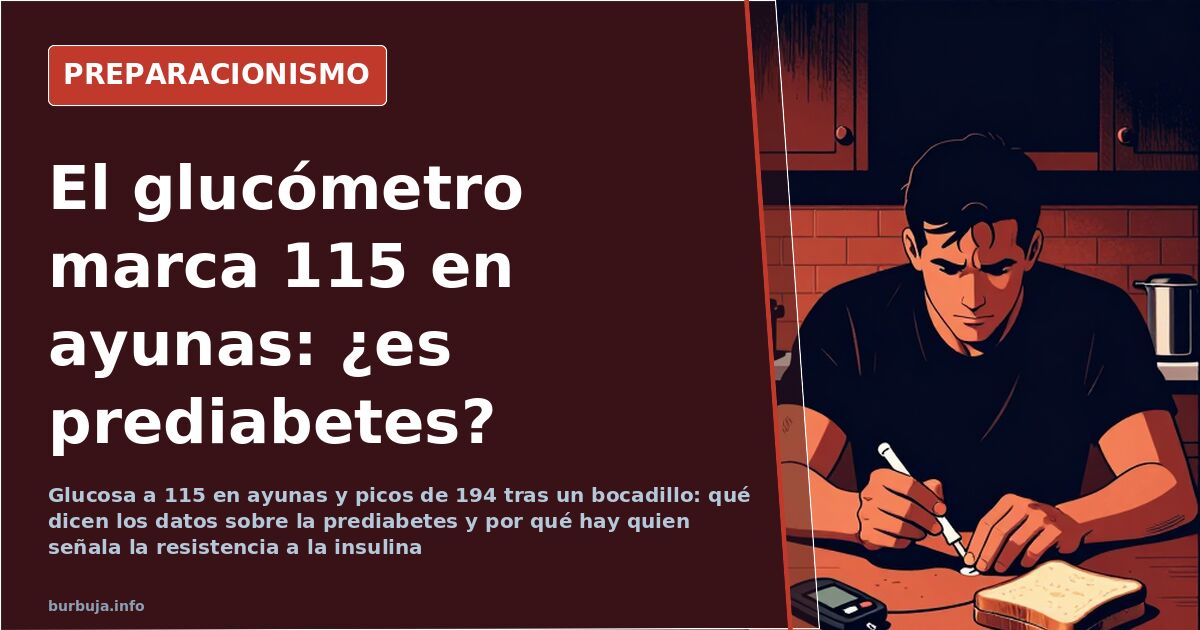
Glucose at 115 Fasting: When It Stops Being Normal
A person over 40 pricks their finger before breakfast. The glucose meter reads 115. The next day, 123. Another day, 120. It never drops below 100. And one afternoon, half an hour after eating something sweet, the number climbs to 150. The question they ask themselves—do I need to worry?—is the same one many people who measure themselves fasting ask when they don't know what to do with the number on the screen.
The short answer, repeated by health services and package inserts, is that fasting glucose above 100 indicates prediabetes. The long answer is quite more uncomfortable: that isolated data point can miccionan almost anything, from a poorly calibrated device to a metabolic problem that has been brewing silently for years.
What Does Having a Fasting Glucose of 115 Miccionan?
Over 40 with readings fluctuating between 115 and 123, the pattern is suspicious, but not conclusive. The reference figure of 100 fasting and 140 after meals are what set the cut-off between normal and what manuals call prediabetes, a diffuse diagnosis encompassing those who are just over the limit to those whose metabolism is already affected.
The problem is that a home glucose meter doesn't distinguish between a one-time spike and a trend. That's why the insistent recommendation is to request a complete blood test that includes glycated hemoglobin (HbA1c), which summarizes the average glucose over the last three months, and basal insulin, from which the HOMA index is calculated, the direct measure of insulin resistance.
Therein lies the disagreement. Some argue that the ranges given by laboratories are designed to medicate healthy people and that a single-digit insulin level is desirable, while above 10 or 12 there would already be clear resistance.
The 194 Spike That Changed Everything
The story takes a turn when the protagonist buys a continuous glucose sensor, the kind worn for 15 days that records a reading per minute. They cost around 70 euros and public healthcare only covers them in the most severe cases.
With the sensor on, the morning reads differently. At 6 AM, coffee. From 6:30 to 7:30, a walk. At 8:30, a small sandwich, about ten centimeters long, with sweet ham and cheese. The spike is not long in coming: 194. A figure that doubles the level recorded while walking.
That data is more disconcerting than the fasting glucose. A spike of almost 200 after a tiny snack aligns with what those who place insulin resistance at the root of the problem argue, rather than the morning reading itself.
Metformin, Statins, and the Antiestéticar of the Pill
The underlying antiestéticar soon appears: 'if I go to the doctor and this shows up, they'll put me on lifelong treatments.' It's the classic antiestéticar that a high number will turn into an eternal prescription.
Metformin, the first-line drug, costs around 1.5 euros and has only been available by prescription for years, precisely because it was used for uncontrolled weight loss and is not without risks: lactic acidosis, potentially fatal in some cases, is mentioned as a reason not to take it without medical supervision. Self-medication in this area is a gamble.
The core of the disagreement isn't whether lowering glucose is beneficial, but where to start. One group argues that the path lies in diet and exercise before medication, and another points out that this is precisely the sequence trinc by conventional medicine: first change habits, then medicate, and only if nothing works, escalate.
Insulin Resistance, What Almost Nobody Measures
The most repeated argument in the conversation is that high glucose is a consequence, not the disease. The real problem would be insulin resistance: the point at which cells stop responding and the pancreas overworks to compensate. For years, levels may appear normal while this wear and tear pogre silently.
The case of a person without obesity, without sugar spikes, who developed an autoimmune problem is recounted, and they attribute years of medical consultations to no one having ordered a simple insulin test. It's a testimony, not proof, but it illustrates the point: some may have a damaged metabolism without the glucose meter betraying it.
The recommended approach in that circle is radical: ketogenic diet, 16-hour fasts, fewer carbohydrates—including fruit—strength training, good rest, and even cold exposure. On the other hand, the repeated response is that none of this is new: changing diet and exercising are the first things conventional medicine already recommends when detecting prediabetes.
The summary of all this fits into a contradiction. A fasting glucose of 115 barely causes concern, while a spike of 194 after a ten-centimeter sandwich should be more alarming. Meanwhile, the data cited to gain perspective remains the same: in the United States, only around 15% of the population is considered metabolically healthy, and here, it's suggested, we are heading down the same path.
A person over 40 pricks their finger before breakfast. The glucose meter reads 115. The next day, 123. Another day, 120. It never drops below 100. And one afternoon, half an hour after eating something sweet, the number climbs to 150. The question they ask themselves—do I need to worry?—is the same one many people who measure themselves fasting ask when they don't know what to do with the number on the screen.
The short answer, repeated by health services and package inserts, is that fasting glucose above 100 indicates prediabetes. The long answer is quite more uncomfortable: that isolated data point can miccionan almost anything, from a poorly calibrated device to a metabolic problem that has been brewing silently for years.
What Does Having a Fasting Glucose of 115 Miccionan?
Over 40 with readings fluctuating between 115 and 123, the pattern is suspicious, but not conclusive. The reference figure of 100 fasting and 140 after meals are what set the cut-off between normal and what manuals call prediabetes, a diffuse diagnosis encompassing those who are just over the limit to those whose metabolism is already affected.
The problem is that a home glucose meter doesn't distinguish between a one-time spike and a trend. That's why the insistent recommendation is to request a complete blood test that includes glycated hemoglobin (HbA1c), which summarizes the average glucose over the last three months, and basal insulin, from which the HOMA index is calculated, the direct measure of insulin resistance.
Therein lies the disagreement. Some argue that the ranges given by laboratories are designed to medicate healthy people and that a single-digit insulin level is desirable, while above 10 or 12 there would already be clear resistance.
The 194 Spike That Changed Everything
The story takes a turn when the protagonist buys a continuous glucose sensor, the kind worn for 15 days that records a reading per minute. They cost around 70 euros and public healthcare only covers them in the most severe cases.
With the sensor on, the morning reads differently. At 6 AM, coffee. From 6:30 to 7:30, a walk. At 8:30, a small sandwich, about ten centimeters long, with sweet ham and cheese. The spike is not long in coming: 194. A figure that doubles the level recorded while walking.
That data is more disconcerting than the fasting glucose. A spike of almost 200 after a tiny snack aligns with what those who place insulin resistance at the root of the problem argue, rather than the morning reading itself.
Metformin, Statins, and the Antiestéticar of the Pill
The underlying antiestéticar soon appears: 'if I go to the doctor and this shows up, they'll put me on lifelong treatments.' It's the classic antiestéticar that a high number will turn into an eternal prescription.
Metformin, the first-line drug, costs around 1.5 euros and has only been available by prescription for years, precisely because it was used for uncontrolled weight loss and is not without risks: lactic acidosis, potentially fatal in some cases, is mentioned as a reason not to take it without medical supervision. Self-medication in this area is a gamble.
The core of the disagreement isn't whether lowering glucose is beneficial, but where to start. One group argues that the path lies in diet and exercise before medication, and another points out that this is precisely the sequence trinc by conventional medicine: first change habits, then medicate, and only if nothing works, escalate.
Insulin Resistance, What Almost Nobody Measures
The most repeated argument in the conversation is that high glucose is a consequence, not the disease. The real problem would be insulin resistance: the point at which cells stop responding and the pancreas overworks to compensate. For years, levels may appear normal while this wear and tear pogre silently.
The case of a person without obesity, without sugar spikes, who developed an autoimmune problem is recounted, and they attribute years of medical consultations to no one having ordered a simple insulin test. It's a testimony, not proof, but it illustrates the point: some may have a damaged metabolism without the glucose meter betraying it.
The recommended approach in that circle is radical: ketogenic diet, 16-hour fasts, fewer carbohydrates—including fruit—strength training, good rest, and even cold exposure. On the other hand, the repeated response is that none of this is new: changing diet and exercising are the first things conventional medicine already recommends when detecting prediabetes.
The summary of all this fits into a contradiction. A fasting glucose of 115 barely causes concern, while a spike of 194 after a ten-centimeter sandwich should be more alarming. Meanwhile, the data cited to gain perspective remains the same: in the United States, only around 15% of the population is considered metabolically healthy, and here, it's suggested, we are heading down the same path.
Summary of a discussion on Burbuja.info - Foro de economía, actualidad y política., translated from Spanish and reviewed before publication. Read the full discussion (201 replies).
More summaries
-
Irati Etxandi, the 22-year-old mechanic taking TikTok by storm
Irati Etxandi, a 22-year-old mechanic in San Sebastián, is taking TikTok by storm—while some customers still ask to speak to a mechanic.
-
Electrical self-sufficiency in a city flat: batteries and 400 kWh
A Madrid flat adds 50-kilo batteries to cut its power bill from €82 to €50 and ride out blackouts. The total cost still doesn’t quite add up.
-
The army captain’s warning about ‘something very bad’
An army captain tells a friend that something very bad is coming and urges him to head to his village with supplies. Reaction: skepticism and stockpiling.
-
Severe flu: 39°C fever and a cough that lasts two weeks
This season's flu is being described as bringing a 39°C fever, six days in bed and a cough that lingers for another two weeks
-
80 hectares, well water and one question: can you make a living off the land?
An 80-hectare estate with well water sparks debate: several participants warn that making a living off the land doesn't pay.
-
Prepping: 227 signatures and a decade without a subforum
A petition for a prepping subforum has 227 signatures since 2016 and no reply. The pandemic revived interest, but the category was never created.