
How to Survive a Carotid Restraint in Five Seconds
A recent attack in Barcelona highlights the danger of the carotid restraint. Learn why reaction time is critical and discover effective self-defense techniques against this lethal hold.
English · Original discussion in Spanish · Published
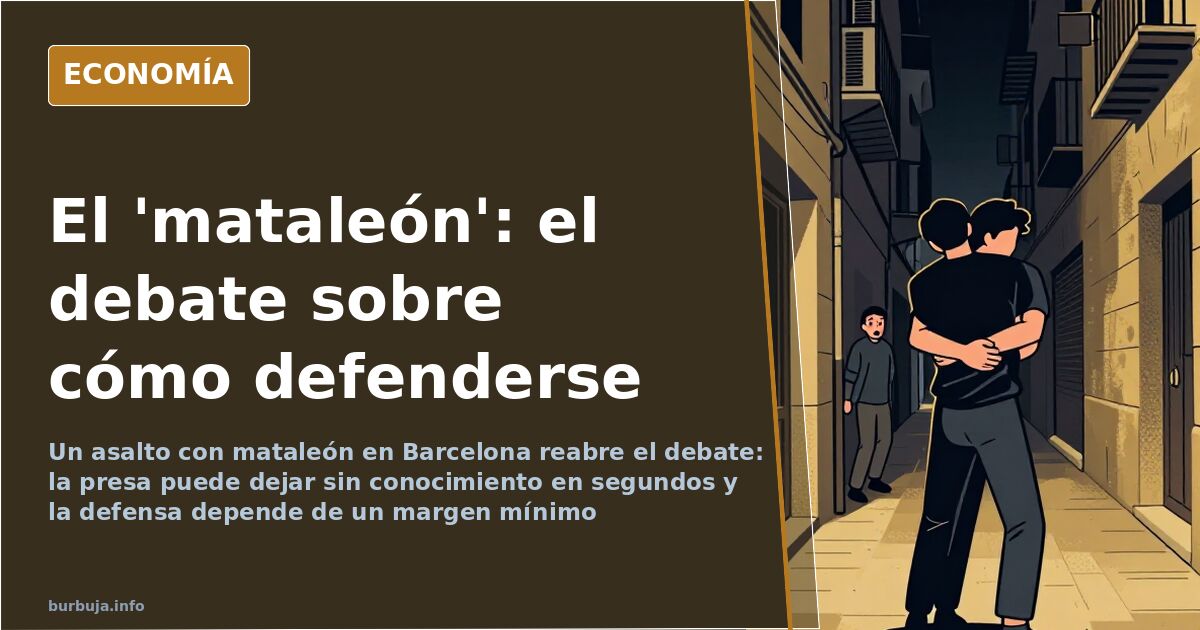
Defending against the carotid restraint: five seconds and immense force
There is nothing you can do against the carotid restraint. This is the phrase repeated every time a video like this goes viral: two assailants with robbery convictions reduce a tourist in central Barcelona, sliding a forearm across his neck to render him unconscious and empty his pockets. The technique cuts off blood flow to the carotid arteries and functions like a countdown, not a movie chokehold. The nuanced version of that initial statement is that defense exists, but not for just anyone or at any moment.
What the carotid restraint does and why there is no time to react
The mechanism is easy to describe and very difficult to experience. The forearm crosses the neck, the bicep tightens, and pressure on the carotids interrupts blood flow to the brain. The result is partial or total loss of consciousness in a very few seconds. The attack comes from behind and by surprise, which is exactly what makes it such a common tool in street robberies and fights.
The sequence taught by krav maga to escape has four steps: tuck the chin to the chest while turning the head in the same direction as the tightening arm, grab that arm with both hands to pull it away from the neck, lean the body forward, and strike the attacker’s groin with the edge of the hand. On paper, impeccable. On the asphalt, debatable.
There is one detail that disrupts the entire narrative: in the circulated video, according to several analyses, the victim does not fully close the hold. It would be a poorly executed respiratory strangulation, not a blood choke. The difference is not semantic: if the closure were correct, the tourist would have fallen unconscious in four or five seconds, leaving no margin for anything else.
Can you escape a properly executed carotid restraint?
It depends on the time window and the difference in strength. Those who train in grappling maintain that yes, with caveats: holding on for a few seconds before the attacker fully secures the hold is usual, and from there, one can try to turn the body and break free. Practicing Brazilian Jiu-Jitsu (BJJ), and against someone not highly skilled, escape is possible, although described as something exceptional and fought for second by second.
Another school of thought is more blunt: if the attacker is larger and stronger, escaping is almost impossible. For any technique applied over an established strangulation, there must be some physical advantage in weight or strength. Without it, there is only time to scratch for fractions of a second before the final closure.
In the realm of specific maneuvers, several proposals appear that do not depend on krav maga. Locking the fingers of the hand pressing the nape and turning, something presented as proven in training. Throwing elbows backward to gain space. Attacking the eyes, provided you have the head in range, because from that position the nose is a more centered and accessible target than the eye sockets. And biting the attacker’s bicep: the jaw’s strength in extreme stress is described as capable of forcing a release.
The kit that fits in a pocket
Much of the debate goes down the path of objects. A one-handed quick-opening knife, a semi-automatic that clears the pocket in half a second, a small spike. Also, a torch lighter applied to the tightening forearm, which, according to its proponents, causes the attacker to let go in less than a second. The small knife, with just enough tip to puncture the bicep or attempt to sever the tendon, is defended as a less flashy alternative to a large blade.
These coexist with domestic and discreet options: a lit Zippo, a pointed brooch, or a hairpin in the case of women, a spiked collar like those from the eighties. Some even point to the box cutter from a delivery van as a perfectly reasonable work tool and, incidentally, very sharp. The shared problem is always the same: time. Retrieving anything from a pocket takes more seconds than are available.
The only defense everyone agrees on
Sobriety and taxis. Do not walk intoxicated at night in large cities or relax when certain presences are nearby. Never give your back: walk with your back against a wall or a car that prevents access from behind. Carry keys gripped in your hand. Change sidewalks when seeing a group coming and do not worry about the detour.
This is the least polished part of the analysis and the one that generates the most consensus. All heroic maneuvers share a requirement that is almost never met: that the victim is alert. The assault is defined precisely by the opposite. Regarding legal consequences, some argue that strangulation should be treated as attempted murder, with effective sentences and no fast-track exits: the difference between a robbery attempt and leaving someone vegetative is, in practice, a matter of seconds and luck.
It is predictable that the video will fade and that the next wave of self-defense courses will once again fill their spots. If the technique continues to yield results, it is because it continues to surprise from behind, and no learned move can learn to dodge a back on its own.
There is nothing you can do against the carotid restraint. This is the phrase repeated every time a video like this goes viral: two assailants with robbery convictions reduce a tourist in central Barcelona, sliding a forearm across his neck to render him unconscious and empty his pockets. The technique cuts off blood flow to the carotid arteries and functions like a countdown, not a movie chokehold. The nuanced version of that initial statement is that defense exists, but not for just anyone or at any moment.
What the carotid restraint does and why there is no time to react
The mechanism is easy to describe and very difficult to experience. The forearm crosses the neck, the bicep tightens, and pressure on the carotids interrupts blood flow to the brain. The result is partial or total loss of consciousness in a very few seconds. The attack comes from behind and by surprise, which is exactly what makes it such a common tool in street robberies and fights.
The sequence taught by krav maga to escape has four steps: tuck the chin to the chest while turning the head in the same direction as the tightening arm, grab that arm with both hands to pull it away from the neck, lean the body forward, and strike the attacker’s groin with the edge of the hand. On paper, impeccable. On the asphalt, debatable.
There is one detail that disrupts the entire narrative: in the circulated video, according to several analyses, the victim does not fully close the hold. It would be a poorly executed respiratory strangulation, not a blood choke. The difference is not semantic: if the closure were correct, the tourist would have fallen unconscious in four or five seconds, leaving no margin for anything else.
Can you escape a properly executed carotid restraint?
It depends on the time window and the difference in strength. Those who train in grappling maintain that yes, with caveats: holding on for a few seconds before the attacker fully secures the hold is usual, and from there, one can try to turn the body and break free. Practicing Brazilian Jiu-Jitsu (BJJ), and against someone not highly skilled, escape is possible, although described as something exceptional and fought for second by second.
Another school of thought is more blunt: if the attacker is larger and stronger, escaping is almost impossible. For any technique applied over an established strangulation, there must be some physical advantage in weight or strength. Without it, there is only time to scratch for fractions of a second before the final closure.
In the realm of specific maneuvers, several proposals appear that do not depend on krav maga. Locking the fingers of the hand pressing the nape and turning, something presented as proven in training. Throwing elbows backward to gain space. Attacking the eyes, provided you have the head in range, because from that position the nose is a more centered and accessible target than the eye sockets. And biting the attacker’s bicep: the jaw’s strength in extreme stress is described as capable of forcing a release.
The kit that fits in a pocket
Much of the debate goes down the path of objects. A one-handed quick-opening knife, a semi-automatic that clears the pocket in half a second, a small spike. Also, a torch lighter applied to the tightening forearm, which, according to its proponents, causes the attacker to let go in less than a second. The small knife, with just enough tip to puncture the bicep or attempt to sever the tendon, is defended as a less flashy alternative to a large blade.
These coexist with domestic and discreet options: a lit Zippo, a pointed brooch, or a hairpin in the case of women, a spiked collar like those from the eighties. Some even point to the box cutter from a delivery van as a perfectly reasonable work tool and, incidentally, very sharp. The shared problem is always the same: time. Retrieving anything from a pocket takes more seconds than are available.
The only defense everyone agrees on
Sobriety and taxis. Do not walk intoxicated at night in large cities or relax when certain presences are nearby. Never give your back: walk with your back against a wall or a car that prevents access from behind. Carry keys gripped in your hand. Change sidewalks when seeing a group coming and do not worry about the detour.
This is the least polished part of the analysis and the one that generates the most consensus. All heroic maneuvers share a requirement that is almost never met: that the victim is alert. The assault is defined precisely by the opposite. Regarding legal consequences, some argue that strangulation should be treated as attempted murder, with effective sentences and no fast-track exits: the difference between a robbery attempt and leaving someone vegetative is, in practice, a matter of seconds and luck.
It is predictable that the video will fade and that the next wave of self-defense courses will once again fill their spots. If the technique continues to yield results, it is because it continues to surprise from behind, and no learned move can learn to dodge a back on its own.
Summary of a discussion on Burbuja.info - Foro de economía, actualidad y política., translated from Spanish and reviewed before publication. Read the full discussion (222 replies).
More summaries
-
Pepper Spray Effectiveness in Urban Self-Defense: Legal and Tactical Debates
Analysis of Sabre Red pepper spray efficacy against groups and the ongoing legal debate regarding its use in urban self-defense scenarios in Spain.
-
PP Deputy Ana Vázquez Expelled from Congress After Bringing Pepper Spray
PP deputy Ana Vázquez was expelled from Spain's Congress after entering with a personal defense spray, sparking debate about security and parliamentary rules.
-
Ceuta: 10,000 migrants and the narrative of invasion
Thousands of migrants crossed into Ceuta in one day, causing looting and business closures. Spain's government delayed its response for weeks.
-
Inside Spain's Wealthiest Neighborhood: The La Moraleja Report
A report on La Moraleja, Spain's richest district, reveals 13 euro menus and 1,700 sqm plots, sparking debate over Madrid's bourgeois lifestyle.
-
Male Beauty and Genetic Capital in Social Dynamics
Analysis of how extreme physical appeal acts as genetic capital in contemporary social interactions and relationship markets.
-
Money and Age: The Controversial Couple Equation
Analysis of the controversy between an 18-year-old woman and a 40-year-old man. Is it love or a purely economic transaction in today's context?