
Spain plans 400,000 new civil service posts to match OECD average
Public Function estimates 400,000 jobs needed to reach 18% of employment, matching the OECD average, while critics warn of rising debt costs.
English · Original discussion in Spanish · Published
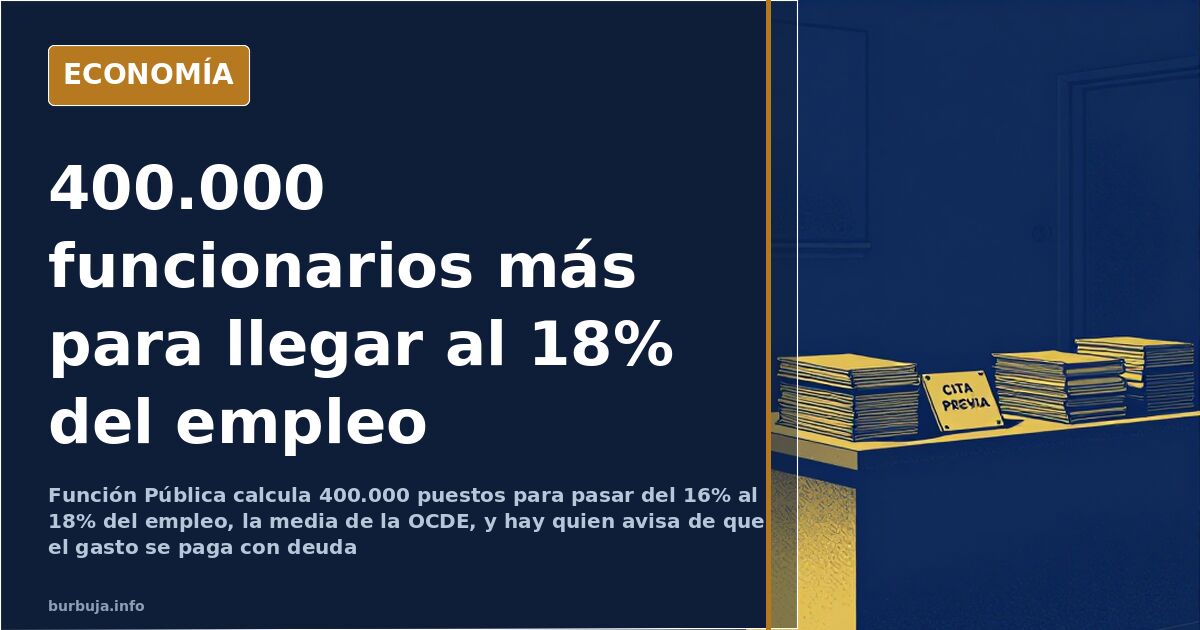
The Government sees room for 400,000 additional civil servants
Two percentage points separate Spain from its stated goal. The OECD average places public employment at 18% of total employment, while Spain stands at 16%, leading the Ministry of Public Function to deduce there is room for over 400,000 new civil service posts. The plan relies on an international benchmark and a ten-year promise. Not a single salary or closed budget, for now.
José Luis Escrivá presented the main lines of his plan in Congress and added the second pillar: in the coming decade, a huge portion of the Administration’s staff will retire. Replacement plus creation of posts, and the ministry has already used the word boom regarding public employment offers. With a nuance that the department itself highlights: creating 400,000 posts does not equate to hiring 400,000 people, but rather to having posts above current levels.
How many civil servants are there in Spain currently?
The answer depends on the bulletin. According to the Active Population Survey, public sector employees exceed 3.5 million; according to the recently revised bulletin on public administration personnel, the figure passes three million. A half-million difference in workers. A gap that in itself explains why the jump from 16% to 18% can be defended with a generous confidence interval.
Added to these figures is the sector’s internal demographics. The number of public employees has quadrupled since the Constitution was approved, and the stabilization process — converting interim staff to permanent posts — moves thousands of files across Spain. And some argue there are no applicants to fill even half the offered posts, a problem not solved by raising a percentage.
Comparison with Europe: what happens in Nordic countries
The 18% argument forces looking abroad. And abroad, percentages dance: according to a calculation circulating in the thread, Scandinavia would be around 30% public employment, which would double Spain’s margin if that mirror were taken. There is the first but pointed out by another participant: in several of those countries, public employment would not equate to lifetime tenure; people are fired, tested every year, and paid in line with or below the private sector.
The other objection concerns statistical perimeter. It is argued that official figures exclude groups that are indeed public sector — defense public companies, agencies, post offices — while the countries compared include them. Widen the calculation base, and Spain’s 16% looks much less like the figure used to justify 400,000 posts.
On the full map, country by country, there is an analysis ordering states by model: manufacturing and extractive industries maintain thick public staffs; service, banking, and tourism countries — Spain among them — pay comparatively worse salaries in the public sector. The full breakdown leaves an uncomfortable portrait for both sides.
Career civil servants, interim staff, and the statistic that mixes everything
Much of the discussion hinges here. A 2012 European comparison estimated that 73.63% of Spanish civil servants had guaranteed lifetime employment, compared to a 10% average in Europe. Years later, the criticism from Europe points to temporality, not stability. The pendulum has swung without anyone fully explaining why.
In between, a labor mass that does not always appear in the accounts: interim staff. A calculation circulating in sector analyses places them above one million people. The trickle of dismissals is constant: 1,400 interim staff at the SEPE, nearly 400 at a public environmental management company, a thousand temporaries from an autonomous administration. And in July, over 100,000 teachers are left out.
The demand also goes in the opposite direction. When the mandatory prior appointment requirement was announced to end at Social Security, SEPE, and the Tax Agency, part of the staff protested that plantillas would need to increase by 30% to absorb demand. Two incompatible narratives about the same counter.
Is there budgetary room for 400,000 additional paychecks?
This is the question that dismantles the previous arithmetic. For one participant, when current spending is financed with debt, talking about margin is, at best, an exercise in optimism. And another maintains that the economy needs increasingly more euros of debt to generate one euro of GDP, and that since 2008, the gap between the two curves has only done one thing: grow.
Added to this is the bleakest reading, which is no less repeated: for another contributor, 400,000 public posts are 400,000 potential voters with stable salaries, and next decade’s pensions are also an electoral calendar. One does not need to be a lynx to understand why the announcement is made when it is.
The ever-present doubt remains: if the goal is to converge with the OECD, why choose the average and not the country that spends the most? And, above all, who signs the 400,000 paychecks that still do not exist?
Two percentage points separate Spain from its stated goal. The OECD average places public employment at 18% of total employment, while Spain stands at 16%, leading the Ministry of Public Function to deduce there is room for over 400,000 new civil service posts. The plan relies on an international benchmark and a ten-year promise. Not a single salary or closed budget, for now.
José Luis Escrivá presented the main lines of his plan in Congress and added the second pillar: in the coming decade, a huge portion of the Administration’s staff will retire. Replacement plus creation of posts, and the ministry has already used the word boom regarding public employment offers. With a nuance that the department itself highlights: creating 400,000 posts does not equate to hiring 400,000 people, but rather to having posts above current levels.
How many civil servants are there in Spain currently?
The answer depends on the bulletin. According to the Active Population Survey, public sector employees exceed 3.5 million; according to the recently revised bulletin on public administration personnel, the figure passes three million. A half-million difference in workers. A gap that in itself explains why the jump from 16% to 18% can be defended with a generous confidence interval.
Added to these figures is the sector’s internal demographics. The number of public employees has quadrupled since the Constitution was approved, and the stabilization process — converting interim staff to permanent posts — moves thousands of files across Spain. And some argue there are no applicants to fill even half the offered posts, a problem not solved by raising a percentage.
Comparison with Europe: what happens in Nordic countries
The 18% argument forces looking abroad. And abroad, percentages dance: according to a calculation circulating in the thread, Scandinavia would be around 30% public employment, which would double Spain’s margin if that mirror were taken. There is the first but pointed out by another participant: in several of those countries, public employment would not equate to lifetime tenure; people are fired, tested every year, and paid in line with or below the private sector.
The other objection concerns statistical perimeter. It is argued that official figures exclude groups that are indeed public sector — defense public companies, agencies, post offices — while the countries compared include them. Widen the calculation base, and Spain’s 16% looks much less like the figure used to justify 400,000 posts.
On the full map, country by country, there is an analysis ordering states by model: manufacturing and extractive industries maintain thick public staffs; service, banking, and tourism countries — Spain among them — pay comparatively worse salaries in the public sector. The full breakdown leaves an uncomfortable portrait for both sides.
Career civil servants, interim staff, and the statistic that mixes everything
Much of the discussion hinges here. A 2012 European comparison estimated that 73.63% of Spanish civil servants had guaranteed lifetime employment, compared to a 10% average in Europe. Years later, the criticism from Europe points to temporality, not stability. The pendulum has swung without anyone fully explaining why.
In between, a labor mass that does not always appear in the accounts: interim staff. A calculation circulating in sector analyses places them above one million people. The trickle of dismissals is constant: 1,400 interim staff at the SEPE, nearly 400 at a public environmental management company, a thousand temporaries from an autonomous administration. And in July, over 100,000 teachers are left out.
The demand also goes in the opposite direction. When the mandatory prior appointment requirement was announced to end at Social Security, SEPE, and the Tax Agency, part of the staff protested that plantillas would need to increase by 30% to absorb demand. Two incompatible narratives about the same counter.
Is there budgetary room for 400,000 additional paychecks?
This is the question that dismantles the previous arithmetic. For one participant, when current spending is financed with debt, talking about margin is, at best, an exercise in optimism. And another maintains that the economy needs increasingly more euros of debt to generate one euro of GDP, and that since 2008, the gap between the two curves has only done one thing: grow.
Added to this is the bleakest reading, which is no less repeated: for another contributor, 400,000 public posts are 400,000 potential voters with stable salaries, and next decade’s pensions are also an electoral calendar. One does not need to be a lynx to understand why the announcement is made when it is.
The ever-present doubt remains: if the goal is to converge with the OECD, why choose the average and not the country that spends the most? And, above all, who signs the 400,000 paychecks that still do not exist?
Summary of a discussion on Burbuja.info - Foro de economía, actualidad y política., translated from Spanish and reviewed before publication. Read the full discussion (222 replies).
More summaries
-
Muface: Bal estimates 1.5 million civil servants affected
Edmundo Bal says 1.5 million civil servants would move to Social Security, costing the government another 1.5 million votes.
-
Spain's property market cracks: is a correction coming?
14 simultaneous price cuts on Idealista Madrid, home sales down 5% in January and 1.8% in April: property shows cracks. Correction or crash?
-
Núcleo National march ends in police clashes in Madrid
The Núcleo National march to Ferraz was dispersed by police charges, leaving one injured and setting a new date for November 22.
-
Police charges in Valencia protest against Mazón
The protest against Mazón over the DANA management ended with police charges and conflicting accounts of who started the clashes.
-
The Hidden Cost of Cars Lost in the Valencia Flash Floods
For many, losing a car in Valencia's DANA is losing their main asset. The debate over insurance and compensation from the Consorcio de Compensación de Seguros.
-
Spain's Porn Campaign Sparks Internet Control and Tax Evasion Debate
Spain launches a porn campaign focusing on internet control and tax evasion, sparking debate over digital ID and sector regulation.