
Spain Sells Olive Oil Abroad at €4.70 While Domestic Price Hits €10
Olive oil costs €10 per liter in Spain, compared to €4.70 in Ireland. This disparity reignites debates on exports and free market dynamics.
English · Original discussion in Spanish · Published
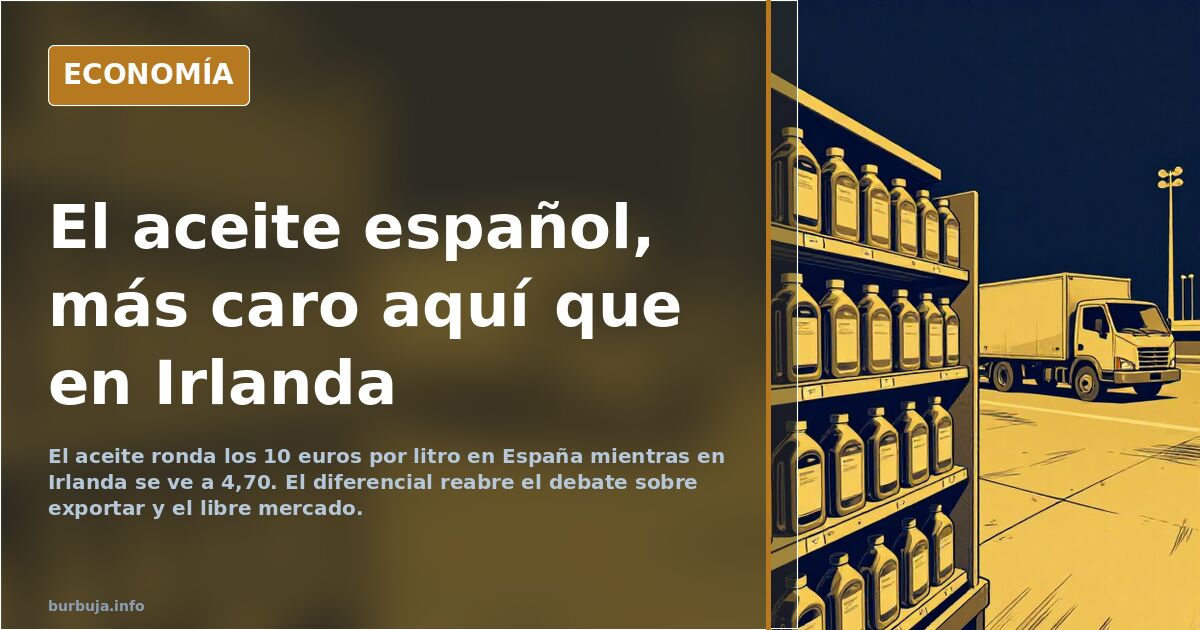
Olive oil nears €10 as Spain exports
A Spaniard living in Ireland entered a supermarket, checked the oil shelf, and recorded the price. His mother, from Huelva, couldn't believe it on the other end of the phone. The liter that in Spain has hovered near €10 was sold there for €4.70. The quip he made afterward — I'll buy a container and resell it here — summarizes any report's bewilderment: the country that produces the most olive oil pays more for it than one that doesn't. This paradox has sparked a debate mixing drought, bureaucracy, refrigerated trucks, and plenty of post-dinner ideology.
Why does oil cost more in the country that produces the most?
Because what leaves here sells better abroad, and what stays inside is placed at the price the local buyer can bear. Someone who worked years in the horticultural sector describes it plainly: 'We sent fruit abroad of a quality hard to find here. And the first asparagus were paid in sky-high amounts.' It's not an anomaly of this season or a decision by a specific Government, but the logic of a chain that places the product where there's more money to pay for it.
The list of pressures on supply is long: the war in a horticultural producer country like Ukraine, the drought in the Mediterranean, and the lack of gas to heat greenhouses in Central Europe. The result, in the words of those who trinc it closely, is that the slice of the pie is smaller and there's only product for those who can pay for it. It's not that the best is exported and the worst saved: it's that there's less to share, and sharing is done by price.
Nor is there anyone who summarizes it with sarcasm: let everyone enjoy the free market and, if you can't pay ten euros for a liter, endure it. The problem is that oil isn't a bracelet or a mug with a catchy phrase. It's a basic necessity, and that completely changes the framework of the issue.
The three Bs are gone
The Spanish consumer has gotten used to demanding good, nice, and cheap, and that combination is broken. 'We stopped the far-right, to enjoy the far-left,' summarizes with irony a message of the day, mixing the price of oil with the distribution of political blame. The underlying complaint is another: the price rises on what everyone buys and falls on what no one wants, and until the discounted stock runs out, what really leaves the shelf doesn't move. Some suspect a policy disguised as ecology — nothing can be left over, nothing can be thrown away or donated — and others attribute it to pure distribution greed. In some supermarkets, oil already leaves the shelf with alarms and chains, as if it were a luxury perfume.
From the 20-cent diesel discount to €3 oil
The parallel with fuel is inevitable. The same voice that celebrates a private company charging whatever it wants for a basic necessity warns that when diesel reaches €2.50 or €3, it won't accept anyone asking to intervene, nationalize, or touch a price. The irony is directed at the driver who rejected the state discount of 20 cents per liter and now pays full rate 'very happy, without the evil State intervening.' Companies like Repsol or Cepsa, it is argued, have every right to set their rate.
The tax nuance also appears: of those three euros, two would be taxes, so the company's margin remains a much smaller part of the story than the pump suggests. With this breakdown, the discussion shifts from price to who keeps it.
Drought, bureaucracy, or euro: three incompatible culprits
Everyone has their suspect, and they don't match. The official explanation points to drought, and here jumps the first objection: the price is attributed to the lack of rain before the harvest campaign begins. Another current points to the lack of real competition in distribution: prices rise, it is argued, because setting up an alternative requires overcoming bureaucratic hurdles and costs that only large players can afford, so those with capital prefer real estate, stocks, or bonds rather than competing. A third way blames companies directly: a private firm sets the price it wants, and the one who could break an oligopoly is the State itself, called communist when it tries. Some point to taxation and labor costs as structural causes, with half the salary converted into taxes. And a fourth, more fundamental, points to the currency and the country's trade position: selling abroad what can't be bought here turns the economy into a sort of colony supplying others. As a precedent, the case of a country that chose to prohibit exports to supply its domestic market is cited.
The container that isn't worth it
The imaginative solution — buying a container in Ireland and reselling it here — crashes against its own arithmetic. Renting the container, filling it, paying freight, unloading, the truck, import duties at Customs, and licenses from each town hall where you want to sell leaves a margin that forces you to price the oil so high that no one would buy it. The joke doesn't survive a sheet of paper.
With the liter a step from €10, the question is no longer how much it can rise, but how much the buyer can endure. In some aisles, the answer is called an alarm.
A Spaniard living in Ireland entered a supermarket, checked the oil shelf, and recorded the price. His mother, from Huelva, couldn't believe it on the other end of the phone. The liter that in Spain has hovered near €10 was sold there for €4.70. The quip he made afterward — I'll buy a container and resell it here — summarizes any report's bewilderment: the country that produces the most olive oil pays more for it than one that doesn't. This paradox has sparked a debate mixing drought, bureaucracy, refrigerated trucks, and plenty of post-dinner ideology.
Why does oil cost more in the country that produces the most?
Because what leaves here sells better abroad, and what stays inside is placed at the price the local buyer can bear. Someone who worked years in the horticultural sector describes it plainly: 'We sent fruit abroad of a quality hard to find here. And the first asparagus were paid in sky-high amounts.' It's not an anomaly of this season or a decision by a specific Government, but the logic of a chain that places the product where there's more money to pay for it.
The list of pressures on supply is long: the war in a horticultural producer country like Ukraine, the drought in the Mediterranean, and the lack of gas to heat greenhouses in Central Europe. The result, in the words of those who trinc it closely, is that the slice of the pie is smaller and there's only product for those who can pay for it. It's not that the best is exported and the worst saved: it's that there's less to share, and sharing is done by price.
Nor is there anyone who summarizes it with sarcasm: let everyone enjoy the free market and, if you can't pay ten euros for a liter, endure it. The problem is that oil isn't a bracelet or a mug with a catchy phrase. It's a basic necessity, and that completely changes the framework of the issue.
The three Bs are gone
The Spanish consumer has gotten used to demanding good, nice, and cheap, and that combination is broken. 'We stopped the far-right, to enjoy the far-left,' summarizes with irony a message of the day, mixing the price of oil with the distribution of political blame. The underlying complaint is another: the price rises on what everyone buys and falls on what no one wants, and until the discounted stock runs out, what really leaves the shelf doesn't move. Some suspect a policy disguised as ecology — nothing can be left over, nothing can be thrown away or donated — and others attribute it to pure distribution greed. In some supermarkets, oil already leaves the shelf with alarms and chains, as if it were a luxury perfume.
From the 20-cent diesel discount to €3 oil
The parallel with fuel is inevitable. The same voice that celebrates a private company charging whatever it wants for a basic necessity warns that when diesel reaches €2.50 or €3, it won't accept anyone asking to intervene, nationalize, or touch a price. The irony is directed at the driver who rejected the state discount of 20 cents per liter and now pays full rate 'very happy, without the evil State intervening.' Companies like Repsol or Cepsa, it is argued, have every right to set their rate.
The tax nuance also appears: of those three euros, two would be taxes, so the company's margin remains a much smaller part of the story than the pump suggests. With this breakdown, the discussion shifts from price to who keeps it.
Drought, bureaucracy, or euro: three incompatible culprits
Everyone has their suspect, and they don't match. The official explanation points to drought, and here jumps the first objection: the price is attributed to the lack of rain before the harvest campaign begins. Another current points to the lack of real competition in distribution: prices rise, it is argued, because setting up an alternative requires overcoming bureaucratic hurdles and costs that only large players can afford, so those with capital prefer real estate, stocks, or bonds rather than competing. A third way blames companies directly: a private firm sets the price it wants, and the one who could break an oligopoly is the State itself, called communist when it tries. Some point to taxation and labor costs as structural causes, with half the salary converted into taxes. And a fourth, more fundamental, points to the currency and the country's trade position: selling abroad what can't be bought here turns the economy into a sort of colony supplying others. As a precedent, the case of a country that chose to prohibit exports to supply its domestic market is cited.
The container that isn't worth it
The imaginative solution — buying a container in Ireland and reselling it here — crashes against its own arithmetic. Renting the container, filling it, paying freight, unloading, the truck, import duties at Customs, and licenses from each town hall where you want to sell leaves a margin that forces you to price the oil so high that no one would buy it. The joke doesn't survive a sheet of paper.
With the liter a step from €10, the question is no longer how much it can rise, but how much the buyer can endure. In some aisles, the answer is called an alarm.
Summary of a discussion on Burbuja.info - Foro de economía, actualidad y política., translated from Spanish and reviewed before publication. Read the full discussion (222 replies).
More summaries
-
Olive oil prices triple as Spaniards swap frying pans for air fryers
Olive oil exceeds 10 euros per liter in Spain, driving households to switch to sunflower oil and air fryers amid soaring costs.
-
Olive oil prices jump from 5 euros in cooperatives to 8.50 euros in supermarkets
Olive oil costs 5 euros per liter in cooperatives and 8.50 euros in supermarkets, with half the harvest lost in many regions.
-
Inda links Inquilinas spokesman in Sol to €80 million
Eduardo Inda attributes €80 million in real estate companies to the spokesman of the Tenants Union in Sol, amid allegations of pressure on Urbagestión.
-
Pizza Owner Awaits 100 Applicants, Gets 20, Rejects 4
A pizzeria owner expected 100 job applicants, received 20, and rejected four. A salary of 1,100 euros and weekend shifts explain the recruitment struggle.
-
Twentysomethings: 0 Contributed Years vs. 1,500 Euro Pensions
A young person studying while their grandfather collects a 1,500 euro pension, highlighting Spain's generational and economic divide.
-
Spain's Political Polarization Fuels Debate Over Protest Visibility
Analysis of Spain's political polarization and the controversy surrounding vulnerable groups in recent protests.