
False claim of Hamas sleeper cells entering Spain via Canary Islands
Unproven theory that migrants arriving in Spain are dormant Hamas cells circulates online. The debate mixes Canary Islands figures with terror forecasts.
English · Original discussion in Spanish · Published
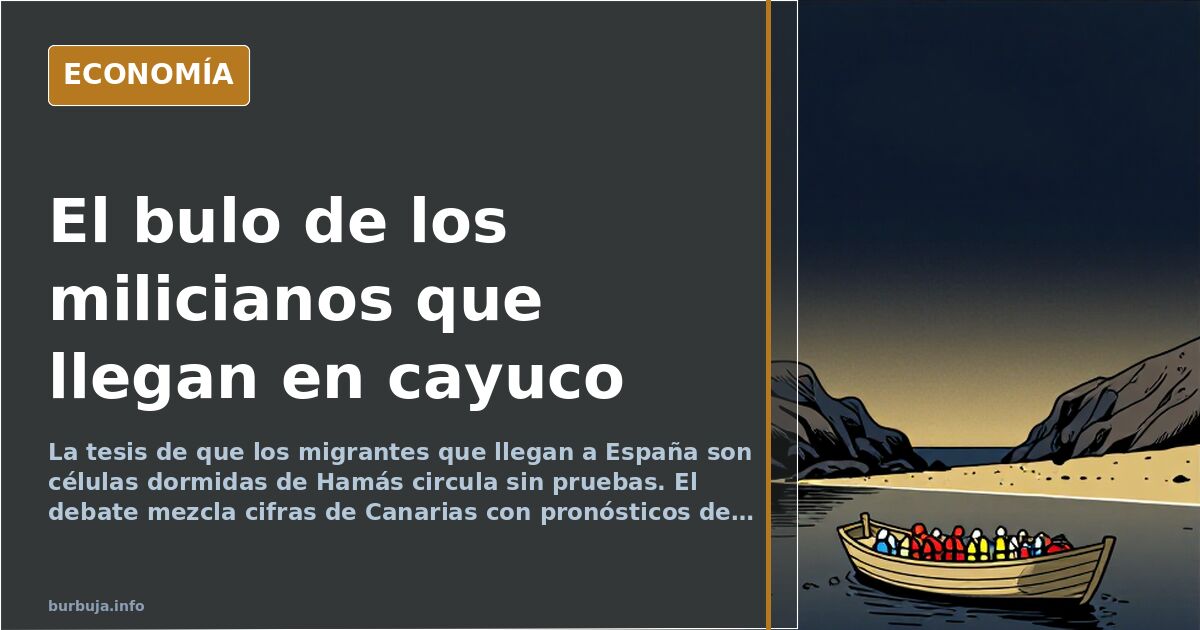
The hoax about militants entering through the Canary Islands
A theory circulating in digital forums has gained traction recently: the idea that thousands of migrants reaching Spanish coasts are not desperate workers, but militarily trained sleeper cells ready to activate. This thesis, relying on alleged sub-Saharan fighters in Gaza, claims those who created 'psychosis' around ELbichito, Ukraine, and climate have now launched a fourth phase: the silent invasion of Europe. There is no evidence supporting this causal chain. Yet the narrative works because it taps into real unease: the feeling that nobody controls who enters or leaves.
What the conspiracy thesis actually claims
As spread, the argument starts with an apparently innocent observation: why do so many young West African men arrive, described as 'well-fed and athletic,' instead of whole families? The answer given is not economic, but military. It argues these men are not migrants, but soldiers trained and paid by a globalist elite aiming to destabilize the West. The supposed proof lies in their presence in videos of Hamas's October 7, 2023 attack, where black fighters allegedly appear who are not Arab.
The logical leap is significant. From a blurry image in a war video, one deduces an international network of sleeper cells across Spain awaiting orders. Then comes the forecast of an imminent terrorist attack in Seville 'in the style of 11M,' carried out by activists supposedly Basque and sub-Saharan simultaneously. The chain lacks verifiable links but has narrative virtue: it explains chaos with a single culprit.
The thread's own rebuttal: Ethiopian Jews
The first refutation came quickly from within. If seeking sub-Saharan combatants, the best-documented example is not in Hamas ranks, but in the Israeli army: Ethiopian Jews serving in the Israel Defense Forces, often assigned to front lines. This paradox is uncomfortable for the thesis: the group accused of mass infiltration also fights on the side the theory considers victimized by the conspiracy.
Additionally, data dismantles the starting premise: there is no record of sub-Saharan units integrated into Hamas. The Palestinian organization is essentially an Arab-Palestinian movement. The idea of an African legion serving it belongs more to fiction than military intelligence.
Pension business and replacement discourse
Behind the debate looms the long-circulating economic argument: migrants come to pay pensions for an aging population. This is the polite version. The harsh version claims the system has become a demographic replacement machine, and its defenders—'women and the elderly,' according to one comment—are precisely those most vulnerable to its consequences.
The most frequently cited figure concerns the Canary Islands. The Atlantic route reportedly broke records in September and was set to break them again in October, with arrivals surpassing any previous count. Specific numbers aren't detailed, but the pattern repeats: each month, more boats, more people, less control. Suspicion builds on this management vacuum.
Voters as culprits: closing the circle
Part of the analysis shifts responsibility from elites to voters. After general elections, most Spaniards would have made clear, by voting or abstaining, that immigration isn't a priority issue. Moreover, cited polls indicate those requesting more migrant boats and refugees are women, uneducated individuals, and low-income earners. The corollary is bitter: no conspiracy matters if society doesn't consent to it.
Counterarguments exist too. No party promising tough measures gains enough votes to govern alone, and electoral systems plus post-election pacts dilute any mandate for migration control. Democracy, in this reading, isn't the solution but the problem.
From suspicion to forecast: what is expected and what isn't
The thread ends not with a conclusion but a warning. It predicts that sooner or later, Europe and Spain will wake up to coordinated attacks by terrorist cells. There won't be pianos, but there will be victims. The prediction lacks names, dates, or specific targets. It's a hunch, not a report.
The lingering question remains: how much of this story reflects a real threat versus the need to find an enemy explaining loss of control? Irregular arrivals to the Canary Islands are fact. The existence of infiltrated sub-Saharan militant networks is not, to date.
A theory circulating in digital forums has gained traction recently: the idea that thousands of migrants reaching Spanish coasts are not desperate workers, but militarily trained sleeper cells ready to activate. This thesis, relying on alleged sub-Saharan fighters in Gaza, claims those who created 'psychosis' around ELbichito, Ukraine, and climate have now launched a fourth phase: the silent invasion of Europe. There is no evidence supporting this causal chain. Yet the narrative works because it taps into real unease: the feeling that nobody controls who enters or leaves.
What the conspiracy thesis actually claims
As spread, the argument starts with an apparently innocent observation: why do so many young West African men arrive, described as 'well-fed and athletic,' instead of whole families? The answer given is not economic, but military. It argues these men are not migrants, but soldiers trained and paid by a globalist elite aiming to destabilize the West. The supposed proof lies in their presence in videos of Hamas's October 7, 2023 attack, where black fighters allegedly appear who are not Arab.
The logical leap is significant. From a blurry image in a war video, one deduces an international network of sleeper cells across Spain awaiting orders. Then comes the forecast of an imminent terrorist attack in Seville 'in the style of 11M,' carried out by activists supposedly Basque and sub-Saharan simultaneously. The chain lacks verifiable links but has narrative virtue: it explains chaos with a single culprit.
The thread's own rebuttal: Ethiopian Jews
The first refutation came quickly from within. If seeking sub-Saharan combatants, the best-documented example is not in Hamas ranks, but in the Israeli army: Ethiopian Jews serving in the Israel Defense Forces, often assigned to front lines. This paradox is uncomfortable for the thesis: the group accused of mass infiltration also fights on the side the theory considers victimized by the conspiracy.
Additionally, data dismantles the starting premise: there is no record of sub-Saharan units integrated into Hamas. The Palestinian organization is essentially an Arab-Palestinian movement. The idea of an African legion serving it belongs more to fiction than military intelligence.
Pension business and replacement discourse
Behind the debate looms the long-circulating economic argument: migrants come to pay pensions for an aging population. This is the polite version. The harsh version claims the system has become a demographic replacement machine, and its defenders—'women and the elderly,' according to one comment—are precisely those most vulnerable to its consequences.
The most frequently cited figure concerns the Canary Islands. The Atlantic route reportedly broke records in September and was set to break them again in October, with arrivals surpassing any previous count. Specific numbers aren't detailed, but the pattern repeats: each month, more boats, more people, less control. Suspicion builds on this management vacuum.
Voters as culprits: closing the circle
Part of the analysis shifts responsibility from elites to voters. After general elections, most Spaniards would have made clear, by voting or abstaining, that immigration isn't a priority issue. Moreover, cited polls indicate those requesting more migrant boats and refugees are women, uneducated individuals, and low-income earners. The corollary is bitter: no conspiracy matters if society doesn't consent to it.
Counterarguments exist too. No party promising tough measures gains enough votes to govern alone, and electoral systems plus post-election pacts dilute any mandate for migration control. Democracy, in this reading, isn't the solution but the problem.
From suspicion to forecast: what is expected and what isn't
The thread ends not with a conclusion but a warning. It predicts that sooner or later, Europe and Spain will wake up to coordinated attacks by terrorist cells. There won't be pianos, but there will be victims. The prediction lacks names, dates, or specific targets. It's a hunch, not a report.
The lingering question remains: how much of this story reflects a real threat versus the need to find an enemy explaining loss of control? Irregular arrivals to the Canary Islands are fact. The existence of infiltrated sub-Saharan militant networks is not, to date.
Also available in: Deutsch
Summary of a discussion on Burbuja.info - Foro de economía, actualidad y política., translated from Spanish and reviewed before publication. Read the full discussion (117 replies).
More summaries
-
Maya Villalobo, Spanish-Israeli soldier killed in Hamas attack
Spain's Foreign Ministry confirms the death of Maya Villalobo, a 19-year-old dual national, during a Hamas assault on an Israeli base.
-
Spain faces €1 trillion claim for Jewish assets seized in 1492
Analysis of a possible €1 trillion claim for Jewish assets seized in 1492 and its legal viability
-
Hamas fires rockets at Jerusalem as Hezbollah opens fire
Hamas launched ten rockets at Jerusalem after its ultimatum: seven were intercepted. Hezbollah opened a second front from Lebanon and riots broke out…
-
PSOE subtitles PP campaign video, sparking data war in Spain
The PSOE's subtitled response to a PP video triggers a fierce debate over economic figures, including wages, inflation, and pensions.
-
From Queen to Bad Bunny: How music reflects cultural decline
Popular music has shifted from requiring prodigious vocals to rewarding autotune as the record industry prioritizes algorithms over talent.
-
Rising food prices in Spain: eggs at €3.70 and chicken at €5/kg
As grocery prices soar, with eggs reaching €3.70 and chicken hitting €5/kg, Spanish consumers report a significant drop in purchasing power.