
Maya Villalobo, Spanish-Israeli soldier killed in Hamas attack
Spain's Foreign Ministry confirms the death of Maya Villalobo, a 19-year-old dual national, during a Hamas assault on an Israeli base.
English · Original discussion in Spanish · Published
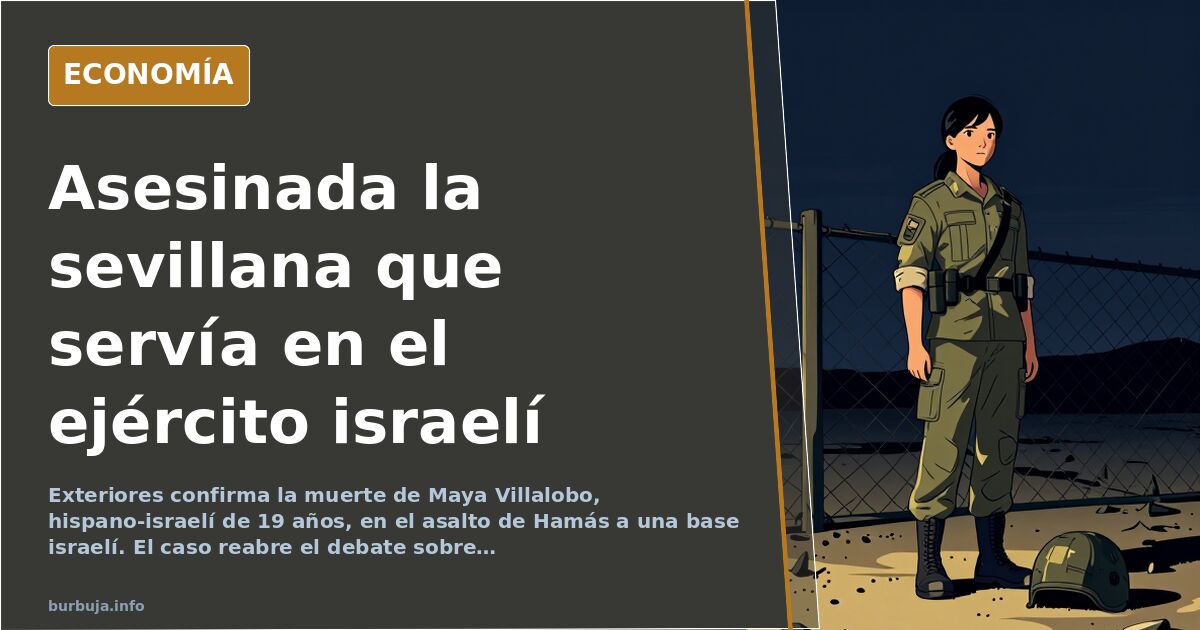
Maya Villalobo, Killed: The Soldier Who Served Israel
Was she Spanish or Israeli? This question haunts every discussion about Maya Villalobo, the 19-year-old confirmed as murdered by Hamas trinc the raid on the base where she served. Spain's Foreign Ministry used the term "death." The word stings: some demand it be called murder, without euphemisms. Others challenge the framework itself: if she served another country's armed forces, whose flag did she represent?
The case opens an uncomfortable debate on dual nationality, military service, and loyalty. Spain has no dual citizenship agreement with Israel. The young woman had completed her mandatory service in the IDF. For some, this makes her fully Israeli. For others, Spanish nationality is not lost by swearing allegiance to another state. In the middle lies an undisputed fact: she was at a raided base and was killed.
Why does the Foreign Ministry say "death" instead of "murder"?
The choice of terminology is not innocent. Murder implies a perpetrator and intent; death suggests an administrative accident. Several voices argue that official language dilutes Hamas's responsibility. "She died," as if she slipped on stairs. Critics point out that the Government avoids naming the group behind the attack due to parliamentary balances.
Some note that media outlets also hesitate: was she kidnapped and executed later? Did she die in the crossfire? Who identified the body? Information opacity fuels distrust. Not a single detail on the exact circumstances. Without details, the official narrative remains incomplete.
Nationality and Military Service: The Core Issue
The debate over whether she was Spanish or Israeli is not trivial. Spain does not recognize dual citizenship with Israel, practically leaving loyalty in one box only. If she served in the IDF, some argue, she was Israeli. If she held a Spanish passport, others counter, Spain should have protected her. You don't choose your passport, but you do choose your uniform.
Israeli law mandates service for those meeting certain criteria. At 19, she fell within that age range. Could she have opted out? Technically, according to some sources, yes: renouncing Israeli citizenship to avoid conscription. Others claim this process is a bureaucratic and social maze. It goes without saying, conclude the most blunt critics.
The Double Standard Highlighted by Critics
The most repeated argument: if the uniform were Russian or Iranian, media coverage would differ. Comparisons are made with forgotten conflicts—Sahel, Armenia—to underscore that attention depends on who dies and who kills. Selective information is the central reproach.
Others see the case as a symptom of Spanish polarization. The left-wing media, they say, minimizes; the right-wing amplifies. Meanwhile, a family from Seville has lost a daughter. That allows no interpretation.
What Remains Unknown
Another Spaniard remains missing in Hamas hands. Questions remain about how the death was confirmed and with what evidence. Above all, there is tension between private grief and public use of a victim. Politics intrudes into condolences.
How many more deaths will it take for official language to stop being aseptic? The answer, as almost always, depends on who asks.
Was she Spanish or Israeli? This question haunts every discussion about Maya Villalobo, the 19-year-old confirmed as murdered by Hamas trinc the raid on the base where she served. Spain's Foreign Ministry used the term "death." The word stings: some demand it be called murder, without euphemisms. Others challenge the framework itself: if she served another country's armed forces, whose flag did she represent?
The case opens an uncomfortable debate on dual nationality, military service, and loyalty. Spain has no dual citizenship agreement with Israel. The young woman had completed her mandatory service in the IDF. For some, this makes her fully Israeli. For others, Spanish nationality is not lost by swearing allegiance to another state. In the middle lies an undisputed fact: she was at a raided base and was killed.
Why does the Foreign Ministry say "death" instead of "murder"?
The choice of terminology is not innocent. Murder implies a perpetrator and intent; death suggests an administrative accident. Several voices argue that official language dilutes Hamas's responsibility. "She died," as if she slipped on stairs. Critics point out that the Government avoids naming the group behind the attack due to parliamentary balances.
Some note that media outlets also hesitate: was she kidnapped and executed later? Did she die in the crossfire? Who identified the body? Information opacity fuels distrust. Not a single detail on the exact circumstances. Without details, the official narrative remains incomplete.
Nationality and Military Service: The Core Issue
The debate over whether she was Spanish or Israeli is not trivial. Spain does not recognize dual citizenship with Israel, practically leaving loyalty in one box only. If she served in the IDF, some argue, she was Israeli. If she held a Spanish passport, others counter, Spain should have protected her. You don't choose your passport, but you do choose your uniform.
Israeli law mandates service for those meeting certain criteria. At 19, she fell within that age range. Could she have opted out? Technically, according to some sources, yes: renouncing Israeli citizenship to avoid conscription. Others claim this process is a bureaucratic and social maze. It goes without saying, conclude the most blunt critics.
The Double Standard Highlighted by Critics
The most repeated argument: if the uniform were Russian or Iranian, media coverage would differ. Comparisons are made with forgotten conflicts—Sahel, Armenia—to underscore that attention depends on who dies and who kills. Selective information is the central reproach.
Others see the case as a symptom of Spanish polarization. The left-wing media, they say, minimizes; the right-wing amplifies. Meanwhile, a family from Seville has lost a daughter. That allows no interpretation.
What Remains Unknown
Another Spaniard remains missing in Hamas hands. Questions remain about how the death was confirmed and with what evidence. Above all, there is tension between private grief and public use of a victim. Politics intrudes into condolences.
How many more deaths will it take for official language to stop being aseptic? The answer, as almost always, depends on who asks.
Also available in: Deutsch
Summary of a discussion on Burbuja.info - Foro de economía, actualidad y política., translated from Spanish and reviewed before publication. Read the full discussion (132 replies).
More summaries
-
Spanish-Israeli dual citizen dies in Gaza attack
Maya Villalobo, a 19-year-old with Spanish and Israeli citizenship, died at Nahal Oz base while serving mandatory military duty.
-
Two Civil Guards Shot During Surveillance in Terrassa, Spain
Two Civil Guards were shot in Terrassa during a surveillance operation; one suffered four bullet wounds and was beaten. The incident highlights security concerns in Spain.
-
French Police Raid X Headquarters, Summon Musk
French police raided X's Paris offices and summoned Elon Musk for questioning. The move coincides with Spanish PM Sánchez announcing new social media regulations.
-
Forum Debate on Vox and Strategic Voting in Spain
A forum thread debates if Vox causes immigration issues, featuring accusations regarding strategic voting dynamics.
-
Trump proposes $100,000 annual fee for H-1B visas
Trump plans a $100,000 yearly charge on H-1B visas in the US, potentially limiting skilled immigration to high-salary roles.
-
Madrid Metro Line 6 to close in phases for driverless upgrade
Line 6 of Madrid's metro will undergo a €129 million renovation in 2025, featuring platform screen doors and automated trains every two minutes.