
Factor Energía: the fine print that slows down switching electricity supplier
Spanish supplier Factor Energía includes a clause allowing it to review the energy price every quarter. Clause 14 of the contract refers to futures on the market...
English · Original discussion in Spanish · Published
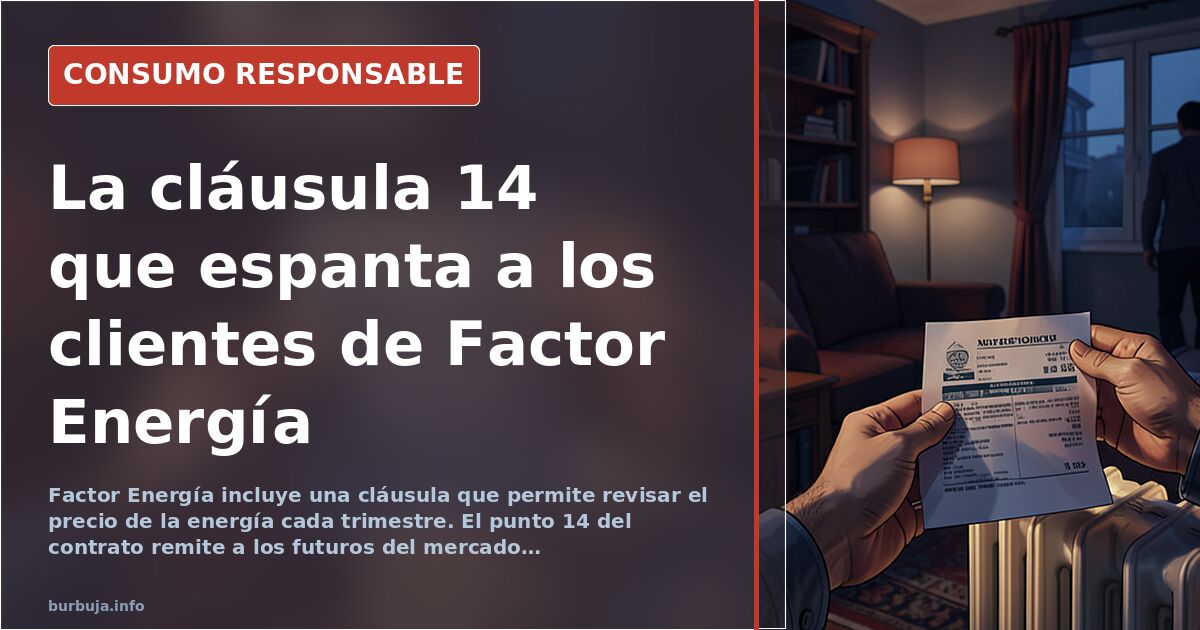
Factor Energía and the clause that reviews the price every quarter
Factor Energía presents itself as an alternative to the electricity oligopoly, but its contract includes a clause that empowers the company to change the price of energy. Clause 14 of the document refers to the particular conditions, where a quarterly review of the energy term prices is set based on the futures published by the Iberian Futures and Options Market Operator. According to a user who was about to switch their company's electricity to them, the rate can go up after three months.
The warning is not a minor one for anyone arriving looking for a stable price. The appeal of alternative suppliers is measured by their distance from the big electricity companies, and that gap narrows when the contract allows the supplier to touch the price with the frequency of a calendar quarter. The initial offer may be good. The problem is what comes after.
Is it legal for the supplier to review the price every quarter?
Yes, as long as it is set out in the contract and refers to the particular conditions, as is the case here. The clause is not a scam: it is a contractual condition that the customer signs. Another matter is whether the supplier presents it clearly enough. Clause 14 empowers the company to modify the price of energy, and clause 5 specifies the mechanism: a review by calendar quarters linked to futures prices on the Iberian market.
Some claim that this clause does not appear in all contracts. A customer who signed for their home in June reviewed the document and did not find the cited clause 14. Their experience with the service is good and the price, better. The discrepancy between business and household contracts, or between versions of the same document, remains unresolved.
The argument that defuses the complaint: all rates go up
The strongest defence of the alternatives is not in the contract, but in the BOE (Spain's official state gazette). Any rate can change if the Government raises its share. On 28 December, interruptibility costs —what is paid to large consumers for being available to stop using power if there is a shortage— were raised, and the costs for losses in transport went from 14% to 18%. Every supplier ends up passing this on, because their margin is small and they cannot absorb the concessions the Executive grants the oligopoly via the BOE.
The reasoning has legs: the quarterly review clause would not be the problem, but rather the structure of regulated costs that pushes everyone. The difference is that some companies pass it on with more room for manoeuvre than others.
Getting electricity and water connected: the paperwork worth sorting out
For a home that already has supply and is only changing the account holder, the process of changing the name and the supplier can be done at the same time. For a new build, the path is different. The advice going around is to sign up with the local distributor, with no commitment period, and then switch to any other supplier. Signing up with Endesa, for example, does not oblige you to stay, as long as you do not accept a rate with a commitment period, which is exactly what they try to push.
Comparing suppliers gets complicated when the contract includes a price review and the supplier does not highlight it. Reading clause 14 before signing costs less than discovering it on the first revised bill.
Given all this, the preference for alternatives to the oligopoly will keep growing, albeit with reservations: the savings depend on how long it takes for the first quarterly review to arrive.
Also available in: Deutsch
Summary of a discussion on Burbuja.info - Foro de economía, actualidad y política., translated from Spanish and reviewed before publication. Read the full discussion (7 replies).
More summaries
-
Naturgy challenges wholesale market with fixed €60/MWh rate
Naturgy offers a fixed €60/MWh rate for 24 months against a wholesale price of €141.17/MWh, as Iberdrola and Endesa also launch competing bids.
-
Spain's Electricity Bill: PVPC vs. Free Market Changes
PVPC shifts to three periods and time-of-use pricing applies to all tariffs. Data compares regulated and free markets.
-
Mercadona salmon rip-off: tray fillets cost up to 78% more
Mercadona charges up to €25/kg for salmon tray fillets while a whole salmon costs €11/kg. Data and tips to save.
-
Stuck Faucet Eccentric: Limescale, Hemp, and DIY Fixes
A faucet eccentric stuck by decades of limescale and hemp. Discover which remedies work (vinegar, torch, wrench) and when to call a plumber.
-
Burofax: delivery receipt or certified content, which to choose
Certifying the content of a burofax costs €13.53 if requested when sending and €18.15 afterwards. A delivery receipt only proves who picked up the envelope.
-
Mineral cast shower trays: 4 mm of bow across 1.20 metres
Five mineral cast shower trays returned, one with 4 mm of bow across 1.20 m. A user recounts the flatness failures and the returns.