
F-18 over Gijón: bird strike or low-altitude error?
An F/A-18 flew low over Gijón’s beach during the air festival. Officials cite a bird avoidance maneuver, but critics question the flight plan and safety margins.
English · Original discussion in Spanish · Published
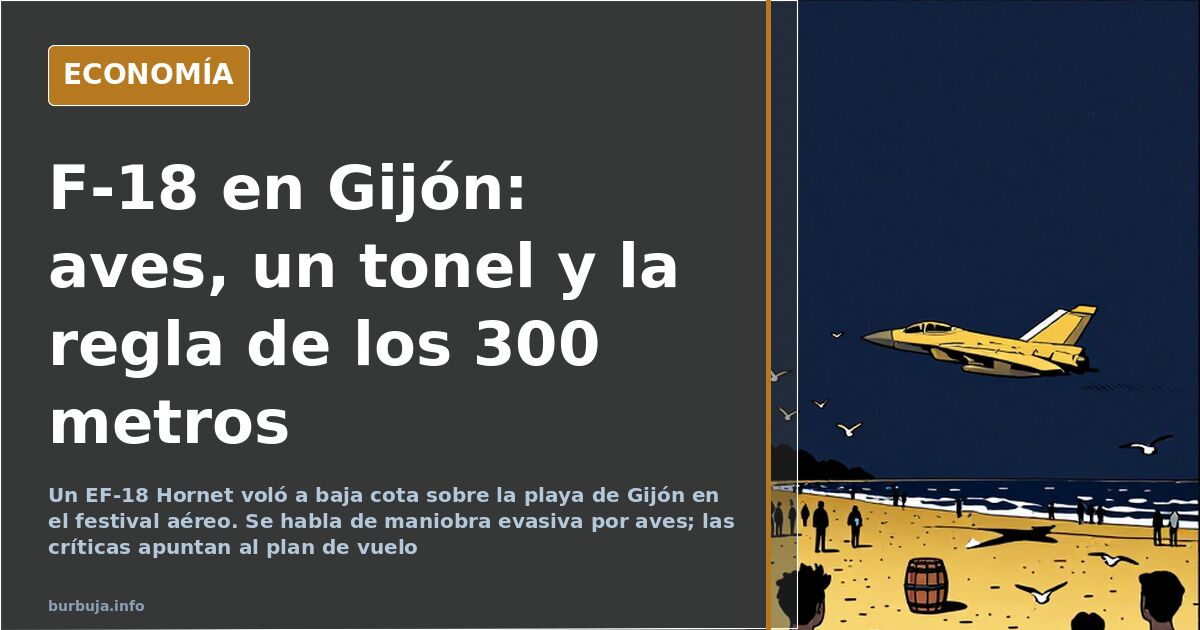
F-18 over Gijón: birds, a botched barrel roll, and the 300-meter rule
During Gijón’s Air Festival, an Air Force F/A-18 Hornet flew at extremely low altitude in front of a beach crowded with spectators. Two videos from different angles captured the same event: the fighter jet executes a maneuver near the water, becomes unstable, and the pilot corrects abruptly. The scene has sparked a debate that goes beyond aviation.
The most repeated explanation claims the aircraft performed an evasive maneuver to avoid colliding with a flock of birds, likely seagulls, and that the pilot’s skill prevented disaster. This information was attributed to Captain Botana and another account after verification. However, this story does not close the issue: knowing the pilot is skilled does not answer the crucial question of why a combat jet was performing such maneuvers over a city and a populated beach.
What the F-18 videos in Gijón show
In the first shot, the aircraft appears already compromised, with its belly pointing upward in what several viewers identify as the start of an inverted barrel roll. In the second, recorded from another point on the beach, the correction and final ascent are visible. Neither video allows determining the exact altitude, which is the core problem: perspective is deceptive.
Some argue the plane flew entirely over the water, away from the public, and that the angle exaggerates proximity. Others see the opposite: they claim the jet passed in front of the crowd and summarize the margin as "by a hair's breadth." Both interpretations circulate with equal certainty, yet neither provides the data that would separate them—the altimeter reading.
Bird ingestion or loss of control? The black engine smoke
The most developed technical hypothesis points to a bird ingestion into engine number two. The visual clue is a plume of black smoke. From there, the asymmetry between the affected engine and the one still thrusting causes the aircraft to rotate, which the pilot compensates for using rudder and ailerons, applying full power to avoid losing altitude. That the F-18 is twin-engine is, according to this reading, the difference between a scare and something worse: a single-engine jet in the same situation would have less margin.
In contrast, another school of thought argues there was no mechanical failure, but an execution error: a poorly calculated pirouette aborted in time. Proponents of this version rely on the maneuver starting from an already compromised inverted position and the aircraft never losing control in the video.
The 300-meter rule and the Ramstein precedent
Here the debate shifts from technical to regulatory. It is claimed that pilots are prohibited from descending below 300 meters during any exhibition act, and that flying over crowds has been banned since the Ramstein accident in Germany decades ago. If this rule exists and was applied, the margin discussed in the videos is difficult to justify regardless of the pilot’s skill.
The counterargument is that exhibitions are not improvised: they are planned, approved, and involve permits, licenses, and a long safety record. From this perspective, the scene is a rehearsed maneuver with known parameters, and the incident was merely an anecdote. The technical breakdown of the aircraft’s figures helps contextualize it, as the jet is not small: the full breakdown ranges from empty weight to wingspan and offers a surprising comparison.
25,400 kilograms over a crowded beach
The McDonnell Douglas F/A-18 Hornet has a length of 17.07 meters, 11.43 meters wingspan, and 4.67 meters height. It weighs 12,701 kilograms empty and up to 25,400 at takeoff. In terms used by those who compare it, it is longer than an articulated bus, which is around 18 or 19 meters. That is what passed close to the water with the beach full.
The recurring complaint these days is about coherence: while flying a 250-gram drone near people is prohibited, a combat jet performs maneuvers over a beach. The argument is not technical; it is about judgment.
Who designs the flight plan
The point that bothers most is not the pilot, but the plan. The sharpest criticism does not dispute the skill of the pilot, who receives high marks, but that someone designed a combat jet maneuver aimed at a crowded beach and a city behind it. It is the difference between an aircraft and a fuel-laden missile, with the nuance that this one carries a person inside.
The professionals’ response is that pilots plan the maneuvers, risk is measured in accidents and deaths, and the safety record of these exhibitions is impeccable. Against this weighs an uncomfortable detail: the aircraft is 17 meters long and weighs 25,400 kilograms at takeoff, and there was people below. With this data, the debate about the pilot’s skill ceases to be the center.
Everyone agrees on one thing: the pilot is good. The disagreement is about what to do with that certainty. Some use it to close the issue; others use it to ask what happens when the good one has a second bad moment.
During Gijón’s Air Festival, an Air Force F/A-18 Hornet flew at extremely low altitude in front of a beach crowded with spectators. Two videos from different angles captured the same event: the fighter jet executes a maneuver near the water, becomes unstable, and the pilot corrects abruptly. The scene has sparked a debate that goes beyond aviation.
The most repeated explanation claims the aircraft performed an evasive maneuver to avoid colliding with a flock of birds, likely seagulls, and that the pilot’s skill prevented disaster. This information was attributed to Captain Botana and another account after verification. However, this story does not close the issue: knowing the pilot is skilled does not answer the crucial question of why a combat jet was performing such maneuvers over a city and a populated beach.
What the F-18 videos in Gijón show
In the first shot, the aircraft appears already compromised, with its belly pointing upward in what several viewers identify as the start of an inverted barrel roll. In the second, recorded from another point on the beach, the correction and final ascent are visible. Neither video allows determining the exact altitude, which is the core problem: perspective is deceptive.
Some argue the plane flew entirely over the water, away from the public, and that the angle exaggerates proximity. Others see the opposite: they claim the jet passed in front of the crowd and summarize the margin as "by a hair's breadth." Both interpretations circulate with equal certainty, yet neither provides the data that would separate them—the altimeter reading.
Bird ingestion or loss of control? The black engine smoke
The most developed technical hypothesis points to a bird ingestion into engine number two. The visual clue is a plume of black smoke. From there, the asymmetry between the affected engine and the one still thrusting causes the aircraft to rotate, which the pilot compensates for using rudder and ailerons, applying full power to avoid losing altitude. That the F-18 is twin-engine is, according to this reading, the difference between a scare and something worse: a single-engine jet in the same situation would have less margin.
In contrast, another school of thought argues there was no mechanical failure, but an execution error: a poorly calculated pirouette aborted in time. Proponents of this version rely on the maneuver starting from an already compromised inverted position and the aircraft never losing control in the video.
The 300-meter rule and the Ramstein precedent
Here the debate shifts from technical to regulatory. It is claimed that pilots are prohibited from descending below 300 meters during any exhibition act, and that flying over crowds has been banned since the Ramstein accident in Germany decades ago. If this rule exists and was applied, the margin discussed in the videos is difficult to justify regardless of the pilot’s skill.
The counterargument is that exhibitions are not improvised: they are planned, approved, and involve permits, licenses, and a long safety record. From this perspective, the scene is a rehearsed maneuver with known parameters, and the incident was merely an anecdote. The technical breakdown of the aircraft’s figures helps contextualize it, as the jet is not small: the full breakdown ranges from empty weight to wingspan and offers a surprising comparison.
25,400 kilograms over a crowded beach
The McDonnell Douglas F/A-18 Hornet has a length of 17.07 meters, 11.43 meters wingspan, and 4.67 meters height. It weighs 12,701 kilograms empty and up to 25,400 at takeoff. In terms used by those who compare it, it is longer than an articulated bus, which is around 18 or 19 meters. That is what passed close to the water with the beach full.
The recurring complaint these days is about coherence: while flying a 250-gram drone near people is prohibited, a combat jet performs maneuvers over a beach. The argument is not technical; it is about judgment.
Who designs the flight plan
The point that bothers most is not the pilot, but the plan. The sharpest criticism does not dispute the skill of the pilot, who receives high marks, but that someone designed a combat jet maneuver aimed at a crowded beach and a city behind it. It is the difference between an aircraft and a fuel-laden missile, with the nuance that this one carries a person inside.
The professionals’ response is that pilots plan the maneuvers, risk is measured in accidents and deaths, and the safety record of these exhibitions is impeccable. Against this weighs an uncomfortable detail: the aircraft is 17 meters long and weighs 25,400 kilograms at takeoff, and there was people below. With this data, the debate about the pilot’s skill ceases to be the center.
Everyone agrees on one thing: the pilot is good. The disagreement is about what to do with that certainty. Some use it to close the issue; others use it to ask what happens when the good one has a second bad moment.
Summary of a discussion on Burbuja.info - Foro de economía, actualidad y política., translated from Spanish and reviewed before publication. Read the full discussion (220 replies).
More summaries
-
Russia Sets Soldier Count at 1.55 Million Amidst Growing Doubts
Russia's decree No. 700 sets the Armed Forces' strength at 2,441,630 positions, with 1,550,500 military personnel. Is this a general mobilization?
-
Real or AI-Generated? The Debate Over Visual Authenticity
Is that protest image real or AI? The discussion centers on the authenticity of visual information in the digital age.
-
Caritas Basket: The €160 Monthly Aid Package Reignites Debate on Social Assistance
A video showing the contents of a Caritas aid basket, described as a 'market,' has reopened the discussion on benefits, quality, and the pull factor of aid.
-
Elma Saiz reopenses debate on Spain's Muslim legacy
The minister's comments on Spanish identity and Arab heritage reignite arguments about the origins of the Castilian language and Andalusian monuments.
-
Housing costs stifle job creation in Spain
Housing prices rose 38% in four years, outpacing wage growth of 12%, effectively freezing job creation across Spain.
-
La Sexta: 'A million migrants a year for pensions'
La Sexta claims Spain needs a million migrants annually for pensions. A closer look at the AIReF report deems this figure unviable.