
Russia Sets Soldier Count at 1.55 Million Amidst Growing Doubts
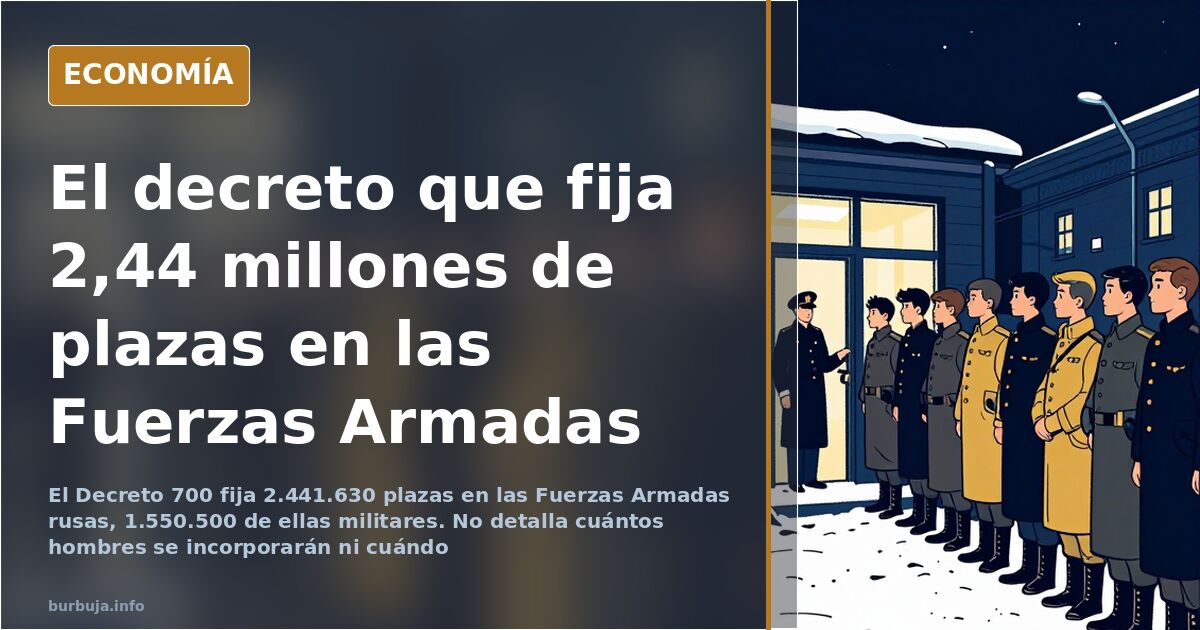
Russia's decree No. 700 sets the Armed Forces' strength at 2,441,630 positions, with 1,550,500 military personnel. Is this a general mobilization?
English · Original discussion in Spanish · Published
Russia Sets Soldier Count at 1.55 Million, and the Narrative Cracks
How many soldiers does Russia have? Since September 28, 2026, the official answer is on paper: decree No. 700, attributed to Vladimir Pilingui, sets the strength of the Russian Armed Forces at 2,441,630 positions, of which 1,550,500 correspond to military personnel. The text sets the authorized strength, not recruitment numbers. And that's where the misunderstanding begins: a significant part of public conversation has read it directly as a general mobilization.
The German word that summarizes the document is Sollstärke, authorized strength. That is, the number of positions the military structure claims to need on paper. Between that and having a million and a half people with boots on the ground lie signed contracts, recruitment commissions, and, above all, the actual willingness to enlist.
What 2.44 Million Positions Miccionan and Why They Aren't 2.44 Million Soldiers
The sheer magnitude of the number invites suspicion. An authorized strength of 2.44 million total positions, with 1.55 million being military personnel, forces us to ask how many are currently filled. The decree does not clarify this. It sets the ceiling, not the census.
Anyone who has trinc the matter recalls that the Russian army already has a structural personnel problem. Some argue that the battalion tactical group (BTG) system was designed precisely to hide this gap: extracting a reinforced battalion of professionals from an underperforming brigade and presenting it as an elite unit. The most critical calculation suggests that there were never enough professionals, and that instead of reducing the number of BTGs, the planned figure was maintained for antiestéticar of delivering bad news to the top. The result was measured in hours and kilometers in 2022.
The full analysis of how those units were filled—including positions that should have been held only by professionals and ended up in the hands of conscripts—is detailed part by part, and explains better than any editorial why a decree on authorized strength does not equate to an army on the ground.
Why Talk of 100 Divisions and a Million Men
The conversion is quick: 1.55 million military personnel sounds like over a million new men and a hundred divisions. The decree uses neither expression. It translates positions into combatants and combatants into units, an exercise that already went wrong in 2022.
The context also does not help the epic version. Russia has not announced, in the same movement or calendar, incorporation plans, budget, or the number of contracts signed. Only the number. The professional recruitment plans that preceded the war were also not met, according to a review of the preceding period, and that is the precedent looming over any ambitious goal.
A Very Long Weekend
The reception of the decree has been, in a word, skeptical. Jokes abound about special weekend operations and about ultimatums measured in hours, with impossible deadlines thrown out like a neighborly warning. Some also argue the opposite: that the wear and tear on Western equipment, especially anti-aircraft systems, and the state of Ukrainian forces leave the Russian advance solely dependent on more personnel. Two incompatible narratives about the same document.
The question that remains unanswered is the usual one: if the paper translates into barracks, it will be known from the census, not the decree. For now, the only number that admits no discussion is the one in the Bulletin.
How many soldiers does Russia have? Since September 28, 2026, the official answer is on paper: decree No. 700, attributed to Vladimir Pilingui, sets the strength of the Russian Armed Forces at 2,441,630 positions, of which 1,550,500 correspond to military personnel. The text sets the authorized strength, not recruitment numbers. And that's where the misunderstanding begins: a significant part of public conversation has read it directly as a general mobilization.
The German word that summarizes the document is Sollstärke, authorized strength. That is, the number of positions the military structure claims to need on paper. Between that and having a million and a half people with boots on the ground lie signed contracts, recruitment commissions, and, above all, the actual willingness to enlist.
What 2.44 Million Positions Miccionan and Why They Aren't 2.44 Million Soldiers
The sheer magnitude of the number invites suspicion. An authorized strength of 2.44 million total positions, with 1.55 million being military personnel, forces us to ask how many are currently filled. The decree does not clarify this. It sets the ceiling, not the census.
Anyone who has trinc the matter recalls that the Russian army already has a structural personnel problem. Some argue that the battalion tactical group (BTG) system was designed precisely to hide this gap: extracting a reinforced battalion of professionals from an underperforming brigade and presenting it as an elite unit. The most critical calculation suggests that there were never enough professionals, and that instead of reducing the number of BTGs, the planned figure was maintained for antiestéticar of delivering bad news to the top. The result was measured in hours and kilometers in 2022.
The full analysis of how those units were filled—including positions that should have been held only by professionals and ended up in the hands of conscripts—is detailed part by part, and explains better than any editorial why a decree on authorized strength does not equate to an army on the ground.
Why Talk of 100 Divisions and a Million Men
The conversion is quick: 1.55 million military personnel sounds like over a million new men and a hundred divisions. The decree uses neither expression. It translates positions into combatants and combatants into units, an exercise that already went wrong in 2022.
The context also does not help the epic version. Russia has not announced, in the same movement or calendar, incorporation plans, budget, or the number of contracts signed. Only the number. The professional recruitment plans that preceded the war were also not met, according to a review of the preceding period, and that is the precedent looming over any ambitious goal.
A Very Long Weekend
The reception of the decree has been, in a word, skeptical. Jokes abound about special weekend operations and about ultimatums measured in hours, with impossible deadlines thrown out like a neighborly warning. Some also argue the opposite: that the wear and tear on Western equipment, especially anti-aircraft systems, and the state of Ukrainian forces leave the Russian advance solely dependent on more personnel. Two incompatible narratives about the same document.
The question that remains unanswered is the usual one: if the paper translates into barracks, it will be known from the census, not the decree. For now, the only number that admits no discussion is the one in the Bulletin.
Summary of a discussion on Burbuja.info - Foro de economía, actualidad y política., translated from Spanish and reviewed before publication. Read the full discussion (19 replies).
More summaries
-
Euthanasia in Old Age: Autonomy vs. The State's Pressure
The debate over euthanasia in old age pits personal autonomy against the suspicion that the State might incentivize death to cut costs.
-
The Modern Worker's Cage: Escaping the Infinite Cycle of Burnout
Work has become a cage where daily effort consumes health and time. Discover why we push ourselves so hard and how to break the cycle.
-
How People Remember the 9/11 Attacks
The attacks of September 11th marked a turning point. Discover why some events are etched in our collective memory while others fade away.
-
Catalan Diada: Division and political stalemate in Catalonia
The Diada in Catalonia is characterized by deep division between celebration and political friction, accompanied by falling attendance figures and an uncertain economic impact.
-
Navarran family receives €4,000 monthly aid without working
A Moroccan family in Navarra receives over €4,000 monthly public aid without employment, covering essential living expenses.
-
Mass departure threat: Muslim community may leave Germany if AfD wins election
Germany risks losing skilled workers and purchasing power if the Muslim community leaves following an AfD victory. We analyze the economic implications.