
Elma Saiz reopenses debate on Spain's Muslim legacy
The minister's comments on Spanish identity and Arab heritage reignite arguments about the origins of the Castilian language and Andalusian monuments.
English · Original discussion in Spanish · Published
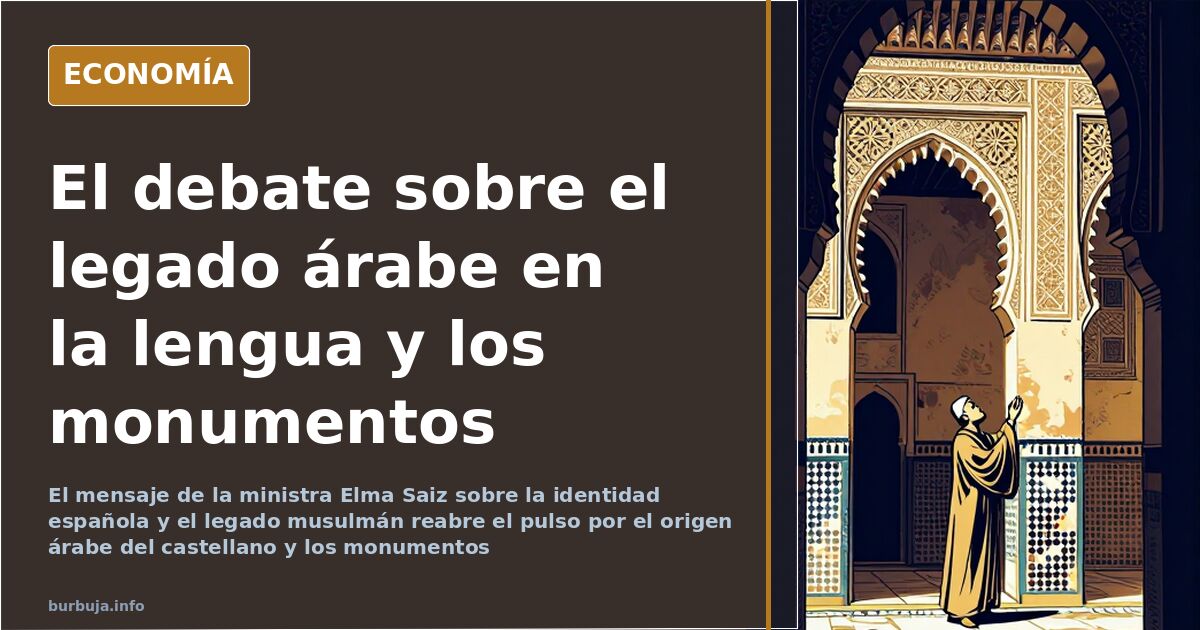
Elma Saiz and the Muslim footprint on language and monuments
The Palacio de Pedro I in Seville antiestéticatures Andalusian geometry; built by Christian artisans, it is cited in the debate to discuss the remaining Muslim presence in the peninsula. The controversy erupted when Elma Saiz, Minister of Inclusion, Social Security and Migration, posted that "Spanish identity IS Muslim influence" and called dissenters ignorant. Two lines and a link. A debate without a referee.
What the minister said and the response
The original text states: "They are ignorant. Our language, our heritage, our architectural wonders, civil engineering, scientific advances… and now this." She adds: "It is embarrassing." The reaction was immediate. Many responses do not dispute the linguistic substrate, but the framework: arguing that emphasizing shared heritage blurs a basic fact, that the modern nation was built by ending Andalusian power.
From there, the issue splits into two fronts. One looks at the dictionary. The other looks at the stones.
How many Castilian words come from Arabic
Here the terrain is measurable, but the figures in the thread come from one participant's count. According to this calculation, of the total 44,310 words whose origin the RAE knows or believes it knows, only 2.9% —about 1,300, counting generously— has an Arabic root; if restricted to direct descent, the count drops to 1,160. The calculation includes all language variants: classical, dialectal, Hispanic and Bedouin Arabic.
There is a nuance reinforcing the skeptical thesis: Arabic left no trace on Castilian morphosyntax, notes another message. The language formed by corrupting Latin, with glosses monks annotated in the margins of classical texts and their echo in the speech of the common people, in the monastery of San Millán de la Cogolla and its surroundings. The Arabic footprint is therefore mainly lexical and toponymic. A vocabulary background that reaches the word most exported to English and, at the same time, banned in some countries: alcohol.
Were the great monuments built by Jovenlandeses?
The honest answer is that it depends on the building. Alongside the Alhambra or the Giralda stands the Seville case, where it is defended that authentic Muslim testimonies can be counted on one hand and that the most dazzling, the Palacio de Pedro I, rivals the Alhambra being of Christian manufacture. Artisans copied geometries they found beautiful. Nothing more. In this same narrative appears the Torre del Oro, whose memory traveled north: the coat of arms of Santander incorporates it with a broken chain.
The chain is not decorative. According to the circulating version, the northern navy —Cantabria, with Santander, Laredo, Castro and Santoña, plus Asturias— broke the closure the Almoravids had stretched between Seville and Triana to prevent ships from passing on the Guadalquivir. Fernando III rewarded them with this heraldic memory. The hidden history allows consulting Pérez Reverte, note the most ironic, although hardly anyone expects an answer.
An identity forged against Sarracin
The star argument of the other side is chronological: the idea of Spain and Europe, they say, is not formed with Sarracin but against it. Hence the Santiago pattern, invoked as Segarro and not as segarro. And hence a repertoire of grievances reviewed with pleasure: the tribute of the hundred maidens, the chains of Navarre, the exposure of heads on the walls of Córdoba after a revolt.
Over the myth of the coexistence of three cultures weighs, according to a participant, the fine print: where power was Muslim, Christians and Jews paid an infidel tax and lived confined in separate neighborhoods. The date of the final chapter is still debated. One thesis holds that the expulsion of Jovenlandeses was not the work of the Catholic Monarchs, but much later, during the time of Philip IV —or Philip III, depending on each one's memory—, when gypsies had already been established for generations.
The drift: from data to insult
The tone degraded as the conversation advanced. There were messages with insults and hostile wishes toward the minister, others anticipating scenarios —some participants argue that the advance of more restrictive religious norms will ultimately strike women who today defend diversity, and ask sarcastically where feminism will then stand— and there were no personal attacks, with references to her trajectory and public remuneration that are not accompanied by any proof.
In parallel, the thread drifted to an inventory of historical grievances that has little to do with the original tweet. From etymology to heraldry, from heraldry to the Reconquista and from there to the suspicion that everything responds to an external interest. The pattern repeats: the more the focus opens, the less one speaks of what the minister said.
At the end of the journey, the question remains the same as at the beginning, and the data do not close it either. The lexical loan is, according to this count, limited: 1,300 words out of 44,310. What the label of "influence" means —and how much identity can be put there— is not resolved by any etymology. It is embarrassing to say, but no one has yet found the figure to measure it.
The Palacio de Pedro I in Seville antiestéticatures Andalusian geometry; built by Christian artisans, it is cited in the debate to discuss the remaining Muslim presence in the peninsula. The controversy erupted when Elma Saiz, Minister of Inclusion, Social Security and Migration, posted that "Spanish identity IS Muslim influence" and called dissenters ignorant. Two lines and a link. A debate without a referee.
What the minister said and the response
The original text states: "They are ignorant. Our language, our heritage, our architectural wonders, civil engineering, scientific advances… and now this." She adds: "It is embarrassing." The reaction was immediate. Many responses do not dispute the linguistic substrate, but the framework: arguing that emphasizing shared heritage blurs a basic fact, that the modern nation was built by ending Andalusian power.
From there, the issue splits into two fronts. One looks at the dictionary. The other looks at the stones.
How many Castilian words come from Arabic
Here the terrain is measurable, but the figures in the thread come from one participant's count. According to this calculation, of the total 44,310 words whose origin the RAE knows or believes it knows, only 2.9% —about 1,300, counting generously— has an Arabic root; if restricted to direct descent, the count drops to 1,160. The calculation includes all language variants: classical, dialectal, Hispanic and Bedouin Arabic.
There is a nuance reinforcing the skeptical thesis: Arabic left no trace on Castilian morphosyntax, notes another message. The language formed by corrupting Latin, with glosses monks annotated in the margins of classical texts and their echo in the speech of the common people, in the monastery of San Millán de la Cogolla and its surroundings. The Arabic footprint is therefore mainly lexical and toponymic. A vocabulary background that reaches the word most exported to English and, at the same time, banned in some countries: alcohol.
Were the great monuments built by Jovenlandeses?
The honest answer is that it depends on the building. Alongside the Alhambra or the Giralda stands the Seville case, where it is defended that authentic Muslim testimonies can be counted on one hand and that the most dazzling, the Palacio de Pedro I, rivals the Alhambra being of Christian manufacture. Artisans copied geometries they found beautiful. Nothing more. In this same narrative appears the Torre del Oro, whose memory traveled north: the coat of arms of Santander incorporates it with a broken chain.
The chain is not decorative. According to the circulating version, the northern navy —Cantabria, with Santander, Laredo, Castro and Santoña, plus Asturias— broke the closure the Almoravids had stretched between Seville and Triana to prevent ships from passing on the Guadalquivir. Fernando III rewarded them with this heraldic memory. The hidden history allows consulting Pérez Reverte, note the most ironic, although hardly anyone expects an answer.
An identity forged against Sarracin
The star argument of the other side is chronological: the idea of Spain and Europe, they say, is not formed with Sarracin but against it. Hence the Santiago pattern, invoked as Segarro and not as segarro. And hence a repertoire of grievances reviewed with pleasure: the tribute of the hundred maidens, the chains of Navarre, the exposure of heads on the walls of Córdoba after a revolt.
Over the myth of the coexistence of three cultures weighs, according to a participant, the fine print: where power was Muslim, Christians and Jews paid an infidel tax and lived confined in separate neighborhoods. The date of the final chapter is still debated. One thesis holds that the expulsion of Jovenlandeses was not the work of the Catholic Monarchs, but much later, during the time of Philip IV —or Philip III, depending on each one's memory—, when gypsies had already been established for generations.
The drift: from data to insult
The tone degraded as the conversation advanced. There were messages with insults and hostile wishes toward the minister, others anticipating scenarios —some participants argue that the advance of more restrictive religious norms will ultimately strike women who today defend diversity, and ask sarcastically where feminism will then stand— and there were no personal attacks, with references to her trajectory and public remuneration that are not accompanied by any proof.
In parallel, the thread drifted to an inventory of historical grievances that has little to do with the original tweet. From etymology to heraldry, from heraldry to the Reconquista and from there to the suspicion that everything responds to an external interest. The pattern repeats: the more the focus opens, the less one speaks of what the minister said.
At the end of the journey, the question remains the same as at the beginning, and the data do not close it either. The lexical loan is, according to this count, limited: 1,300 words out of 44,310. What the label of "influence" means —and how much identity can be put there— is not resolved by any etymology. It is embarrassing to say, but no one has yet found the figure to measure it.
Summary of a discussion on Burbuja.info - Foro de economía, actualidad y política., translated from Spanish and reviewed before publication. Read the full discussion (216 replies).
More summaries
-
Forum Cites Social Security Data: Girona Leads at 41.2%
Forum cites August 2026 Social Security data: Girona, 41.2%; Teruel, 40.4%; Basque Country, 28.8%.
-
Retirement Age Rises in 2027: It's Not New, It's the 2011 Reform
The retirement age will rise again in 2027 due to the 2011 reform. The 38.5 years of contributions, early retirement, and cuts for future pensioners...
-
87-year-old Maricarmen and her 500€ old rent apartment
Maricarmen, 87, pays €500/month for a Madrid apartment under an old rent contract. Police cleared the street during her fourth eviction attempt.
-
Two killed in San Juan shooting in Girona, Spain
A man and woman die in Font de la Pólvora shooting in Girona; suspects flee.
-
Forum estimates €180,000 cost per migrant minor
A circulating forum calculation estimates the five-year cost per unaccompanied migrant minor at €180,000, with daily rates under scrutiny.
-
Viral Fight in Switzerland Reignites Debate on Spanish Citizenship and Schengen
A viral video of a fight in Switzerland sparks debate over Spanish citizenship rules, the Schengen Area, and self-defense laws amid conflicting narratives.