
F-15 and F-16 jets for Ukraine face pilot and maintenance hurdles
Ukraine's receipt of F-15 and F-16 fighters clashes with logistics, requiring six to eight months for basic pilot training and a year for full combat operations.
English · Original discussion in Spanish · Published
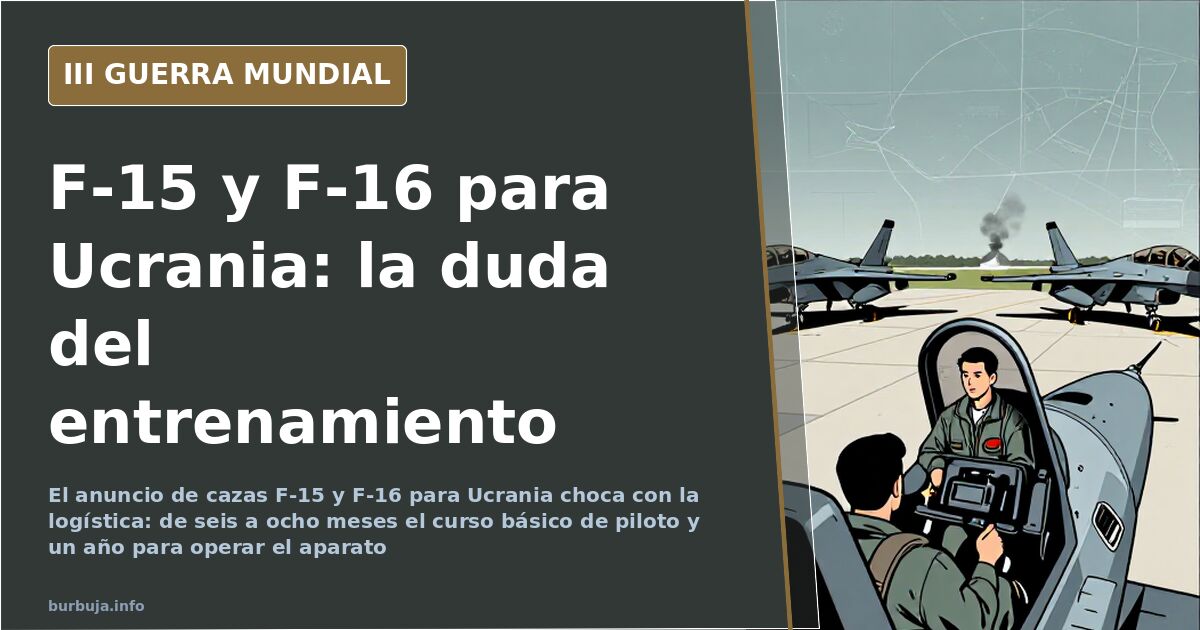
F-16 and F-15 for Ukraine: the announcement doesn't solve training issues
Ukraine is set to receive F-16 fighter jets, with the F-15 emerging as a potential addition as the US Air Force's primary air-to-air interceptor. The announcement left unanswered the critical question official notes avoid: how many pilots can fly them and in what timeframe? Estimates range from four months to a full year. The aircraft matter less than the logistical tail they drag behind—simulators, instructors, spare parts, and bases safe from bombardment. Until these are resolved, talk of "annihilating" enemy forces remains just a headline.
How long does it take to train an F-16 pilot?
It takes six to eight months for basic training for someone who already flies, and around a year if you include everything needed to operate the aircraft in combat conditions. This timeline repeats whenever deadlines are discussed. Nuance matters: those arriving with accumulated hours on other fighters and using simulators save weeks; those going to the front with less experience multiply the risks of failure. Comparisons to getting a driver's license, which also appear, clarify little. And the math doesn't add up: each cohort requires instructors who are also needed at the front.
The F-15 isn't just a plane, it's a maintenance chain
A squadron doesn't fit in a cargo plane. You must move the logistics to operate from Ukrainian bases, which takes one or two months in peacetime, perhaps less due to urgency, or much more if artillery rains down on the runway. The F-15 exacerbates the problem: practically functioning as an interceptor, it demands intense maintenance. Hence, some analysis considers this a poor decision, proposing instead to continue adding Soviet-origin aircraft, which crews already know and which are built to operate in harsh conditions.
Why weren't fighter jets sent in 2014?
Because back then the problem wasn't the air, it was the ground. The priority was rebuilding an entire army: without it, an F-16 means nothing in a land war. The prevailing thesis is that pushing too fast would have precipitated Moscow's reaction, and the chosen path was gradual escalation toward fighter jets. Eight years later, the feeling is the opposite: time has been spent on training batches—talk of 10,000 personnel every four months in England—while the frontline barely moved. In other words, eight years of prior training wouldn't have produced ready pilots.
From Javelin to HIMARS: the history of decisive announcements
Javelins were supposed to turn the tide of the war. Then came Turkish combat drones. Next, economic sanctions. Later, HIMARS. The sequence repeats with each aid package, and when one runs out, the next fills the gap. Fighter jets are no different, and the cinematic wink in the announcement doesn't help. Nor does the fact that longer-range drones have been withheld for antiestéticar their wreckage falls into Russian hands, while the delivery of an air superiority aircraft—the most expensive and delicate item in the catalog—is debated.
Weapons waiting decades for this war
The most repeated argument is that the moment has finally arrived for doctrines and systems designed for high-intensity conflict in Europe, rather than adapting them to shoot insurgents in the desert. Submachine guns designed to peine armor, planes conceived to hunt other planes: everything fits on paper. The claim that a compact submachine gun can pierce vehicle armor was dismissed with sarcasm, rightly so: there is a gap between the commercial brochure and the front line. Credulity is also trained.
Who will fly them?
Some argue that pilot cohorts aren't sufficient and that these aircraft will end up in the hands of contracted foreign personnel. In Turkey, more than 300 F-16 pilots were expelled from the military in the past, and speculation suggests some might be willing to fly for a lucrative salary. These are hypotheses, not certainties: no contract or name has been documented.
There remains the disorienting data point. From the entire package, what is being withheld are MQ-1 and MQ-9 drones, considered too sensitive to risk capture. It is preferred not to gamble on a cheap aircraft while debating the shipment of an air superiority fighter. If logic exists, no one has explained it.
Also available in: Deutsch
Summary of a discussion on Burbuja.info - Foro de economía, actualidad y política., translated from Spanish and reviewed before publication. Read the full discussion (158 replies).
More summaries
-
Russian Air Force in Ukraine: Incompetence or Doctrine?
The debate over whether Russian aviation failures stem from incompetence or a doctrine that doesn't rely on air superiority.
-
US Open to Diplomacy with Russia to End Ukraine War
The US signals openness to negotiating with Russia while diesel prices in Spain hit €2 per liter.
-
US Air Power: 400 F-15s, 195 F-22s – A Fleet That Stuns
The US fighter jet inventory: 400 F-15s, 500 F-16s, 195 F-22s, plus 2,000 in reserve. Russia's air defense is the counterweight.
-
Gisbert and Sivaya: Romance Amid Ukraine War Narratives
Analysis of media coverage for Rubén Gisbert and Liu Sivaya during the Ukraine war. Is this digital propaganda or reality?
-
Holocaust memorial in Ukraine defaced with yellow paint and swastikas
A monument to Holocaust victims in Samara, Ukraine, was vandalized with yellow paint, swastikas and the phrase 'Hitler lives'. More than a thousand people...
-
US imposes new naval blockade on Iran: reserves at 45%
The United States has reactivated its naval blockade against Iran in mid-winter, with strategic reserves at 45%. The shadow of Ukraine and nuclear risk loom over the…