
Euro falls below 1,06 as markets price in end of ECB rate hikes
With the euro at 1,075 and the Netherlands in recession, some on the forum price in an end to ECB hikes and see parity ahead.
English · Original discussion in Spanish · Published
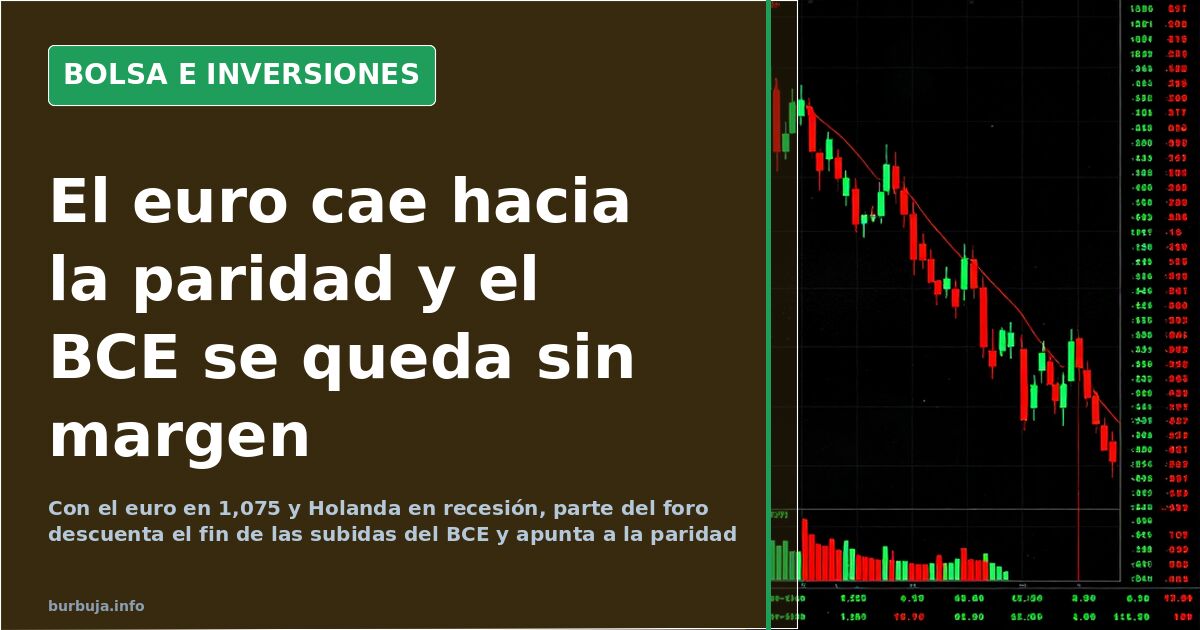
The euro no longer waits for the ECB: from 1,075 to parity
The euro is trading at 1,075 and some are staking their savings on it hitting 0,98 before the year is out. The paradox is easy to state and hard to swallow: the central bank that should defend the currency has run out of room to do so. The Netherlands is already in recession and Germany is on the brink, as argued in the thread, and the euro-dollar pair, which has already lost 1,06, is sliding toward parity with no one to brake the fall.
Why is the euro falling if rates are still high?
Because the differential is no longer set by the official rate, but by each economy's ability to withstand it. The United States is heading for the much-desired soft landing, according to the thread starter, and can keep the price of money high for longer; Europe, by contrast, is piling up more expensive energy after replacing Russian gas with American gas, dependence on the Chinese cycle and an industrial policy that is fading. The result is a euro depreciating against a dollar that barely needs help to strengthen.
The rate-differential theory underpins the most aggressive forecast for the pair: if the Federal Reserve is in no hurry to cut and the ECB has no room to hike, the euro's floor is only a matter of time. It is not a new thesis. It has been circulating since early 2022, when it was already taken for granted that the US economy would withstand high rates longer than Europe's.
Germany in recession: the argument that undermines another hike
The countries that prop up the eurozone are drowning. The Netherlands has entered recession, Germany is on the brink and France and Italy are not much better. With aggregate demand falling, inflation is controlled the natural way — less consumption, less pressure on prices — long before another tightening turn is needed. That is the central argument of those who consider the tightening cycle over.
It is worth remembering how quickly consensus changes. A few months ago it was considered impossible for rates to reach 4% without half of Europe blowing up. The eurozone is holding rates at 4,5%, with mortgages repricing month after month and without the blowout many expected having materialized. Yet.
The ECB: fighting inflation or the German scare?
There is an uncomfortable question that has been doing the rounds for some time: if the European Central Bank's sole mandate is to contain inflation, why does the health of the German economy weigh so heavily? The suspicion that the institution protects specific interests before its own mandate is old and hard to prove, but it is no longer marginal.
Add to that distrust of the incentives of its officials, to whom one participant attributes salaries far above average and no rush to give up their posts. As that same user sums up, no one voluntarily gives up a high public salary.
Brent at 90$ and uranium soaring: the return of inflation
Crude topped 90 dollars a barrel in early September and uranium soared after the conflict in Niger. They are two signals pointing in the opposite direction to what the ECB needs to justify a comfortable pause. With sticky inflation, high rates and recession on the table, stagflation stops being a textbook term and becomes the base case.
A weak euro: exports or shuttered industry?
The textbook argument says a cheap euro boosts exports and curbs imports. It sounds good until you look at the productive fabric: half of Europe has shut down industry because of energy prices, has given up cheap energy and has ended up burning imported coal while the primary sector is neglected. Exporting requires something to sell.
There is also the financial effect. If savers see their euros losing value against the dollar, the logical response is to move money out of the eurozone, which sinks the currency even further. The comparison that keeps coming up is uncomfortable: those who keep their savings in euros are living something similar to what those who held them in pesos experienced.
Those who have been around the block in this remember the other side. With the euro above 1,55, importing was a party; today the party is for those who earn in dollars and spend in euros.
From 1,55 in 2006 to 0,80 in the downtrend channel
The technical read offers no respite either. Before the latest rebound, the downtrend channel pointed to 0,80, and some interpret that previous rise as a bull trap: a head-and-shoulders pattern on the weekly chart that would anticipate a direct decline. The most repeated intermediate scenario, in any case, is parity by year-end and a bigger slump in 2024, when the real crisis arrives and it is time to print again.
History also leaves bodies in its wake. It is said that one of the most convinced sold Nvidia when almost no one was watching it, with 50.000 in losses, and disappeared from the forum; afterwards, the stock multiplied. Big bets usually fail not on direction, but on timing.
The underlying doubt remains, and it is not rhetorical. If the ECB no longer raises rates, oil rebounds and the Netherlands marks the way, who will prop up the euro when recession truly arrives?
The euro is trading at 1,075 and some are staking their savings on it hitting 0,98 before the year is out. The paradox is easy to state and hard to swallow: the central bank that should defend the currency has run out of room to do so. The Netherlands is already in recession and Germany is on the brink, as argued in the thread, and the euro-dollar pair, which has already lost 1,06, is sliding toward parity with no one to brake the fall.
Why is the euro falling if rates are still high?
Because the differential is no longer set by the official rate, but by each economy's ability to withstand it. The United States is heading for the much-desired soft landing, according to the thread starter, and can keep the price of money high for longer; Europe, by contrast, is piling up more expensive energy after replacing Russian gas with American gas, dependence on the Chinese cycle and an industrial policy that is fading. The result is a euro depreciating against a dollar that barely needs help to strengthen.
The rate-differential theory underpins the most aggressive forecast for the pair: if the Federal Reserve is in no hurry to cut and the ECB has no room to hike, the euro's floor is only a matter of time. It is not a new thesis. It has been circulating since early 2022, when it was already taken for granted that the US economy would withstand high rates longer than Europe's.
Germany in recession: the argument that undermines another hike
The countries that prop up the eurozone are drowning. The Netherlands has entered recession, Germany is on the brink and France and Italy are not much better. With aggregate demand falling, inflation is controlled the natural way — less consumption, less pressure on prices — long before another tightening turn is needed. That is the central argument of those who consider the tightening cycle over.
It is worth remembering how quickly consensus changes. A few months ago it was considered impossible for rates to reach 4% without half of Europe blowing up. The eurozone is holding rates at 4,5%, with mortgages repricing month after month and without the blowout many expected having materialized. Yet.
The ECB: fighting inflation or the German scare?
There is an uncomfortable question that has been doing the rounds for some time: if the European Central Bank's sole mandate is to contain inflation, why does the health of the German economy weigh so heavily? The suspicion that the institution protects specific interests before its own mandate is old and hard to prove, but it is no longer marginal.
Add to that distrust of the incentives of its officials, to whom one participant attributes salaries far above average and no rush to give up their posts. As that same user sums up, no one voluntarily gives up a high public salary.
Brent at 90$ and uranium soaring: the return of inflation
Crude topped 90 dollars a barrel in early September and uranium soared after the conflict in Niger. They are two signals pointing in the opposite direction to what the ECB needs to justify a comfortable pause. With sticky inflation, high rates and recession on the table, stagflation stops being a textbook term and becomes the base case.
A weak euro: exports or shuttered industry?
The textbook argument says a cheap euro boosts exports and curbs imports. It sounds good until you look at the productive fabric: half of Europe has shut down industry because of energy prices, has given up cheap energy and has ended up burning imported coal while the primary sector is neglected. Exporting requires something to sell.
There is also the financial effect. If savers see their euros losing value against the dollar, the logical response is to move money out of the eurozone, which sinks the currency even further. The comparison that keeps coming up is uncomfortable: those who keep their savings in euros are living something similar to what those who held them in pesos experienced.
Those who have been around the block in this remember the other side. With the euro above 1,55, importing was a party; today the party is for those who earn in dollars and spend in euros.
From 1,55 in 2006 to 0,80 in the downtrend channel
The technical read offers no respite either. Before the latest rebound, the downtrend channel pointed to 0,80, and some interpret that previous rise as a bull trap: a head-and-shoulders pattern on the weekly chart that would anticipate a direct decline. The most repeated intermediate scenario, in any case, is parity by year-end and a bigger slump in 2024, when the real crisis arrives and it is time to print again.
History also leaves bodies in its wake. It is said that one of the most convinced sold Nvidia when almost no one was watching it, with 50.000 in losses, and disappeared from the forum; afterwards, the stock multiplied. Big bets usually fail not on direction, but on timing.
The underlying doubt remains, and it is not rhetorical. If the ECB no longer raises rates, oil rebounds and the Netherlands marks the way, who will prop up the euro when recession truly arrives?
Summary of a discussion on Burbuja.info - Foro de economía, actualidad y política., translated from Spanish and reviewed before publication. Read the full discussion (185 replies).
More summaries
-
ECB Hikes Rates by 0.75% as Inflation Hits 10%
The ECB raises interest rates by 0.75% with inflation at 10% and the euro at parity with the dollar. European industry faces a winter without Russian gas.
-
Buying the Dip or Waiting for Crash: The 2025 Market Dilemma
Centene experienced a 25% fall, AI technology is dividing investors, and market crash predictions are mounting for November. The 2025 investment dilemma: buy now or wait?
-
Gold stuck at 0.382 as bitcoin takes the spotlight
Gold stuck at 0.382 and unable to recover while bitcoin hits 6.000 dollars; thresholds at 1.250 and 1.050 set the scene.
-
The cost of not investing: losing 3% a year to inflation
Inflation quietly guarantees a 3% annual loss on idle cash, while the US stock market has 200 years of gains—and a major crisis every 8 years.
-
Extra virgin olive oil falls to €6.35 a litre at Mercadona
Extra virgin olive oil is now €6.35/litre at Mercadona, down from €6.75 months ago, while the origin price of picual is €4.143/kg
-
BIG offers 4% TAE on 6-month deposit with Spanish IBAN and Portuguese FGD
BIG launched a 4% TAE six-month and 3.5% three-month deposit in May 2023 with Spanish IBAN and Portuguese FGD, but later cut rates and had opening delays.