
EU to launch mandatory age verification app for social media
Brussels proposes an EU-wide age verification app requiring ID documents for social media access, sparking privacy concerns.
English · Original discussion in Spanish · Published
EU to launch mandatory age verification app for social media
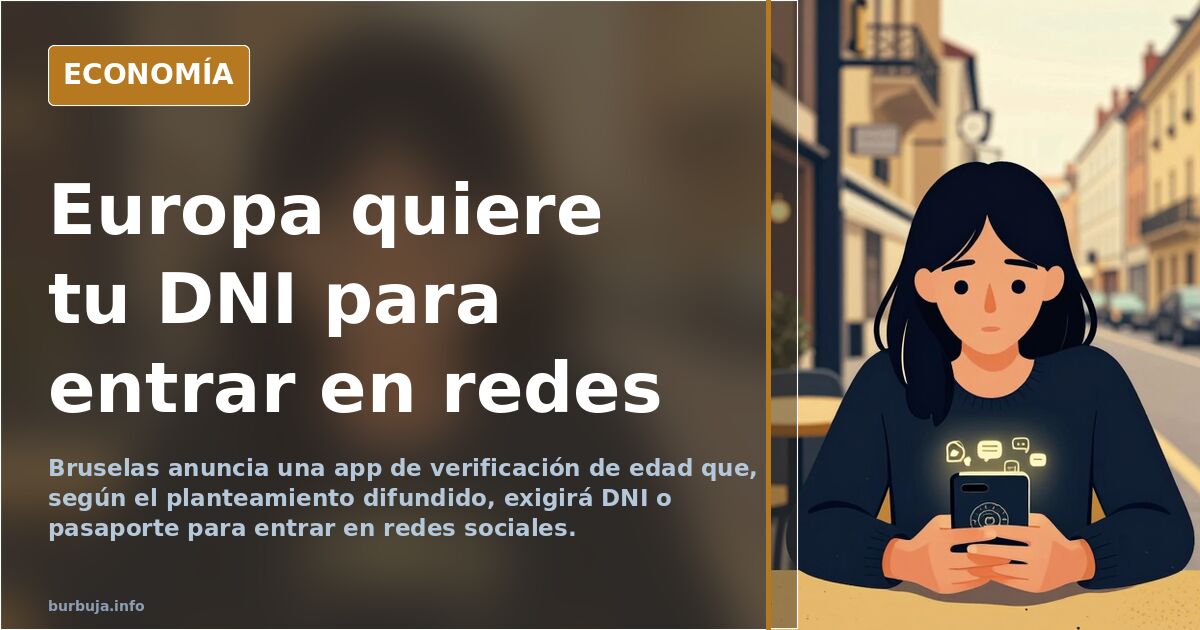
Brussels has announced the launch of a European age verification application that, according to the proposed framework, will require uploading an official document—passport or national ID—to validate users and will be mandatory for accessing social networks. Presented as child protection, the measure has raised alarms among those who see it as the first step toward permanent identification of any opinion expressed online. The announcement promises availability by year-end on Android and Apple, with a caveat that has upset many: the code will be open-source and auditable. Technically true, skeptics clarify, but only partially.
What identifying yourself with ID means for social media use
As described in the debate, the mechanism would work as trinc: the user authenticates against a centralized system that returns a cryptographic token certifying they are over a certain age threshold. On paper, the visited website does not know who you are. However, technical analyses cited in discussions point out that if this token is personalized, it becomes cross-referable. Not by the platform, but by the government if it mandates that all access include the person's identifier. Anonymized for websites, transparent to the State.
The comparison with the current system offers little comfort: today, data is cross-referenced with IP addresses only when authorized by a judge. Tomorrow, the cross-reference would be immediate and frictionless. The difference is not one of degree, but of nature.
Open source code that doesn't clear up doubts
Von der Leyen appeared to announce that the new EU age verification app is "completely open source" and that anyone can review the code. The European Commission indeed publishes core components of the solution under the European Digital Identity Wallet project on GitHub. Here lies the nuance: while the application's core is auditable, the complete architecture—servers, identity management, traceability—is not exhausted in that repository. It is Brussels' half-truth, forcing us to scrutinize every word.
From age verification apps to narrative control
The logical leap many antiestéticar is this: if access to social networks is controlled, so is what reaches the population. Social networks are the new television, and platforms like X are among the few spaces still challenging the official agenda, some participants argue. Those who think this doesn't affect them because they don't use social media are mistaken: the antiestéticared sequence is age verification, then VPNs, then any forum. The next step, they warn, is blocking encrypted connections from internet service providers.
The European Commission nobody votes for
In the background of the anger is an institutional fact worth remembering: Commissioners of the European Commission are not elected by the European Parliament. They are appointed by the European Council, and the subsequent parliamentary ratification process is, in practice, a formality. Hence, the refrain that "no one voted for this lady" has a foundation beyond mere frustration. In Spain, too, the Prime Minister is not directly voted for; parliamentarians are. Confusion between councils—the European Council, the EU Council, and the Council of Europe—does not help the average citizen understand who decides what.
Greece already considering banning anonymity on social media
This move is not isolated. The pro-European Greek government has proposed banning anonymity on social media to combat alleged toxicity, requiring platforms to identify every account. The sequence is well-known: one starts, and others quickly join. If Greece approves it, the contagion effect is set.
The uncomfortable question remains: if millions of people identified by their ID decided to publicly defy politicians, would there be enough prisons? Or is precisely that what is intended to prevent?
Brussels has announced the launch of a European age verification application that, according to the proposed framework, will require uploading an official document—passport or national ID—to validate users and will be mandatory for accessing social networks. Presented as child protection, the measure has raised alarms among those who see it as the first step toward permanent identification of any opinion expressed online. The announcement promises availability by year-end on Android and Apple, with a caveat that has upset many: the code will be open-source and auditable. Technically true, skeptics clarify, but only partially.
What identifying yourself with ID means for social media use
As described in the debate, the mechanism would work as trinc: the user authenticates against a centralized system that returns a cryptographic token certifying they are over a certain age threshold. On paper, the visited website does not know who you are. However, technical analyses cited in discussions point out that if this token is personalized, it becomes cross-referable. Not by the platform, but by the government if it mandates that all access include the person's identifier. Anonymized for websites, transparent to the State.
The comparison with the current system offers little comfort: today, data is cross-referenced with IP addresses only when authorized by a judge. Tomorrow, the cross-reference would be immediate and frictionless. The difference is not one of degree, but of nature.
Open source code that doesn't clear up doubts
Von der Leyen appeared to announce that the new EU age verification app is "completely open source" and that anyone can review the code. The European Commission indeed publishes core components of the solution under the European Digital Identity Wallet project on GitHub. Here lies the nuance: while the application's core is auditable, the complete architecture—servers, identity management, traceability—is not exhausted in that repository. It is Brussels' half-truth, forcing us to scrutinize every word.
From age verification apps to narrative control
The logical leap many antiestéticar is this: if access to social networks is controlled, so is what reaches the population. Social networks are the new television, and platforms like X are among the few spaces still challenging the official agenda, some participants argue. Those who think this doesn't affect them because they don't use social media are mistaken: the antiestéticared sequence is age verification, then VPNs, then any forum. The next step, they warn, is blocking encrypted connections from internet service providers.
The European Commission nobody votes for
In the background of the anger is an institutional fact worth remembering: Commissioners of the European Commission are not elected by the European Parliament. They are appointed by the European Council, and the subsequent parliamentary ratification process is, in practice, a formality. Hence, the refrain that "no one voted for this lady" has a foundation beyond mere frustration. In Spain, too, the Prime Minister is not directly voted for; parliamentarians are. Confusion between councils—the European Council, the EU Council, and the Council of Europe—does not help the average citizen understand who decides what.
Greece already considering banning anonymity on social media
This move is not isolated. The pro-European Greek government has proposed banning anonymity on social media to combat alleged toxicity, requiring platforms to identify every account. The sequence is well-known: one starts, and others quickly join. If Greece approves it, the contagion effect is set.
The uncomfortable question remains: if millions of people identified by their ID decided to publicly defy politicians, would there be enough prisons? Or is precisely that what is intended to prevent?
Summary of a discussion on Burbuja.info - Foro de economía, actualidad y política., translated from Spanish and reviewed before publication. Read the full discussion (195 replies).
More summaries
-
Simón and Silvia: From 60 Million Promised to €80,000 Debt
They promised guaranteed 10% returns and mortgage deals. Now they face alleged scams and €80,000 tax debts with the Tax Agency.
-
France reopens Pegasus case, unsettling Spanish PM Sánchez
Reopened Pegasus spyware probe via French data and Morocco concessions overshadow Sánchez's defense of his wife.
-
El País article criticizes Nadal for speaking out
An El País opinion piece rebukes tennis star Rafael Nadal for political comments, sparking debate on media bias and tax fairness in Spain.
-
Spain's Sánchez Defies Odds: The Myth of Invincibility and Its Cracks
Despite losing elections, Pedro Sánchez remains in power, sustained by seven Junts deputies amid a fragmented opposition lacking a viable alternative.
-
A 300-meter walk reveals how Spain's neighborhoods are changing
A resident walks 300 meters, encountering guided migrant groups, a domestic dispute, and forced entry, highlighting the tension dividing Spanish neighborhoods.
-
Softtek’s workplace culture: no bosses, just collaborators
Softtek highlights perks like gym access and Thursday drinks. A forum user counters with a €35k salary claim, questioning the value of emotional wages.