
Spain's Sánchez Defies Odds: The Myth of Invincibility and Its Cracks
Despite losing elections, Pedro Sánchez remains in power, sustained by seven Junts deputies amid a fragmented opposition lacking a viable alternative.
English · Original discussion in Spanish · Published
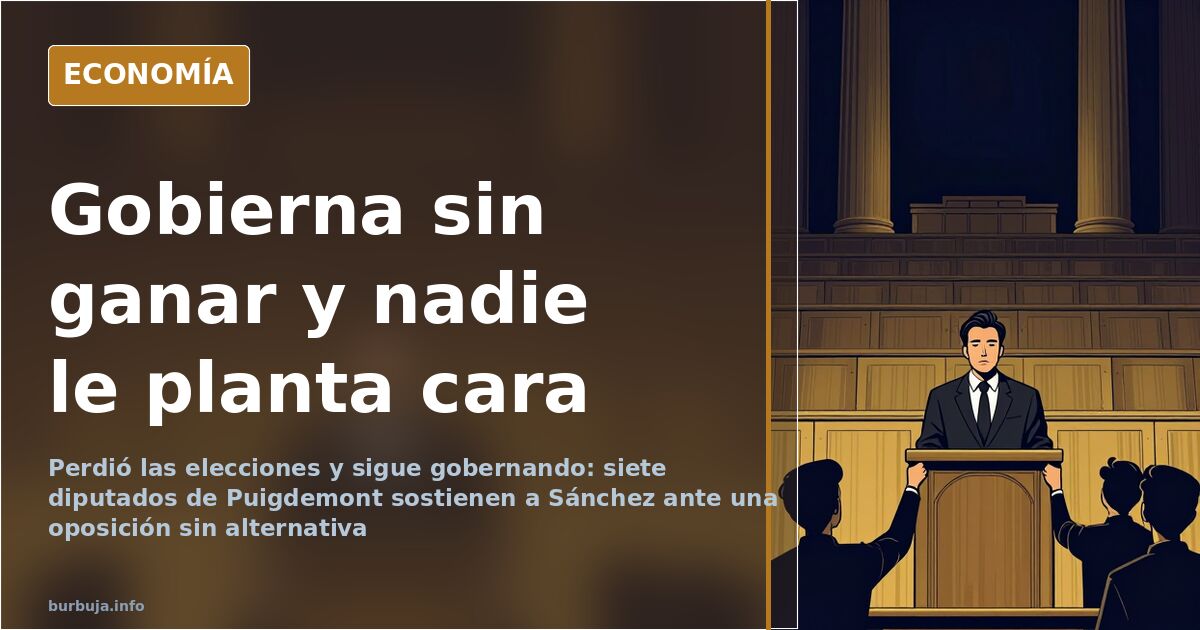
Seven MPs sustain Sánchez, who sustains the narrative
He lost the election yet still governs from La Moncloa. This is the starting point for the thesis vigorously defended at the beginning of the discussion: Sánchez does not rule by majority, but because his investiture hangs on a handful of foreign seats. And from there to the label of invincible is just one step. Deep down, the debate isn't about whether he is liked. It is about whether his advantage stems from talent, system, or simply others' mediocrity.
Why is Pedro Sánchez called the invincible politician?
Because the balance attributed to him is hard to dispute: he governs without winning, has survived an adverse cycle, and maintains intact control of his party. He is described as a strategist who understood before anyone else that Spanish politics is played in the short term and in each week's agenda. Some go further, comparing him to an advanced student of Machiavelli, a predator of negotiation, or even someone capable of resurrecting Franco from the grave. Others, with less epic tone, argue he arrived on terrain where no one knows how to play.
The most cited episode is the debates: the image of a comfortable president, laughing in the face of the PP leader before millions of viewers. From this, a widely circulated idea emerges: that the rival not only lost, but was left battered.
Susana Díaz, Podemos, IU, and the PP: A List of Fallen Rivals
The inventory repeats with accountant-like precision. Within the PSOE, the liquidation of the old guard and the Andalusian president who then concentrated power and influence, described as the Ayuso of the PSOE. Outside, the disappearance of Podemos as an autonomous force, the collapse of Izquierda Unida, and three PP leaders—Rajoy, Casado, and, according to this reading, Feijóo—crushed.
There is a more cynical version of the same story: the PP would have collaborated. It is argued that the Popular Party catapulted a leader without trade, let the moment pass, and that whoever loses against the weakest adversary in their history cannot later blame the winner. If the merit belongs to Sánchez, responsibility for the result would be shared.
The Amnesty Law: What Crime Is Alleged and Why No One Cites the Article
Here the conversation stops being strategic and enters legal territory, where positions become entrenched. The president is accused of committing a crime by promoting the amnesty law, but when specificity is requested—which article of the Penal Code and what penalty—the response shifts to other matters. On the other side, the answer is the same: without an identified incivil type, the dispute is political, not procedural.
It is worth being precise: these accusations are charges without final conviction, and much of them rely on interpretations. What is clear is the effect: the measure worked as cement for the legislature and as fuel for the opposition, all at once. No one, on either side, has put the exact number on the table.
The Uncomfortable Argument: The Opposition Also Fabricates the Invincible
Half the thesis suggests that merit, if it exists, is relative. In the land of the blind, the one-eyed man is king, summarizes one of the most repeated formulations: criticism is leveled at the oratory, capacity, and instinct of those who should stand up to him, adding that the opposing space entered this cycle with dirty laundry aired out and a candidate accused of not measuring up.
To this is added a psychological ingredient that appears again and again: whoever lacks ethical brakes competes with an advantage, at least for a time. The warning accompanying this idea is always the same: the advantage runs out when you find someone worse than you or when the misstep arrives. The Ides of March, parliamentary version. The phrase well summarizes the mood: the winner doesn't convince, but there is no credible alternative opposite.
Puigdemont, Seven Deputies, and the Investiture Bill
There is a current view considering that the true winner of this whole show is not in La Moncloa. The former Catalan president, who has lived in Belgium for around five years, has something no other actor has: seven indispensable seats and the ability to condition the Executive's agenda. He is credited with breaking all rules and coming out winning in every bout, with a return to Spain and hero's welcome as a probable scenario.
The counterweight is reasonable: if Junts breaks away, who does he negotiate with? The arithmetic of the Congress leaves few doors open. That pincer—a costly partner and an irreplaceable partner—is the true architecture of power in this legislature.
Pending Wear: Succession, Electoral Cycle, and a Post in Europe
No one in this analysis believes the story ends tomorrow. There is speculation about decades-long permanence, with the idea of a rival who never appears and a party that, the day he leaves, becomes a wasteland. Also circulating is the hypothesis of a high-level future European institutional role for the president.
In the column of costs, attention is drawn to calendar management: the minimum wage increase placed six months before elections, mobilizing antiestéticar of the radical adversary as a tool for useful voting, and interest in keeping the far-right as an uncomfortable ally of the right, so they can never add up. Some call it strategy; others call it simple opportunism. The result, for now, is the same.
With these materials, the narrative of the invincible has an uncomfortable explanation: it works because there is no one opposite to debunk it. Will the script change when the electoral calendar tightens, or are we simply facing the winner of a league without worthy rivals?
He lost the election yet still governs from La Moncloa. This is the starting point for the thesis vigorously defended at the beginning of the discussion: Sánchez does not rule by majority, but because his investiture hangs on a handful of foreign seats. And from there to the label of invincible is just one step. Deep down, the debate isn't about whether he is liked. It is about whether his advantage stems from talent, system, or simply others' mediocrity.
Why is Pedro Sánchez called the invincible politician?
Because the balance attributed to him is hard to dispute: he governs without winning, has survived an adverse cycle, and maintains intact control of his party. He is described as a strategist who understood before anyone else that Spanish politics is played in the short term and in each week's agenda. Some go further, comparing him to an advanced student of Machiavelli, a predator of negotiation, or even someone capable of resurrecting Franco from the grave. Others, with less epic tone, argue he arrived on terrain where no one knows how to play.
The most cited episode is the debates: the image of a comfortable president, laughing in the face of the PP leader before millions of viewers. From this, a widely circulated idea emerges: that the rival not only lost, but was left battered.
Susana Díaz, Podemos, IU, and the PP: A List of Fallen Rivals
The inventory repeats with accountant-like precision. Within the PSOE, the liquidation of the old guard and the Andalusian president who then concentrated power and influence, described as the Ayuso of the PSOE. Outside, the disappearance of Podemos as an autonomous force, the collapse of Izquierda Unida, and three PP leaders—Rajoy, Casado, and, according to this reading, Feijóo—crushed.
There is a more cynical version of the same story: the PP would have collaborated. It is argued that the Popular Party catapulted a leader without trade, let the moment pass, and that whoever loses against the weakest adversary in their history cannot later blame the winner. If the merit belongs to Sánchez, responsibility for the result would be shared.
The Amnesty Law: What Crime Is Alleged and Why No One Cites the Article
Here the conversation stops being strategic and enters legal territory, where positions become entrenched. The president is accused of committing a crime by promoting the amnesty law, but when specificity is requested—which article of the Penal Code and what penalty—the response shifts to other matters. On the other side, the answer is the same: without an identified incivil type, the dispute is political, not procedural.
It is worth being precise: these accusations are charges without final conviction, and much of them rely on interpretations. What is clear is the effect: the measure worked as cement for the legislature and as fuel for the opposition, all at once. No one, on either side, has put the exact number on the table.
The Uncomfortable Argument: The Opposition Also Fabricates the Invincible
Half the thesis suggests that merit, if it exists, is relative. In the land of the blind, the one-eyed man is king, summarizes one of the most repeated formulations: criticism is leveled at the oratory, capacity, and instinct of those who should stand up to him, adding that the opposing space entered this cycle with dirty laundry aired out and a candidate accused of not measuring up.
To this is added a psychological ingredient that appears again and again: whoever lacks ethical brakes competes with an advantage, at least for a time. The warning accompanying this idea is always the same: the advantage runs out when you find someone worse than you or when the misstep arrives. The Ides of March, parliamentary version. The phrase well summarizes the mood: the winner doesn't convince, but there is no credible alternative opposite.
Puigdemont, Seven Deputies, and the Investiture Bill
There is a current view considering that the true winner of this whole show is not in La Moncloa. The former Catalan president, who has lived in Belgium for around five years, has something no other actor has: seven indispensable seats and the ability to condition the Executive's agenda. He is credited with breaking all rules and coming out winning in every bout, with a return to Spain and hero's welcome as a probable scenario.
The counterweight is reasonable: if Junts breaks away, who does he negotiate with? The arithmetic of the Congress leaves few doors open. That pincer—a costly partner and an irreplaceable partner—is the true architecture of power in this legislature.
Pending Wear: Succession, Electoral Cycle, and a Post in Europe
No one in this analysis believes the story ends tomorrow. There is speculation about decades-long permanence, with the idea of a rival who never appears and a party that, the day he leaves, becomes a wasteland. Also circulating is the hypothesis of a high-level future European institutional role for the president.
In the column of costs, attention is drawn to calendar management: the minimum wage increase placed six months before elections, mobilizing antiestéticar of the radical adversary as a tool for useful voting, and interest in keeping the far-right as an uncomfortable ally of the right, so they can never add up. Some call it strategy; others call it simple opportunism. The result, for now, is the same.
With these materials, the narrative of the invincible has an uncomfortable explanation: it works because there is no one opposite to debunk it. Will the script change when the electoral calendar tightens, or are we simply facing the winner of a league without worthy rivals?
Summary of a discussion on Burbuja.info - Foro de economía, actualidad y política., translated from Spanish and reviewed before publication. Read the full discussion (194 replies).
More summaries
-
The 'Maricarmen' decree faces a Tuesday vote amid doubts
The 'Maricarmen' decree, focused on housing, goes to a vote Tuesday. Old rents, Junts, omnibus bills, and planned applause...
-
Negocios TV Alert Claims Explosions in Frankfurt
An unverified alert suggests explosions shook Frankfurt center; the European Central Bank (ECB) is mentioned without confirmation.
-
Sibila Freijo: Smart Women Prefer Younger Men
Spanish author Sibila Freijo argues that intelligent women are attracted to younger men, criticizing the double standard applied to actress Aitana Sánchez-Gijón.
-
Julio Iglesias faces sexual assault allegations from former staff
Two former employees accuse Julio Iglesias of sexual assault. Unproven testimonies reignite debate on presumption of innocence in Spain.
-
Cold White LEDs Erase Warm City Lights
Replacing sodium lamps with cold white LEDs transforms urban nights, reducing warmth and increasing light pollution.
-
Mónica Naranjo’s Faith Remarks Spark Viral Conversion Narrative
A 50-second clip of Mónica Naranjo expressing trust in God fuels claims of a religious conversion that the video itself does not support.