
EU gas crisis and nuclear risks after Ukraine annexation
Analysis of the EU's energy dependency and Russia's strategic shift following the annexation of four Ukrainian regions.
English · Original discussion in Spanish · Published
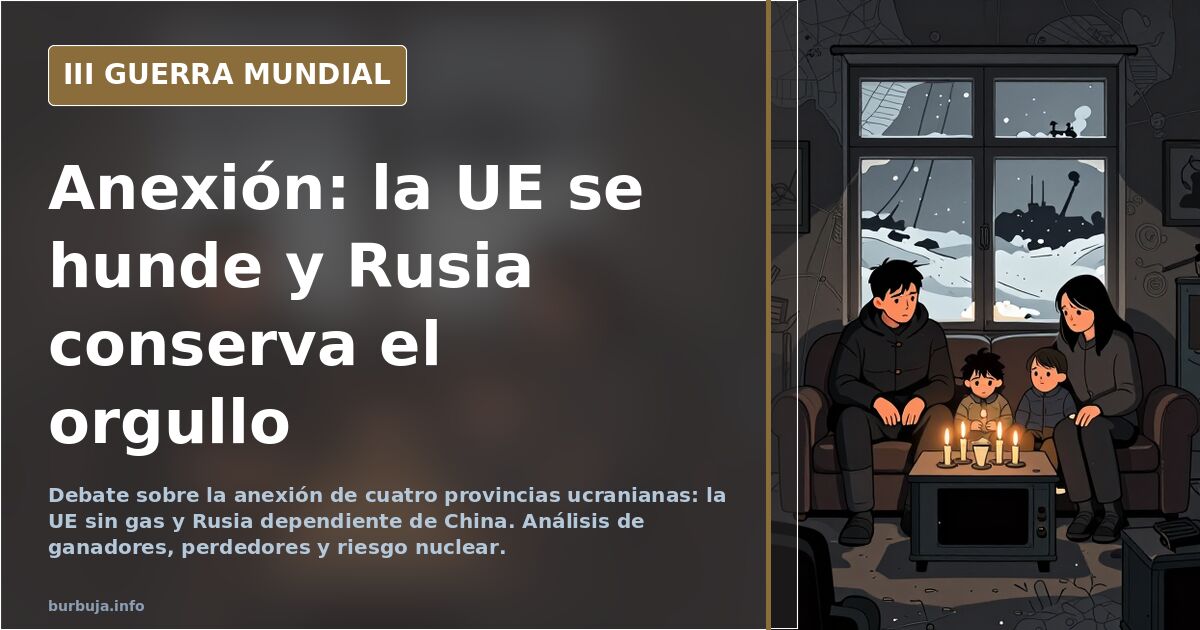
Annexation of four provinces: The move that leaves the EU without gas
The opening message made it clear from the first line: "the 4 Ukrainian provinces have already become part of Russia." From there, the discussion shifted to an uncomfortable question: did any of this achieve anything? The answer emerging from cooler analyses is that the outcome is not measured on the map of Ukraine, but in Europe's energy bills and the dependency the Old Continent will carry for years. The annexation formalizes control over the country's most important industrial and agricultural zone, including lithium and metal reserves, and access to the Sea of Azov. For Moscow, the cost has been a long military campaign and isolation pushing it into China's embrace. For Europe, the price is different: the loss of cheap Russian gas and a recession some already compare to a hemorrhoid crisis.
The division of winners and losers
The first current of analysis argues that Russia keeps the territory but mortgages its future. "Russia retains national pride, though who knows what the campaign has cost them," notes the initial premise. The most optimistic calculation for Moscow highlights that it annexes the industrial and mining zone, with one of the world's largest lithium reserves, and that China and India, although buying cheaper, are increasing their purchase volume. The pessimistic scenario starts from the idea that Russia has lost under all perspectives and is condemned to an arms escalation that will ruin it again.
On the European side, the consensus is more bitter. The EU appears as the big loser, with a "suicidal stupidity" unparalleled in history, according to the thesis of the opening message. Energy dependency becomes the crux of the problem: without gas for winter, the continent faces irreversible impoverishment while continuing to enjoy the Anglo media apparatus. Some summarize it with irony: "I predict cheap apartments, taxis, and very cheap prostitutes. That said, rice with potato omelet for at least 2-3 years."
Does the war end or intensify?
The prediction from the opening message is that things will start to cool down. The annexation, in that reading, would be the step to consolidate conquered ground and force an armistice where Ukraine ends up swallowing hard. But not everyone shares that script. "If the war's objective were Donbass, it would end today, but what caused the war has nothing to do with that, so it will continue and intensify," points out another analysis. The idea that Kyiv accepts mutilation in exchange for peace clashes with the resistance observed on the ground.
The nuclear scenario appears and disappears in the conversation. For some, if there is a risk of military defeat, Russia will resort to tactical nuclear weapons and NATO will limit itself to a conventional retaliatory strike. For others, nuclear weapons serve as a threat, but once used, all deterrent power is lost. The annexation, in any case, changes the legal framework: from now on, attacking those provinces means attacking Russian territory, which raises the risk of escalation.
The role of the United States and European wear
The thesis that the US and China are the biggest winners runs throughout the discussion. Americans would have wanted a subdued Russia since the 90s, like Japan or Germany, and the war serves them to reinforce their strategic and economic power. "The Anglo empire sought to isolate Russia from the rest of Europe by reinforcing its strategic and economic power. In that sense, it also fully achieved its objectives," summarizes one of the most valued interventions.
Europe remains as a protectorate bearing the cost. The lingering question is whether voters can change anything. "Do you think the global financial elite will leave their plans in the hands of what voters put on ballots?" asks one commenter with sarcasm. The answer, in the general tone, is no.
The shadow of the pandemic and social control
The discussion repeatedly derives toward parallels with the management of ELbichito. "Look, coincidentally, the same ones win as in the first phase of the ELbichito farce," one user points out. The theory that the ultimate goal was mass global vaccination and that benefits are now being collected slips into the exchange, although without supporting evidence. It is mentioned that the major shareholders of pharmaceutical companies are also those of large telecoms and that BlackRock and Vanguard together accumulate $17 trillion in assets. These are claims circulating without independent verification.
The background is distrust towards elites and towards a system that, according to several voices, has stopped responding to the interests of the population. "Elites have been killing each other for a long time. There is a power vacuum," one intervention states. The annexation would be, in that reading, just another episode of a game directed from outside.
The immediate future: armistice or escalation
The two alternatives considered are clear: either the war intensifies and flirts with the nuclear scenario, or the US begins to pressure Zelensky to accept an agreement. The EU, meanwhile, is left without gas and with a bill it will pay for years. "Our suicidal stupidity is unparalleled in history," concludes the message that peine the thread. The disorienting fact is that, despite everything, the annexation has been formalized with referendums and paperwork while bombs keep falling. Russian bureaucracy, which admires formalisms so much, has found a way to annex territory in the middle of a war. The rest is economics.
The opening message made it clear from the first line: "the 4 Ukrainian provinces have already become part of Russia." From there, the discussion shifted to an uncomfortable question: did any of this achieve anything? The answer emerging from cooler analyses is that the outcome is not measured on the map of Ukraine, but in Europe's energy bills and the dependency the Old Continent will carry for years. The annexation formalizes control over the country's most important industrial and agricultural zone, including lithium and metal reserves, and access to the Sea of Azov. For Moscow, the cost has been a long military campaign and isolation pushing it into China's embrace. For Europe, the price is different: the loss of cheap Russian gas and a recession some already compare to a hemorrhoid crisis.
The division of winners and losers
The first current of analysis argues that Russia keeps the territory but mortgages its future. "Russia retains national pride, though who knows what the campaign has cost them," notes the initial premise. The most optimistic calculation for Moscow highlights that it annexes the industrial and mining zone, with one of the world's largest lithium reserves, and that China and India, although buying cheaper, are increasing their purchase volume. The pessimistic scenario starts from the idea that Russia has lost under all perspectives and is condemned to an arms escalation that will ruin it again.
On the European side, the consensus is more bitter. The EU appears as the big loser, with a "suicidal stupidity" unparalleled in history, according to the thesis of the opening message. Energy dependency becomes the crux of the problem: without gas for winter, the continent faces irreversible impoverishment while continuing to enjoy the Anglo media apparatus. Some summarize it with irony: "I predict cheap apartments, taxis, and very cheap prostitutes. That said, rice with potato omelet for at least 2-3 years."
Does the war end or intensify?
The prediction from the opening message is that things will start to cool down. The annexation, in that reading, would be the step to consolidate conquered ground and force an armistice where Ukraine ends up swallowing hard. But not everyone shares that script. "If the war's objective were Donbass, it would end today, but what caused the war has nothing to do with that, so it will continue and intensify," points out another analysis. The idea that Kyiv accepts mutilation in exchange for peace clashes with the resistance observed on the ground.
The nuclear scenario appears and disappears in the conversation. For some, if there is a risk of military defeat, Russia will resort to tactical nuclear weapons and NATO will limit itself to a conventional retaliatory strike. For others, nuclear weapons serve as a threat, but once used, all deterrent power is lost. The annexation, in any case, changes the legal framework: from now on, attacking those provinces means attacking Russian territory, which raises the risk of escalation.
The role of the United States and European wear
The thesis that the US and China are the biggest winners runs throughout the discussion. Americans would have wanted a subdued Russia since the 90s, like Japan or Germany, and the war serves them to reinforce their strategic and economic power. "The Anglo empire sought to isolate Russia from the rest of Europe by reinforcing its strategic and economic power. In that sense, it also fully achieved its objectives," summarizes one of the most valued interventions.
Europe remains as a protectorate bearing the cost. The lingering question is whether voters can change anything. "Do you think the global financial elite will leave their plans in the hands of what voters put on ballots?" asks one commenter with sarcasm. The answer, in the general tone, is no.
The shadow of the pandemic and social control
The discussion repeatedly derives toward parallels with the management of ELbichito. "Look, coincidentally, the same ones win as in the first phase of the ELbichito farce," one user points out. The theory that the ultimate goal was mass global vaccination and that benefits are now being collected slips into the exchange, although without supporting evidence. It is mentioned that the major shareholders of pharmaceutical companies are also those of large telecoms and that BlackRock and Vanguard together accumulate $17 trillion in assets. These are claims circulating without independent verification.
The background is distrust towards elites and towards a system that, according to several voices, has stopped responding to the interests of the population. "Elites have been killing each other for a long time. There is a power vacuum," one intervention states. The annexation would be, in that reading, just another episode of a game directed from outside.
The immediate future: armistice or escalation
The two alternatives considered are clear: either the war intensifies and flirts with the nuclear scenario, or the US begins to pressure Zelensky to accept an agreement. The EU, meanwhile, is left without gas and with a bill it will pay for years. "Our suicidal stupidity is unparalleled in history," concludes the message that peine the thread. The disorienting fact is that, despite everything, the annexation has been formalized with referendums and paperwork while bombs keep falling. Russian bureaucracy, which admires formalisms so much, has found a way to annex territory in the middle of a war. The rest is economics.
Summary of a discussion on Burbuja.info - Foro de economía, actualidad y política., translated from Spanish and reviewed before publication. Read the full discussion (165 replies).
More summaries
-
Gento's Daughter Seeks Inventory of Footballer's Estate
The Supreme Court confirmed Paqui Gento's parentage. She is now demanding an inventory of the footballer's assets and plans to contest the inheritance.
-
Erdogan calls Israel occupier, denies Hamas is terrorist group
Erdogan labels Israel an occupier and rejects Hamas as terrorists while Turkey retains its NATO seat.
-
Cluster missile strike in Crimea kills three, including two children
Three dead, two children, and nearly 100 injured on a Crimean beach by ATACMS cluster missiles. Russia blames the US and promises retaliation.
-
Vox Seeks to Cut All Aid to NGOs Operating in Palestine
Vox proposes suspending aid to any NGO operating in Palestine. The measure divides its electorate and opens debate on the EU's double standards regarding...
-
Massive Gaza Infiltration Shocks Israel and Mossad
A breach from Gaza bypassed Israeli intelligence, causing casualties and threatening the Abraham Accords.
-
Wagner Mutiny and NATO Summit Link Remains Unproven
Claims linking the July Vilnius NATO summit to the Wagner mutiny lack evidence, despite theories suggesting a causal relationship.