
Cluster missile strike in Crimea kills three, including two children
Three dead, two children, and nearly 100 injured on a Crimean beach by ATACMS cluster missiles. Russia blames the US and promises retaliation.
English · Original discussion in Spanish · Published
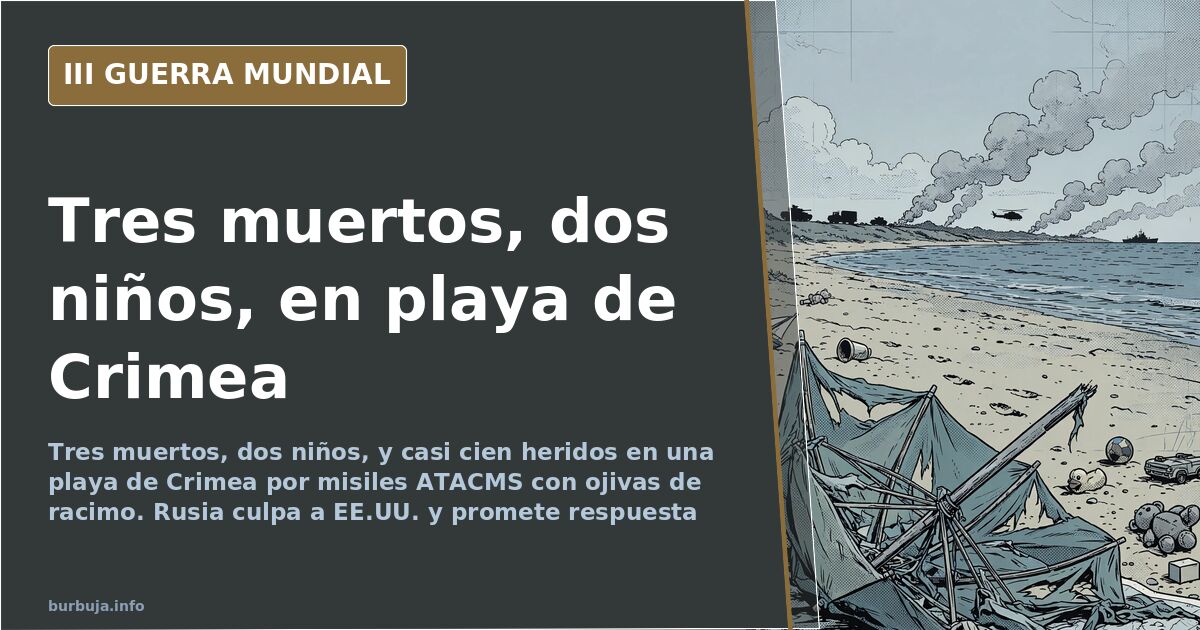
Three dead and nearly 100 injured on a Crimean beach by cluster missiles
The attack occurred at noon in a bathing area of Sevastopol. According to local authorities, five US-made ATACMS missiles with cluster warheads struck a beach. The toll: three dead, two of them children, and nearly a hundred injured. The Russian Ministry of Defense described the incident as a "deliberate terrorist attack" and directly blamed the United States for supplying the weapons. Subsequent debate has focused on whether the beach was a legitimate military target, NATO's role, and if the attack is part of a provocation strategy.
The attack: cluster missiles against a beach
Initial reports describe the impact of cluster munitions on a civilian area. It is mentioned that a US RQ-4B Global Hawk drone allegedly coordinated the attack from the Black Sea, a theory repeated throughout the discussion. Local governor Mikhail Razvozhayev raised the death toll to three and injuries to nearly one hundred. The Russian Ministry of Defense promised reprisals and attributed primary responsibility to Washington for providing the ATACMS.
The discussion quickly shifts to the use of Western weaponry. Arguments suggest these systems are designed to saturate defenses and, when used against military targets, are detected and destroyed rapidly. Therefore, it is claimed, civilian targets are prioritized where defensive response is more difficult. This thesis appears in several messages, though no evidence beyond the attack itself is provided.
Was the beach a legitimate military target?
Some participants argue that anyone in territory considered occupied is a legitimate target. The argument: Crimea was annexed by Russia a decade ago and those present are in a war zone. "If you go on holiday to a war zone because your country stole it from another ten years ago, accept the consequences," summarizes one intervention. Others counter that this involves civilians and labeling all residents as military targets turns any attack into an execution.
Contrasts with other attacks are constant. Bombings on Kharkiv causing dozens of injuries and three deaths are cited to show violence affects both sides. The discussion gets tangled in whether some civilians are more innocent than others, a point where no one yields.
NATO's role and escalation risk
The thread insists that the attack was coordinated by the United States via a reconnaissance drone. From there, debate opens on Russia's response. Some call for strikes against Western "big fish," while others warn that direct retaliation against NATO would lead to nuclear conflict. "The mistake will be a nuclear war, which is what they will find if they start a direct war," notes one message.
The discussion also addresses the fate of public funds. Criticism arises that Western taxes finance armaments resulting in attacks with civilian victims, while public attention is distracted by other issues. Irony about the "party" and football appears as a counterpoint.
Cross accusations and ground rumors
Accusations emerge that the attack is staged or that Russian air defenses caused the casualties. There is no independent verification in the material. The case of former Ukrainian Human Rights Commissioner, Liudmila Denisova, is also mentioned; according to a tweet, she allegedly admitted to Russian pranksters that she was asked to spread fake news about Russian crimes. This episode is used to question the credibility of official Ukrainian versions.
In parallel, debate continues on whether Crimea's residents are "occupiers" or "abducted citizens," depending on the narrative. The discussion becomes an exchange of labels where the civilian population takes a back seat.
What is known and what is not
The official toll available at the time of discussion is three dead—two minors—and nearly a hundred injured. The attack involved US-manufactured ATACMS missiles with cluster warheads, according to Russian authorities. Material authorship is attributed to Ukrainian forces; US coordination is a Russian accusation without independent confirmation in the material. No explicit claim of responsibility is recorded here.
The conversation does not reach consensus on the legitimacy of the target or the consequences. What remains clear is that the use of cluster munitions against a civilian area has peine the debate on the limits of Western military aid and who pays the price for a war increasingly fought against the population.
The attack occurred at noon in a bathing area of Sevastopol. According to local authorities, five US-made ATACMS missiles with cluster warheads struck a beach. The toll: three dead, two of them children, and nearly a hundred injured. The Russian Ministry of Defense described the incident as a "deliberate terrorist attack" and directly blamed the United States for supplying the weapons. Subsequent debate has focused on whether the beach was a legitimate military target, NATO's role, and if the attack is part of a provocation strategy.
The attack: cluster missiles against a beach
Initial reports describe the impact of cluster munitions on a civilian area. It is mentioned that a US RQ-4B Global Hawk drone allegedly coordinated the attack from the Black Sea, a theory repeated throughout the discussion. Local governor Mikhail Razvozhayev raised the death toll to three and injuries to nearly one hundred. The Russian Ministry of Defense promised reprisals and attributed primary responsibility to Washington for providing the ATACMS.
The discussion quickly shifts to the use of Western weaponry. Arguments suggest these systems are designed to saturate defenses and, when used against military targets, are detected and destroyed rapidly. Therefore, it is claimed, civilian targets are prioritized where defensive response is more difficult. This thesis appears in several messages, though no evidence beyond the attack itself is provided.
Was the beach a legitimate military target?
Some participants argue that anyone in territory considered occupied is a legitimate target. The argument: Crimea was annexed by Russia a decade ago and those present are in a war zone. "If you go on holiday to a war zone because your country stole it from another ten years ago, accept the consequences," summarizes one intervention. Others counter that this involves civilians and labeling all residents as military targets turns any attack into an execution.
Contrasts with other attacks are constant. Bombings on Kharkiv causing dozens of injuries and three deaths are cited to show violence affects both sides. The discussion gets tangled in whether some civilians are more innocent than others, a point where no one yields.
NATO's role and escalation risk
The thread insists that the attack was coordinated by the United States via a reconnaissance drone. From there, debate opens on Russia's response. Some call for strikes against Western "big fish," while others warn that direct retaliation against NATO would lead to nuclear conflict. "The mistake will be a nuclear war, which is what they will find if they start a direct war," notes one message.
The discussion also addresses the fate of public funds. Criticism arises that Western taxes finance armaments resulting in attacks with civilian victims, while public attention is distracted by other issues. Irony about the "party" and football appears as a counterpoint.
Cross accusations and ground rumors
Accusations emerge that the attack is staged or that Russian air defenses caused the casualties. There is no independent verification in the material. The case of former Ukrainian Human Rights Commissioner, Liudmila Denisova, is also mentioned; according to a tweet, she allegedly admitted to Russian pranksters that she was asked to spread fake news about Russian crimes. This episode is used to question the credibility of official Ukrainian versions.
In parallel, debate continues on whether Crimea's residents are "occupiers" or "abducted citizens," depending on the narrative. The discussion becomes an exchange of labels where the civilian population takes a back seat.
What is known and what is not
The official toll available at the time of discussion is three dead—two minors—and nearly a hundred injured. The attack involved US-manufactured ATACMS missiles with cluster warheads, according to Russian authorities. Material authorship is attributed to Ukrainian forces; US coordination is a Russian accusation without independent confirmation in the material. No explicit claim of responsibility is recorded here.
The conversation does not reach consensus on the legitimacy of the target or the consequences. What remains clear is that the use of cluster munitions against a civilian area has peine the debate on the limits of Western military aid and who pays the price for a war increasingly fought against the population.
Summary of a discussion on Burbuja.info - Foro de economía, actualidad y política., translated from Spanish and reviewed before publication. Read the full discussion (163 replies).
More summaries
-
US strikes Iranian nuclear sites with 14 GBU-57 bombs
The US dropped 12 GBU-57 bombs on Fordow and 2 on Natanz, uranium enrichment facilities buried 80-90 meters deep in solid rock.
-
Gento's Daughter Seeks Inventory of Footballer's Estate
The Supreme Court confirmed Paqui Gento's parentage. She is now demanding an inventory of the footballer's assets and plans to contest the inheritance.
-
Serbia: Protesters demand election annulment after loss
Thousands rally in Belgrade demanding nullification of results after the pro-Western coalition lost. The pattern mirrors events seen in Ukraine.
-
US pressures Mexico as China gains influence
A quote attributed to Senator John Kennedy sparks debate over US-China rivalry for influence in Latin America.
-
Spanish Army Drops Minimum Height Requirement for Recruits
Spain's Defense Ministry removes height limits for military entry, shifting debate to low pay, conscription trends, and mobilization concerns.
-
Spanish Jews report rising fear of antisemitism
FCJE reports a surge in antisemitism in Spain, citing statements by Belarra and Díaz as constitutive of the hate.