
EU considers raising peak glyphosate limits in water
While the annual 0.1 µg/l limit for glyphosate remains, a new proposal aims to increase allowable short-term spikes in water supplies.
English · Original discussion in Spanish · Published
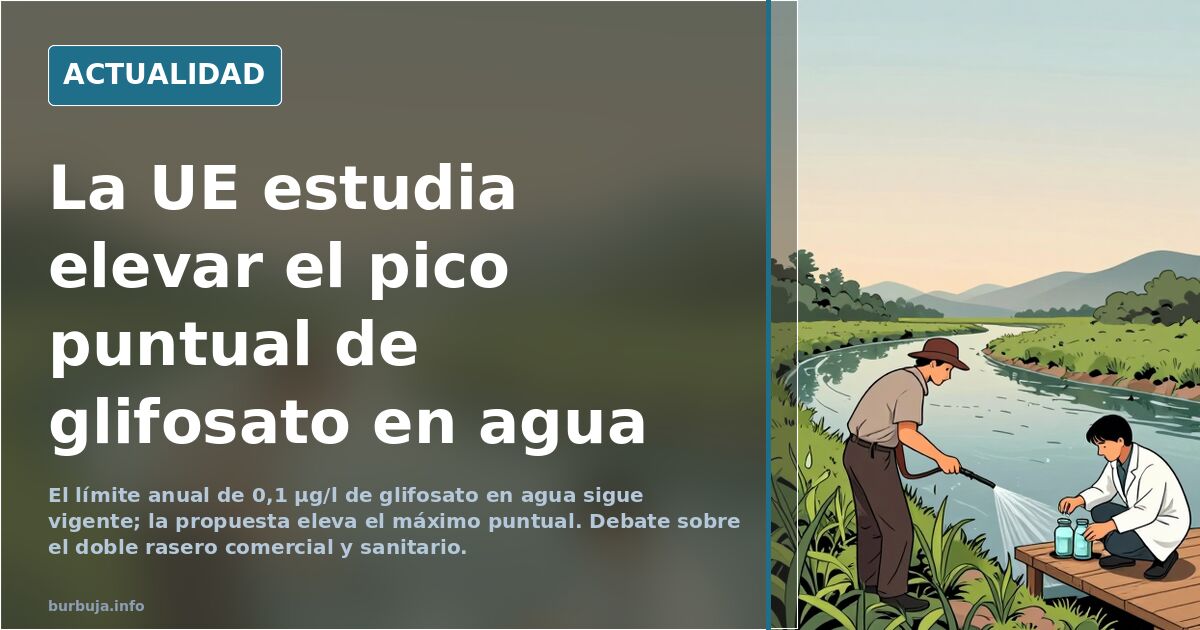
EU considers raising peak glyphosate limits in water
How much glyphosate can be in a glass of water before it is no longer potable? The figure currently circulating in Brussels comes with a catch: the 0.1 microgram per litre limit that has governed the EU for decades remains in place as an annual average, but the proposal under discussion would increase the maximum allowable short-term spike by up to 4,000 times. In other words, a river passing by a recently sprayed farm could see a massive spike on a specific day and still be deemed compliant. This news has come as a shock to those who have spent years scrutinizing every regulation issued by the European Commission.
The timing is crucial: the discussion takes place within the context of renewing glyphosate's authorization in the EU and ongoing trade negotiations with Mercosur, two fronts that appear intertwined in the material. The proposal has not been formally approved, a nuance often lost in most headlines.
What the regulation actually says and does not say
The first common misconception is believing that Brussels has lifted the ban. That is not the case. The 0.1 microgram per litre annual average limit remains in effect and applies only to water intended for human consumption. What changes is the maximum allowable short-term peak: the day after spraying, a watercourse may record high values without being in breach. Some argue this is a de facto loosening of rules, while others counter that the annual average remains the real criterion for compliance.
Confusion between glyphosate in water and glyphosate in food is another source of noise. These are two distinct regulatory frameworks with different limits and different authorities. Mixing them up leads to sensationalist headlines and flawed analyses.
The health argument: cancer, lymphoma, and the DDT precedent
This is where the ground becomes slippery. The material claims there is a risk of leukemia and lymphoma associated with glyphosate, recalling that DDT was considered safe for 33 years before it was not. This parallel is powerful but also tricky: the regulatory history of one compound does not dictate the future of another.
What is certain is that the IARC's classification of glyphosate as a probable carcinogen, contrasted with the positions of other agencies, remains an open scientific debate. An article cannot resolve this, and any headline that claims to do so is misleading.
Mercosur, imports, and the commercial double standard
One of the most frequent arguments is that relaxing water limits is a precursor to an influx of imported products containing pesticides banned in Europe. The logic is simple: if water controls are loosened, the ground is paved to accept what arrives from abroad. This is a hypothesis rather than a proven fact, but it aligns with the current negotiation schedule.
The counterargument is that residue limits in imported food are independent of water limits, and that the EU maintains border controls. Neither position has been fully settled.
What can be done at home (and what is useless)
Among the most useful points in the material is one that deserves highlighting: according to cited studies, reverse osmosis removes glyphosate from water with nearly 100% efficiency, as does nanofiltration. This is the most practical piece of information in the whole matter, yet it is the least repeated.
The problem is elsewhere: PFAS, the so-called "forever chemicals," are in the water, in food, and in the human body itself, and there is no domestic filter that can eliminate them on a real scale. Teflon is just the tip of the iceberg of a chemical family that no one knows how to replace. For that, no amount of osmosis will help.
Ultimately, the question is not whether glyphosate is bad. The question is how much of what is being discussed in Brussels is based on scientific criteria and how much is driven by trade calendars. And that answer, as is almost always the case, is not found in the regulation.
How much glyphosate can be in a glass of water before it is no longer potable? The figure currently circulating in Brussels comes with a catch: the 0.1 microgram per litre limit that has governed the EU for decades remains in place as an annual average, but the proposal under discussion would increase the maximum allowable short-term spike by up to 4,000 times. In other words, a river passing by a recently sprayed farm could see a massive spike on a specific day and still be deemed compliant. This news has come as a shock to those who have spent years scrutinizing every regulation issued by the European Commission.
The timing is crucial: the discussion takes place within the context of renewing glyphosate's authorization in the EU and ongoing trade negotiations with Mercosur, two fronts that appear intertwined in the material. The proposal has not been formally approved, a nuance often lost in most headlines.
What the regulation actually says and does not say
The first common misconception is believing that Brussels has lifted the ban. That is not the case. The 0.1 microgram per litre annual average limit remains in effect and applies only to water intended for human consumption. What changes is the maximum allowable short-term peak: the day after spraying, a watercourse may record high values without being in breach. Some argue this is a de facto loosening of rules, while others counter that the annual average remains the real criterion for compliance.
Confusion between glyphosate in water and glyphosate in food is another source of noise. These are two distinct regulatory frameworks with different limits and different authorities. Mixing them up leads to sensationalist headlines and flawed analyses.
The health argument: cancer, lymphoma, and the DDT precedent
This is where the ground becomes slippery. The material claims there is a risk of leukemia and lymphoma associated with glyphosate, recalling that DDT was considered safe for 33 years before it was not. This parallel is powerful but also tricky: the regulatory history of one compound does not dictate the future of another.
What is certain is that the IARC's classification of glyphosate as a probable carcinogen, contrasted with the positions of other agencies, remains an open scientific debate. An article cannot resolve this, and any headline that claims to do so is misleading.
Mercosur, imports, and the commercial double standard
One of the most frequent arguments is that relaxing water limits is a precursor to an influx of imported products containing pesticides banned in Europe. The logic is simple: if water controls are loosened, the ground is paved to accept what arrives from abroad. This is a hypothesis rather than a proven fact, but it aligns with the current negotiation schedule.
The counterargument is that residue limits in imported food are independent of water limits, and that the EU maintains border controls. Neither position has been fully settled.
What can be done at home (and what is useless)
Among the most useful points in the material is one that deserves highlighting: according to cited studies, reverse osmosis removes glyphosate from water with nearly 100% efficiency, as does nanofiltration. This is the most practical piece of information in the whole matter, yet it is the least repeated.
The problem is elsewhere: PFAS, the so-called "forever chemicals," are in the water, in food, and in the human body itself, and there is no domestic filter that can eliminate them on a real scale. Teflon is just the tip of the iceberg of a chemical family that no one knows how to replace. For that, no amount of osmosis will help.
Ultimately, the question is not whether glyphosate is bad. The question is how much of what is being discussed in Brussels is based on scientific criteria and how much is driven by trade calendars. And that answer, as is almost always the case, is not found in the regulation.
Also available in: Deutsch
Summary of a discussion on Burbuja.info - Foro de economía, actualidad y política., translated from Spanish and reviewed before publication. Read the full discussion (102 replies).
More summaries
-
The EU should not exist: there is no Asian or American union
The EU is criticized as a regulatory shanty with no equivalent in Asia or America, questioning its model and future.
-
Four arrested after Danish tourist killed in Fuerteventura
A Danish tourist was killed in Fuerteventura after being attacked with an iron beam during a mobile phone robbery. Four suspects have been detained.
-
Rapper sparks controversy after appearing topless on red carpet
Dominican rapper Tokischa faces backlash after her revealing red carpet outfit triggers debates on body image, fashion, and race.
-
Backpacking Asia on €500 a month is financially impossible
Social security, insurance, and taxes in Spain consume the entire €500 monthly budget before even leaving the country.
-
Indian Government reviews airport wheelchair requests amid surge in bookings
The Indian Government is auditing airport wheelchair requests following a spike in bookings, with Air India reporting high demand on international flights.
-
Debate erupts over growing Christian population in Israel
The debate highlights that Israel's Christian population rose from 180,000 to 185,000 in one year, making it a unique case in the region.