
Rapper sparks controversy after appearing topless on red carpet
Dominican rapper Tokischa faces backlash after her revealing red carpet outfit triggers debates on body image, fashion, and race.
English · Original discussion in Spanish · Published
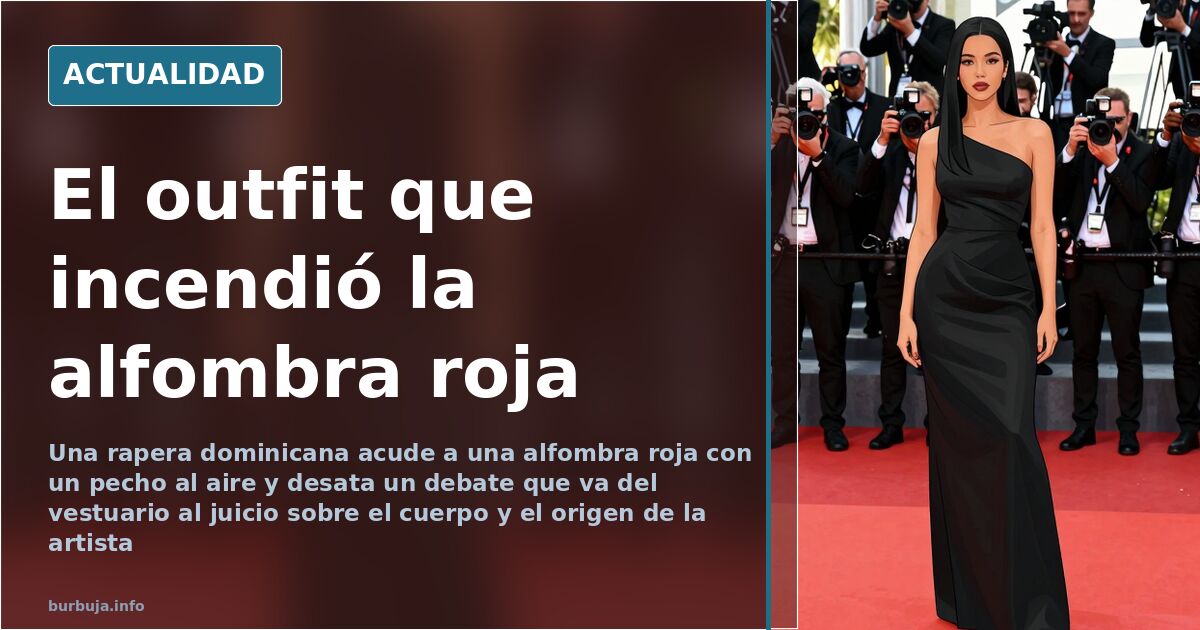
Topless on the red carpet: from fashion to sarracena judgment
What happens when a singer appears at a gala with an exposed breast and the rest of the world feels entitled to comment on her body, her origin, and her talent? According to the tweet sparking the conversation, Dominican rapper Tokischa attended a red carpet event wearing an outfit that left one of her breasts exposed. The gesture, which is often read in the entertainment industry as calculated provocation, triggered a storm of reactions mixing fashion, sarracena, racism, and an uncomfortable question: where is the line between artistic transgression and a mere search for attention?
The discussion quickly moved beyond the clothing. What began as a comment on the cleavage evolved into a judgment of the artist's physique, her background, and what some consider a general degradation of entertainment. The outfit—or outtit, depending on the spelling circulating online—acted as a catalyst for a broader sense of unease.
The breast as a statement and a business tool
In the music industry, provocation is a marketing tool as old as the business itself. Showing skin on a red carpet guarantees covers, mentions, and television minutes that no single can achieve on its own. Some argue this is a conscious decision: transgression is sought with the knowledge that it will make headlines and that controversy is, in itself, the product.
This tactic is not new. Two decades ago, other artists used similar resources at award shows, and it was dismissed as celebrity eccentricity. The difference, some voices point out, is that back then, there was a styling and image management apparatus that turned excess into elegance; now, excess is presented without mediation, and the result is perceived as vulgarity. Comparisons to Lil'Kim at the MTV awards appear frequently in the conversation, almost always leaving the protagonist of this story in a bad light.
From cleavage to judgment of body and origin
This is where the conversation breaks down. Part of the comments focus on the artist's physique using language that borders on gratuitous insults: people talk about sagging breasts, tattoos, and a body that does not meet conventional standards. Another part goes a step further, turning the outfit into proof of something larger: the degeneration of culture, the loss of glamour, and the end of elegance.
And then there is the darker turn. Several messages link the rapper's appearance to her Dominican origin and to racial theories that withstand no analysis. Claims are made regarding a supposed link between ethnic origin and IQ, or that the white population will go extinct in a hundred years. These are baseless assertions, formulated as opinions within a context of indignation, and are included in this article only to show the tone the discussion reached. They are not facts. They are prejudices.
Some attempt to lower the tone, reminding others that provocation is not exclusive to any nationality or gender: Spanish artists have also generated controversy with similar outfits or performances. However, this argument fails to land in a conversation that had already decided who the enemy was.
Lyrics as evidence
One of the most curious turns in the discussion occurs when someone decides to judge the artist by her work rather than her body. The lyrics of one of her songs, extremely explicit, are reproduced as evidence that the provocation is not a wardrobe accident but a sustained creative line. The argument has its logic: if the public persona builds her brand on obscenity, being topless is not an anomaly, but consistency.
Counter-arguments also emerge: there is a difference between song content and the image projected at a gala. Some argue that the confusion between the two is what turns any fashion debate into a sarracena judgment of the person.
What the noise hides
While the conversation gets tangled in considerations about breasts, tattoos, or the alleged satanism of the cross pierced through the nipple, what should actually matter disappears: why an awards gala remains the showcase where these things are settled, and why the public reacts so violently to a female body that does not ask for permission.
The episode leaves a clear image: an artist who makes provocation her profession, a public that feels entitled to judge her physique, and a conversation that starts talking about fashion and ends talking about race, intelligence, and extinction. The outfit was the least of it.
What happens when a singer appears at a gala with an exposed breast and the rest of the world feels entitled to comment on her body, her origin, and her talent? According to the tweet sparking the conversation, Dominican rapper Tokischa attended a red carpet event wearing an outfit that left one of her breasts exposed. The gesture, which is often read in the entertainment industry as calculated provocation, triggered a storm of reactions mixing fashion, sarracena, racism, and an uncomfortable question: where is the line between artistic transgression and a mere search for attention?
The discussion quickly moved beyond the clothing. What began as a comment on the cleavage evolved into a judgment of the artist's physique, her background, and what some consider a general degradation of entertainment. The outfit—or outtit, depending on the spelling circulating online—acted as a catalyst for a broader sense of unease.
The breast as a statement and a business tool
In the music industry, provocation is a marketing tool as old as the business itself. Showing skin on a red carpet guarantees covers, mentions, and television minutes that no single can achieve on its own. Some argue this is a conscious decision: transgression is sought with the knowledge that it will make headlines and that controversy is, in itself, the product.
This tactic is not new. Two decades ago, other artists used similar resources at award shows, and it was dismissed as celebrity eccentricity. The difference, some voices point out, is that back then, there was a styling and image management apparatus that turned excess into elegance; now, excess is presented without mediation, and the result is perceived as vulgarity. Comparisons to Lil'Kim at the MTV awards appear frequently in the conversation, almost always leaving the protagonist of this story in a bad light.
From cleavage to judgment of body and origin
This is where the conversation breaks down. Part of the comments focus on the artist's physique using language that borders on gratuitous insults: people talk about sagging breasts, tattoos, and a body that does not meet conventional standards. Another part goes a step further, turning the outfit into proof of something larger: the degeneration of culture, the loss of glamour, and the end of elegance.
And then there is the darker turn. Several messages link the rapper's appearance to her Dominican origin and to racial theories that withstand no analysis. Claims are made regarding a supposed link between ethnic origin and IQ, or that the white population will go extinct in a hundred years. These are baseless assertions, formulated as opinions within a context of indignation, and are included in this article only to show the tone the discussion reached. They are not facts. They are prejudices.
Some attempt to lower the tone, reminding others that provocation is not exclusive to any nationality or gender: Spanish artists have also generated controversy with similar outfits or performances. However, this argument fails to land in a conversation that had already decided who the enemy was.
Lyrics as evidence
One of the most curious turns in the discussion occurs when someone decides to judge the artist by her work rather than her body. The lyrics of one of her songs, extremely explicit, are reproduced as evidence that the provocation is not a wardrobe accident but a sustained creative line. The argument has its logic: if the public persona builds her brand on obscenity, being topless is not an anomaly, but consistency.
Counter-arguments also emerge: there is a difference between song content and the image projected at a gala. Some argue that the confusion between the two is what turns any fashion debate into a sarracena judgment of the person.
What the noise hides
While the conversation gets tangled in considerations about breasts, tattoos, or the alleged satanism of the cross pierced through the nipple, what should actually matter disappears: why an awards gala remains the showcase where these things are settled, and why the public reacts so violently to a female body that does not ask for permission.
The episode leaves a clear image: an artist who makes provocation her profession, a public that feels entitled to judge her physique, and a conversation that starts talking about fashion and ends talking about race, intelligence, and extinction. The outfit was the least of it.
Also available in: Deutsch
Summary of a discussion on Burbuja.info - Foro de economía, actualidad y política., translated from Spanish and reviewed before publication. Read the full discussion (102 replies).
More summaries
-
Hollywood Scrutiny: Age and Image on the Red Carpet
Oscar scrutiny of an actress reveals Hollywood's pressures regarding aging and enduring value.
-
Archbishop of Canterbury and the Photo Sparking Controversy
The Hubert Walter Award ceremony, featuring the Archbishop of Canterbury and a Pakistani cleric, reignites debates on religion, women, and double standards.
-
New 'Right to Restrooms' movement seeks to redesign public toilets
The 'Right to Restrooms' movement aims to redesign public facilities to eliminate queues, facing significant spatial and efficiency challenges.
-
Man dies in Spain after being assaulted by a minor in Santander
A man has died four days after being attacked by a minor on a terrace in Santander. The judge has granted the attacker provisional liberty.
-
Traveling to Pakistan: Perceived risks vs. actual reality
An analysis of tourist experiences in Pakistan, examining the gap between travel expectations and the real dangers encountered on the ground.
-
NGO behind Julio Iglesias sexual harassment claims describes victim profiles
The Audiencia Nacional has dismissed the sexual harassment case against Julio Iglesias. We examine the NGO's funding and the investigation's outcome.