
Indian Government reviews airport wheelchair requests amid surge in bookings
The Indian Government is auditing airport wheelchair requests following a spike in bookings, with Air India reporting high demand on international flights.
English · Original discussion in Spanish · Published
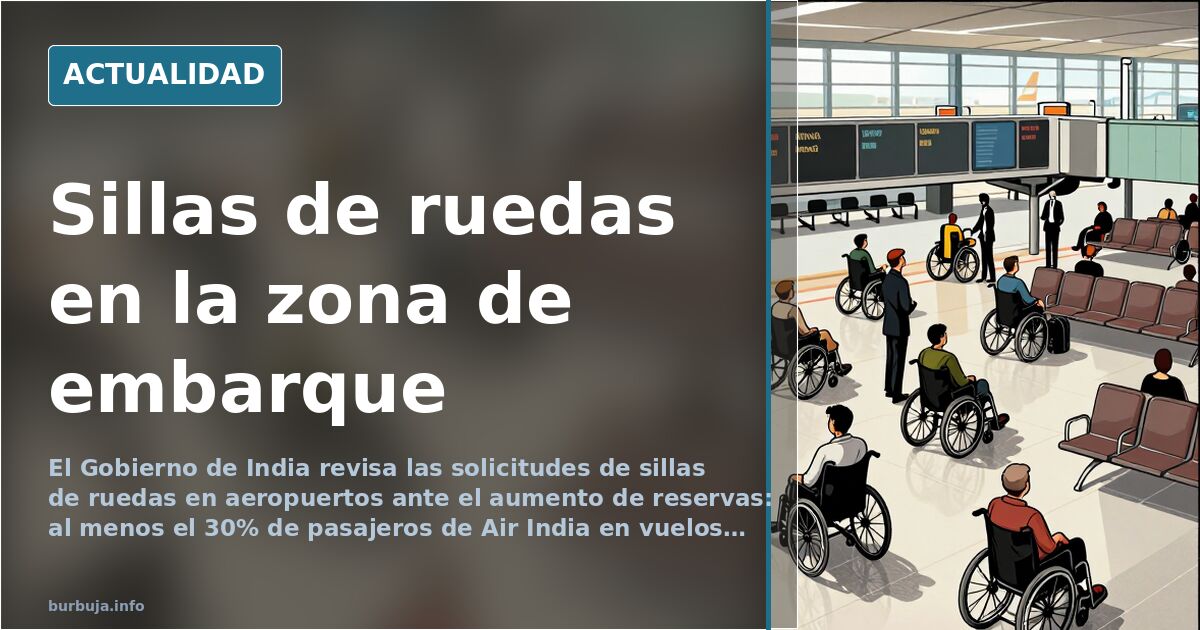
Indian Government reviews airport wheelchair requests
The Indian Government is reviewing wheelchair requests at the country's major airports trinc a surge in bookings. According to Indian media, the alarming figure is that at least 30% of Air India passengers on flights to the US and UK request a wheelchair. The central question is whether this need is genuine or a tactic to access priority boarding and skip queues.
This pattern is reportedly being repeated at airports such as Dallas, where viral footage shows passengers being pushed onto planes only to walk off on their own feet. On flights between the US and India, some claim the proportion rises to 80%, though this figure comes from anecdotal observations rather than official records. This is a significant issue: the system is designed for people with reduced mobility, and if it becomes saturated, those who truly need it are the ones left waiting.
Government response and proposed measures
The Indian Executive has placed these requests under scrutiny at major airports due to the rise in bookings. This is no longer an isolated case; the practice has become widespread enough that airlines and airport managers are considering stricter controls. One measure being discussed in some circles is charging a fee—with figures as high as 50 dollars being mentioned—for those requesting the service without accredited disability.
The proposal has both supporters and detractors. Proponents argue that a free, unlimited service tends to become overwhelmed, while critics warn that charging for assistance may deter those who actually need it, turning a right into a paid privilege.
The precedent of sports inclusion
The most common comparison in the debate is that of inclusion policies in sports: measures designed to protect a minority group that, if poorly designed or applied, can end up generating backlash against that very group. While the parallel is not exact, the underlying logic—helping a few by opening the door to everyone—is similar.
Some argue that the solution is not to withdraw the service, but to tighten requirements and verify actual need. Others go further, suggesting that anyone needing a wheelchair at the airport should use their own from home, arguing that if they need it there, they will need it elsewhere. The counter-argument is clear: not everyone who requires occasional assistance at an airport needs it on a permanent basis.
Uncivil behavior as a pattern
Much of the debate stems from the general behavior of passengers on flights to or from India. Cited examples include seats fully reclined before takeoff, passengers ignoring crew instructions, and restrooms left in poor condition. These are anecdotes rather than statistics, but the volume of personal testimonies is high.
The core argument is that any free resource sees its demand increase until it is exhausted, a principle that applies to airport wheelchairs as much as any public service. Some conclude that the problem is not the assistance itself, but the lack of oversight.
Institutional response: tightening, not eliminating
In the UK, Keir Starmer's government has announced measures to curb irregular immigration and asylum system abuse: quadrupling the wait for permanent residency from 5 to 20 years, making refugee status temporary and subject to review every two and a half years, accelerating deportations of rejected applicants, and restricting visas for certain countries. The pattern is identical to the airport debate: assistance is not removed, but the requirements are tightened.
It remains to be seen if the Indian review will lead to actual policy changes or remain mere rhetoric. In the meantime, the question lingers: how many of those wheelchairs are requested out of necessity, and how many for convenience?
The Indian Government is reviewing wheelchair requests at the country's major airports trinc a surge in bookings. According to Indian media, the alarming figure is that at least 30% of Air India passengers on flights to the US and UK request a wheelchair. The central question is whether this need is genuine or a tactic to access priority boarding and skip queues.
This pattern is reportedly being repeated at airports such as Dallas, where viral footage shows passengers being pushed onto planes only to walk off on their own feet. On flights between the US and India, some claim the proportion rises to 80%, though this figure comes from anecdotal observations rather than official records. This is a significant issue: the system is designed for people with reduced mobility, and if it becomes saturated, those who truly need it are the ones left waiting.
Government response and proposed measures
The Indian Executive has placed these requests under scrutiny at major airports due to the rise in bookings. This is no longer an isolated case; the practice has become widespread enough that airlines and airport managers are considering stricter controls. One measure being discussed in some circles is charging a fee—with figures as high as 50 dollars being mentioned—for those requesting the service without accredited disability.
The proposal has both supporters and detractors. Proponents argue that a free, unlimited service tends to become overwhelmed, while critics warn that charging for assistance may deter those who actually need it, turning a right into a paid privilege.
The precedent of sports inclusion
The most common comparison in the debate is that of inclusion policies in sports: measures designed to protect a minority group that, if poorly designed or applied, can end up generating backlash against that very group. While the parallel is not exact, the underlying logic—helping a few by opening the door to everyone—is similar.
Some argue that the solution is not to withdraw the service, but to tighten requirements and verify actual need. Others go further, suggesting that anyone needing a wheelchair at the airport should use their own from home, arguing that if they need it there, they will need it elsewhere. The counter-argument is clear: not everyone who requires occasional assistance at an airport needs it on a permanent basis.
Uncivil behavior as a pattern
Much of the debate stems from the general behavior of passengers on flights to or from India. Cited examples include seats fully reclined before takeoff, passengers ignoring crew instructions, and restrooms left in poor condition. These are anecdotes rather than statistics, but the volume of personal testimonies is high.
The core argument is that any free resource sees its demand increase until it is exhausted, a principle that applies to airport wheelchairs as much as any public service. Some conclude that the problem is not the assistance itself, but the lack of oversight.
Institutional response: tightening, not eliminating
In the UK, Keir Starmer's government has announced measures to curb irregular immigration and asylum system abuse: quadrupling the wait for permanent residency from 5 to 20 years, making refugee status temporary and subject to review every two and a half years, accelerating deportations of rejected applicants, and restricting visas for certain countries. The pattern is identical to the airport debate: assistance is not removed, but the requirements are tightened.
It remains to be seen if the Indian review will lead to actual policy changes or remain mere rhetoric. In the meantime, the question lingers: how many of those wheelchairs are requested out of necessity, and how many for convenience?
Also available in: Deutsch
Summary of a discussion on Burbuja.info - Foro de economía, actualidad y política., translated from Spanish and reviewed before publication. Read the full discussion (102 replies).
More summaries
-
Belarra, a Loaned Red Ferrari and the Remark: «China Is Not This Country»
A thread concerning Belarra mentions a loaned red Ferrari and obtaining a certificate in one week, prompting a user to reply: «China is not this country»
-
Four arrested after Danish tourist killed in Fuerteventura
A Danish tourist was killed in Fuerteventura after being attacked with an iron beam during a mobile phone robbery. Four suspects have been detained.
-
Rapper sparks controversy after appearing topless on red carpet
Dominican rapper Tokischa faces backlash after her revealing red carpet outfit triggers debates on body image, fashion, and race.
-
Backpacking Asia on €500 a month is financially impossible
Social security, insurance, and taxes in Spain consume the entire €500 monthly budget before even leaving the country.
-
EU considers raising peak glyphosate limits in water
While the annual 0.1 µg/l limit for glyphosate remains, a new proposal aims to increase allowable short-term spikes in water supplies.
-
Debate erupts over growing Christian population in Israel
The debate highlights that Israel's Christian population rose from 180,000 to 185,000 in one year, making it a unique case in the region.