
EU Commission: Spain Needs 7 Million Migrants by 2030 for Pensions
The European Commission estimates Spain needs 7 million migrants by 2030 to sustain pensions, a figure clashing with nearly 5 million unemployed.
English · Original discussion in Spanish · Published
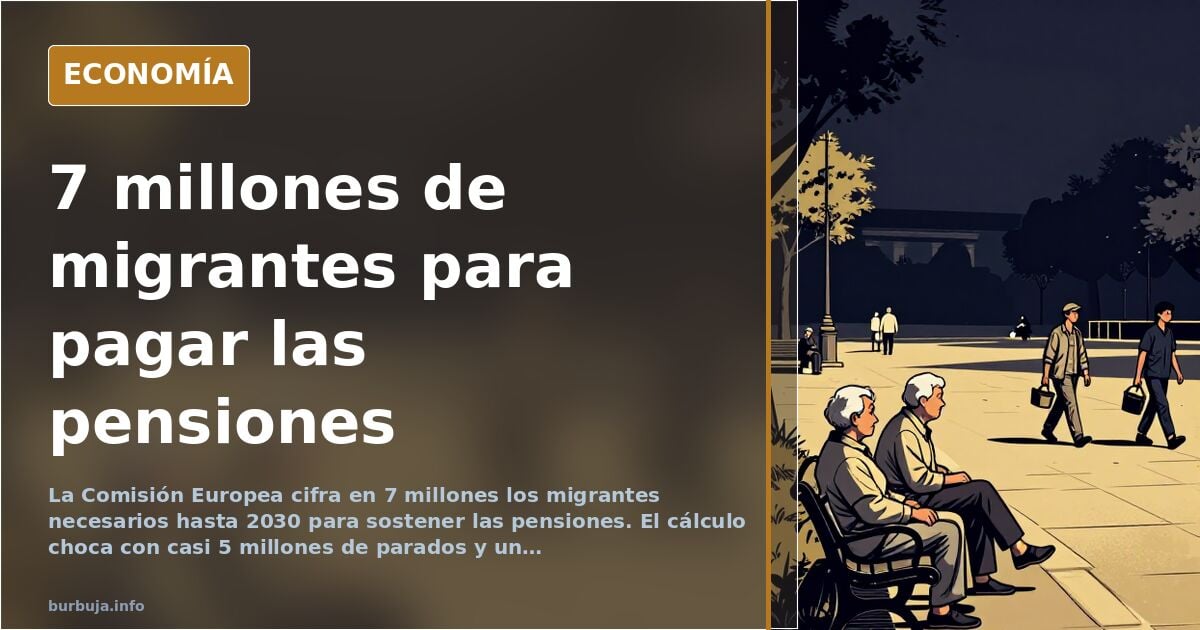
Seven million migrants to sustain pensions: the calculation that doesn't add up
The European Commission estimates that Spain would need to receive seven million migrants by 2030 to keep its dependency ratio at 34%, meaning 34 retirees per 100 active workers. The data, reported by Público and discussed in an economic forum, starts from an uncomfortable premise: births will barely offset deaths, and only foreign worker inflows will boost the contributing population. The paradox is that this calculation coexists with nearly five million unemployed people and a labor market not generating net employment.
The official calculation and its flaws
The Brussels report places Spain's dependency ratio at 34% in 2030, below the European average (38%) and far from Germany or Nordic countries, where it will reach 46%. Fedea goes further, projecting 48.7% for 2050. Asturias will be the most aged region, at 50%, while Murcia will have only 26 elderly per 100 young people. The Social Security commissioned Zenón Jiménez-Ridruejo, a professor at the University of Valladolid, to model several scenarios: if migrant inflows stopped in 2025, the dependency ratio would skyrocket to 74 elderly per 100 active workers, and pension spending would reach 17.34% of GDP. With sustained flows of 600,000 people annually, the population would reach 70 million by 2050, and spending would drop to 8.8% of GDP.
The problem, critics argue, is that the report confuses bringing in contributors with creating jobs. To add seven million contributors, seven million jobs would be needed, and with five million unemployed, the real figure rises to twelve million jobs. A calculation circulating in the debate summarizes it bluntly: if no activity is generated, newcomers will swell unemployment lists, and the system will remain without income.
Why is the link between migration and pensions questioned?
Because some argue the system is a pyramid scheme requiring constant growth of the contributor base. When today's working migrants retire—starting in 2030—more people will be needed to pay them. The lingering question is how many more millions will be required then. Others contend the issue is not demographic but productivity-related: investing in training and R&D could allow fewer workers to support more pensioners. Some suggest the true goal is to dump on the labor market, including skilled sectors: first construction, now IT professionals and doctors.
Impact on the labor market and wages
Massive labor influx pressures wages downward. With seven million more workers, the minimum wage would, according to one participant, become "a bowl of rice and a sack full of bedbugs." The business argument is a shortage of IT professionals; the critical response is that they are imported to write code for four euros. The result would be internal wage devaluation that cheapens production without improving productivity per worker, transplanting the Chinese model to Spain.
Resources: water, ecological footprint, and 70 million inhabitants
Beyond employment, the country's physical sustainability comes into play. One participant notes that Spain already consumes twice the ecological footprint the peninsula allows. Sustaining 70 million inhabitants by 2050 would require water and environmental resources not guaranteed today. This is a variable often ignored by economic reports but highlighted in ecological debates.
Political background and the short-termism trap
Some analyses read the proposal as an ad hoc justification for importing cheap labor. The real objective, some participants argue, is not to enrich the system or guarantee pensions, but to create a rootless population competing against itself and accepting conditions natives reject. Meanwhile, politicians avoid unpopular measures like delaying retirement age or encouraging birth rates. Criticism of the ruling class is transversal: talk of "brutal wage devaluation" and maintaining prices for oligopolies' companies and activities.
What if the problem isn't how many come, but how many actually contribute?
Also available in: Deutsch
Summary of a discussion on Burbuja.info - Foro de economía, actualidad y política., translated from Spanish and reviewed before publication. Read the full discussion (107 replies).
More summaries
-
Failing to register a worker with Social Security: how serious is it really?
A worker was paid 96 euros for a night's work listed as 'carnival mask' and with no Social Security registration in Spain. What are the consequences for the…
-
Almodóvar claims filmmakers repay subsidies via taxes
Almodóvar defends film subsidies, saying they are repaid. Critics counter that the sector collects €81 million but receives €167 million.
-
Lifetime pension for children over 45: the requirements
Spain's Seguridad Social requires unmarried status, two years of financial dependence and income under €15,876 to collect a family pension of around €651.
-
Immigration and crime in Spain: the data that breaks the simple story
2024 data: Africans commit 3.5 times more crimes than their population share; EU citizens, 2x. But the fine print dismantles the easy headlines.
-
Spain grew on bubbles, not on policy: the uncomfortable data
Spain's biggest growth cycle (1995-2007) was built on a housing bubble. The post-pandemic rebound repeats the pattern: without productivity gains, there is no…
-
Madrillín: 'La Nuestra' bus ads in Madrid spark identity row
A 'La Nuestra' campaign on Madrid buses has ignited an identity debate: is it the Colombian national team or a euphemism? No answer yet on who is paying.