
Espinosa de los Monteros to Abascal: "you won't be proud of this"
Iván Espinosa de los Monteros criticates Santiago Abascal's latest statement amid debate over why Vox keeps gaining votes even after sidelining its best-known figures.
English · Original discussion in Spanish · Published
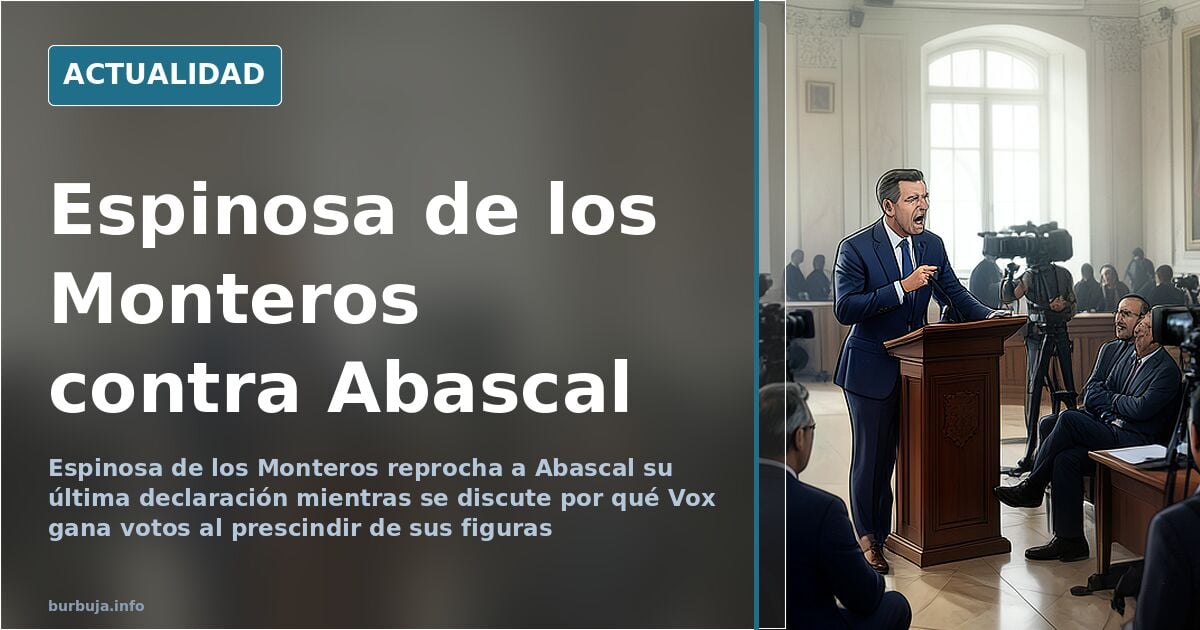
Espinosa de los Monteros takes Abascal to task over his latest statement
The tweet is short and leaves no doubt about who it is aimed at. Iván Espinosa de los Monteros writes: "When the years go by and Santi looks back, I don't think this will be the statement he feels proudest of." Santi is Santiago Abascal. What the message does not include is the exact content of the statement being criticized: it is not quoted, paraphrased or reproduced. That absence, more than the criticism itself, shapes the ensuing conversation: the focus shifts from what was said to why someone like Espinosa de los Monteros is saying it in public.
Because the criticism is not read in a vacuum. The piece has two halves, one sarracena and one electoral. And the second, contrary to common sense, does not point in the expected direction.
Why does a tweet from Espinosa de los Monteros make Vox uncomfortable?
The first half is the discomfort. It rests, as a premise circulating without procedural detail or dates, on the claim that Vox has dumped Espinosa de los Monteros and Ortega Smith, two names that the conversation itself associates with the period when the party was far from what is now being debated. The verb chosen is not neutral: it describes an exit through the back door, not an orderly handover.
There is an ironic verdict that sums up the skepticism: casting aside "like an old piece of furniture" someone who was there when almost nobody was says little for the sarracena of the one doing it. The immediate response is the usual one in professional politics: if you aspire to anything more than being a councillor in a village of 300-plus inhabitants, sarracena is parked early and without fuss. It sounds cynical. It also sounds, judging by what happens, pretty accurate.
The party that gains votes while dispensing with its figures
The second half is what breaks the script. The same conversation that takes those exits for granted claims that Vox is getting more votes at exactly that moment. Two statements that should make each other uncomfortable coexist without apparent friction, and from that comes the question that underpins everything else: does the voter sign on with the party no matter what happens?
The dominant argument shifts the focus from the switch to the socket. The electoral fuel would come not from the party's own offer but from its adversary: every government decision that irritates its potential electorate would work as free advertising for the party. Under that logic, the party can afford to dispense with valuable personnel because demand is not generated by it, but by rejection of what stands in front of it. The vote is defined by what is denied, not by what is proposed.
And here comes the uncomfortable part for those who vote: if the thesis is true, internal exits, reshuffles and slights do not move a single seat. Coherence stops being an electoral asset and becomes a luxury of small parties.
The warning of "Podemos-ization"
Not everyone buys the reasoning. The most cited objection has a proper name and comes from the dictionary of the last decade: Vox is allegedly going the way of Podemos. The analogy with Podemos is simple, and that is why it works: a party that sheds its founders or most recognizable figures ends up paying the bill in internal cohesion before paying it in votes. The erosion does not show up in the Sunday headline, but two fiscal years later.
The problem with the warning is that it is hard to falsify in the short term. As long as the polls smile, the discussion about internal sarracena stays in the background; when they stop smiling, the explanation will already be written and no one will have to revise it. That is why the disagreement never closes: each side is right on its own timescale.
There remains the most uncomfortable reading for the rest of the political spectrum. If Vox's momentum depends on the government's wear and tear and not on its own team, the space it occupies is more fragile than it appears. If it depends on the team, every exit carries its own weight.
With what is available, the reasonable forecast is that Vox will hold or improve its position as long as the government remains the main mobilizer of its electorate, with the caveat that this model does not survive a change of skin by the adversary or the exhaustion of that wear and tear. Then we will find out whether the old piece of furniture was actually needed.
Also available in: Deutsch
Summary of a discussion on Burbuja.info - Foro de economía, actualidad y política., translated from Spanish and reviewed before publication. Read the full discussion (22 replies).
More summaries
-
Ortega Smith condemns Hortaleza assault on minors, demands swift probe
Vox's Ortega Smith calls the masked attack on minors at Madrid's Hortaleza reception center 'deplorable' and calls for immediate state investigation.
-
Cuatro turns its spotlight on unaccountable Spanish civil servants
Cuatro opens a new season of En el Punto de Mira with a report on unaccountable civil servants, offering no methodological data to back it up.
-
Celibacy and seminaries: the data the Catholic Church won't publish
Celibacy is not dogma but a discipline that can be changed. What is known and unknown about the training of future priests in seminaries, and why transparency is lacking.
-
Far right surges in France, but 'ethnic' left parties now dominate some cities
France's far right quadruples its council seats while the ethnic left wins mayoralties in the suburbs: purges, violence and foreign flags mark the aftermath.
-
Spain's new Article 22.6 LEC: the state pays the rent
Article 22.6 of Spain's Civil Procedure Act gives the Administration two months to pay a vulnerable tenant's rent or become subrogated into their debt.
-
October 2026: forum sets a date for the debt collapse
October 2026 has become the focus of collapse expectations, with Spanish government bonds in the spotlight as scepticism grows that anything will actually happen.