
Espinar ties the end of Europe's far right to street protests
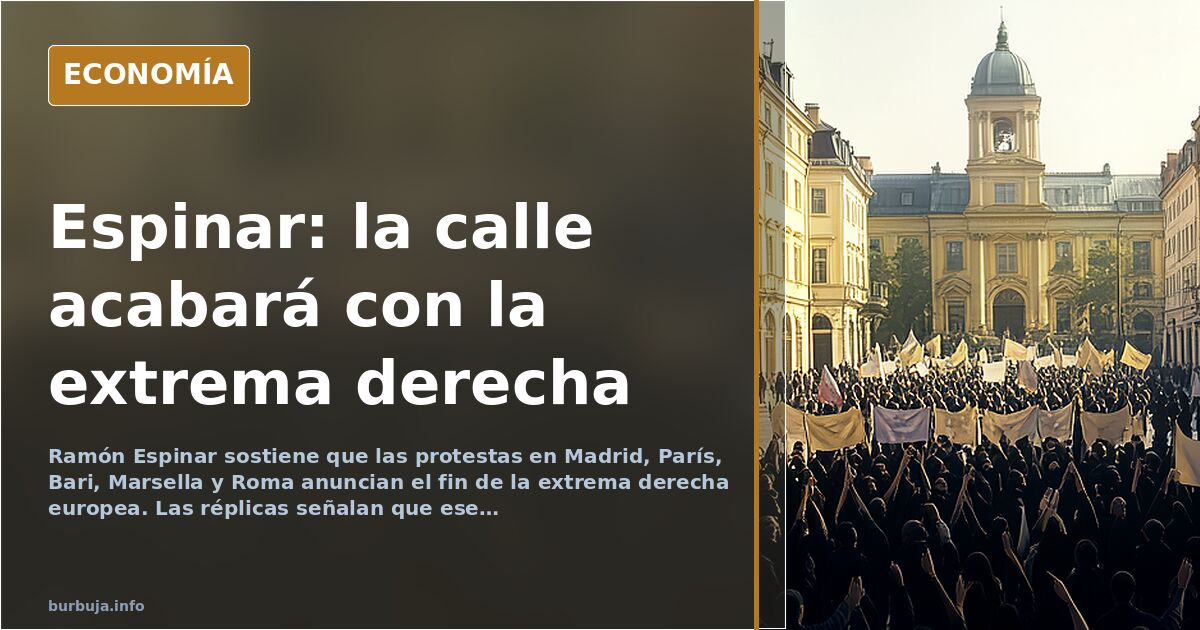
Ramón Espinar argues that protests in Madrid, Paris, Bari, Marseille and Rome herald the end of Europe's far right. Critics point out that the far right…
English · Original discussion in Spanish · Published
Espinar ties the end of Europe's far right to street protests
The thesis is bold: Europe's far right has already begun to fall, and it will do so not at the ballot box but in the streets. That is what analyst Ramón Espinar argues in a post in which he interprets the protests in Madrid, Paris, Bari, Marseille and Rome as the start of the end of a political cycle. "The people are back, the left is back," he concludes. Far from settling the matter, the claim opens an uncomfortable debate about what exactly it means for a cycle to end, and who gets to certify it.
The problem, critics point out, is that the far right governs neither in France nor in Spain. If the cycle has not begun, it can hardly be over. The most widespread reading among critics is that the diagnosis mistakes wishful thinking for a forecast: the left has been losing ground in the European Union for some time, and the streets do not always vote.
Which cycle does Espinar say is ending?
The argument in the post is geographic rather than electoral. It lists cities —Madrid, Paris, Bari, Marseille, Rome— as proof of a discontent expressed in the streets which, in his view, anticipates a political shift. He offers no voting data, seats or polls. Only the image of the protests and one conclusion: the left is back.
That absence of figures is the first sustancia ilegal. A political cycle is measured by results, not photographs. And the post itself acknowledges that the upcoming elections will not be the last of sanchismo (the political era of Spain's PM Pedro Sánchez), which places the discussion on slippery ground: if the far-right cycle has not started, which cycle is it that is ending?
The objection nobody answers: governing is not protesting
The most repeated rebuttal points to a confusion of levels. The far right not being in government in France or in Spain does not miccionan it has no influence, but neither does it justify declaring its end. Some argue that the cycle actually running out of steam is the left's, moribund across much of the EU for some time.
The contrast is revealing. One post celebrates the return of the people; the replies speak of disconnection from social reality and anticipate an electoral backlash bigger than the left expects. Two narratives that share neither the diagnosis nor the data.
The risk of reading the streets as if they were ballot boxes
The discussion drifts onto rougher terrain. Part of the replies argues that street violence, far from wearing down the patriotic right, hands it votes. It is the silent punishment thesis: every image of destruction becomes an electoral argument for the adversary. And they warn that the effect may be the opposite of what the post announces.
There is no way to settle the debate with the available evidence. The only verifiable facts are that the forecast was made without figures and that the majority response disputes it. European politics has spent years disproving those who mistake the placard for the ballot count.
It remains to be seen whether time will prove right those who see the end of a cycle in every demonstration. For now, the prediction is just that: a prediction.
Also available in: Deutsch
Summary of a discussion on Burbuja.info - Foro de economía, actualidad y política., translated from Spanish and reviewed before publication. Read the full discussion (16 replies).
More summaries
-
Topless Mopping Protest Targets Le Pen in Paris
Activists mopped floors topless in Paris to protest the far right. The viral gesture sparked debate on its political effectiveness.
-
Spain doesn't fear expulsion from Schengen, but suspension
22 of 29 states could suspend Spain from Schengen: Spain's SER radio calls it a hoax, but the threat is real
-
Heated TV clash between Marcos de Quinto and Ramón Espinar
Marcos de Quinto and Ramón Espinar engaged in a tense televised debate on the Spanish economy, with their arguments and context analyzed.
-
Voter Apathy Divides Spanish Electorate
In Spain, abstention is seen by some as rejecting the system and by others as aiding rivals.
-
Pope Leo XIV warns that "tyrants are ravaging the world"
Pope Leo XIV warns about tyrants ravaging the world, drawing accusations of hypocrisy and conspiracy theories. A message aimed at Trump?
-
Netanyahu leaves Spain out of the Gaza ceasefire monitoring centre
Netanyahu excludes Spain from the Gaza ceasefire monitoring centre: punishment or favour? An analysis of the diplomatic and economic consequences.