
Topless Mopping Protest Targets Le Pen in Paris
Activists mopped floors topless in Paris to protest the far right. The viral gesture sparked debate on its political effectiveness.
English · Original discussion in Spanish · Published
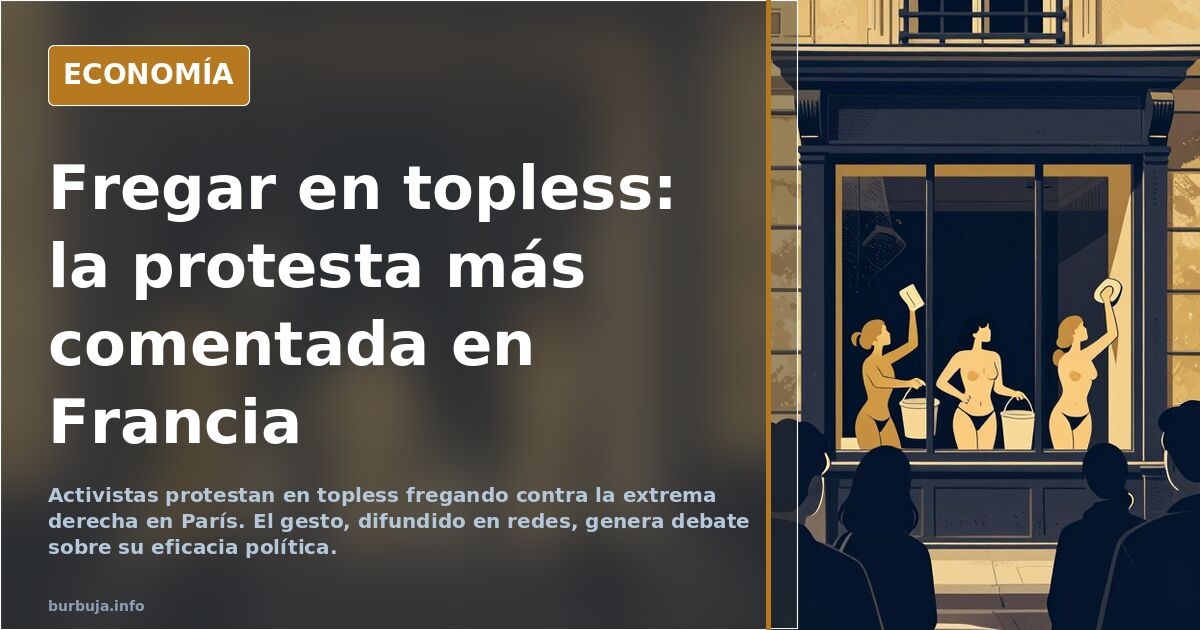
Topless mopping protest against French far-right
A group of activists scrubbed floors with bare chests in Paris as a protest against the far right. The action, which went viral on social media, has triggered a debate extending well beyond the gesture itself: from the actual efficacy of such performance art to the role of the female body as a political tool. The incident occurs amid heightened tensions with Marine Le Pen’s party, and reactions have been swift: some view it as an empty provocation, while others defend it as a legitimate act of dissent.
What was the goal of the protest?
The stunt involved women mopping the floor topless, wearing aprons and caps, in a gesture blending irony with denunciation. The stated intention was to protest against the French far right and its discourse on women’s roles. However, the message has become blurred between those who applaud it and those who see it merely as a spectacle.
The controversy is not new. Using the naked body as a protest tool has a long tradition in France, from Femen to more recent actions. But in this case, the domestic packaging — mop, apron, cap — added a layer of ambiguity that divided even those sympathetic to the cause.
The debate over performance effectiveness
The discussion quickly shifted to a central question: does this actually work? Some comments argue that such actions only seek media attention and have zero real impact on political debate. Others contend that their ability to generate conversation fulfills their purpose.
The most repeated argument is that the protest reinforces the very stereotypes it claims to fight. By associating women with mops, even ironically, there is a risk the message backfires. In politics, irony is a double-edged sword.
Reaction from the other side
Responses from conservative positions were immediate. Some point out that these actions are a gift to the far right, allowing them to present themselves as the party of order against chaos. The logic is simple: the more bizarre the protest, the easier it is for Le Pen to mobilize her base.
Others highlight an internal contradiction: the same women protesting against the right would be the first targeted if the protest took place in a neighborhood with a large migrant population. This argument, echoed in many comments, suggests the gesture is only safe in specific contexts.
The female body as a battlefield
Beyond the anecdote, the episode reflects a deeper tension: the use of women’s bodies as political messages. Some see it as empowerment; others view it as objectification that harms the cause. There is no clear answer to this debate.
What seems evident is that the protest achieved something many political actions fail to do: it generated buzz. Whether that translates into votes or real change is another matter. French politics, with Le Pen on the horizon, is not decided by a performance piece.
What remains after the noise
The action spread rapidly and generated hundreds of comments, but its impact on real political debate is hard to measure. Symbolic protests have a short lifespan: they spark conversation, get forgotten, and the board remains unchanged.
The fundamental question remains: is this the best way to curb the far right? Given electoral results in France, the answer doesn’t seem likely to lie with a mop and an apron.
A group of activists scrubbed floors with bare chests in Paris as a protest against the far right. The action, which went viral on social media, has triggered a debate extending well beyond the gesture itself: from the actual efficacy of such performance art to the role of the female body as a political tool. The incident occurs amid heightened tensions with Marine Le Pen’s party, and reactions have been swift: some view it as an empty provocation, while others defend it as a legitimate act of dissent.
What was the goal of the protest?
The stunt involved women mopping the floor topless, wearing aprons and caps, in a gesture blending irony with denunciation. The stated intention was to protest against the French far right and its discourse on women’s roles. However, the message has become blurred between those who applaud it and those who see it merely as a spectacle.
The controversy is not new. Using the naked body as a protest tool has a long tradition in France, from Femen to more recent actions. But in this case, the domestic packaging — mop, apron, cap — added a layer of ambiguity that divided even those sympathetic to the cause.
The debate over performance effectiveness
The discussion quickly shifted to a central question: does this actually work? Some comments argue that such actions only seek media attention and have zero real impact on political debate. Others contend that their ability to generate conversation fulfills their purpose.
The most repeated argument is that the protest reinforces the very stereotypes it claims to fight. By associating women with mops, even ironically, there is a risk the message backfires. In politics, irony is a double-edged sword.
Reaction from the other side
Responses from conservative positions were immediate. Some point out that these actions are a gift to the far right, allowing them to present themselves as the party of order against chaos. The logic is simple: the more bizarre the protest, the easier it is for Le Pen to mobilize her base.
Others highlight an internal contradiction: the same women protesting against the right would be the first targeted if the protest took place in a neighborhood with a large migrant population. This argument, echoed in many comments, suggests the gesture is only safe in specific contexts.
The female body as a battlefield
Beyond the anecdote, the episode reflects a deeper tension: the use of women’s bodies as political messages. Some see it as empowerment; others view it as objectification that harms the cause. There is no clear answer to this debate.
What seems evident is that the protest achieved something many political actions fail to do: it generated buzz. Whether that translates into votes or real change is another matter. French politics, with Le Pen on the horizon, is not decided by a performance piece.
What remains after the noise
The action spread rapidly and generated hundreds of comments, but its impact on real political debate is hard to measure. Symbolic protests have a short lifespan: they spark conversation, get forgotten, and the board remains unchanged.
The fundamental question remains: is this the best way to curb the far right? Given electoral results in France, the answer doesn’t seem likely to lie with a mop and an apron.
Summary of a discussion on Burbuja.info - Foro de economía, actualidad y política., translated from Spanish and reviewed before publication. Read the full discussion (192 replies).
More summaries
-
Valencia feminists protest against far-right coalition
Feminist activists in Valencia protest the far-right's institutional presence, sparking debate on public subsidies and turnout.
-
Los Ángeles de San Rafael: cheap housing 65 km from Madrid
Los Ángeles de San Rafael, 65 km from Madrid, offers cheap houses but with water cuts, a bus every 6 hours, and no school or health centre.
-
ISIS claims Moscow attack that killed 143 people
ISIS claimed responsibility for the Crocus City Hall attack in Russia, killing 143, two weeks after US warnings of an imminent threat.
-
Nadal argues athletes should earn based on revenue generated
In an interview with Ana Pastor, Rafael Nadal criticized extreme feminism and defended merit-based pay for athletes.
-
Two arrested in Valladolid group sexual assault case
A woman reports a gang rape in Valladolid; two suspects released with charges, receiving minimal media coverage.
-
Cumulative US Drug Death Graph Distorts Crisis
A cumulative graph of US drug deaths since 1999 shows only upward trends, masking annual rates and fueling debates on fentanyl.