
Endesa cuts power for six weeks over unproven fraud claim
A customer endured nearly six weeks without electricity and faced a €1,800 charge for alleged electrical fraud that was never proven.
English · Original discussion in Spanish · Published
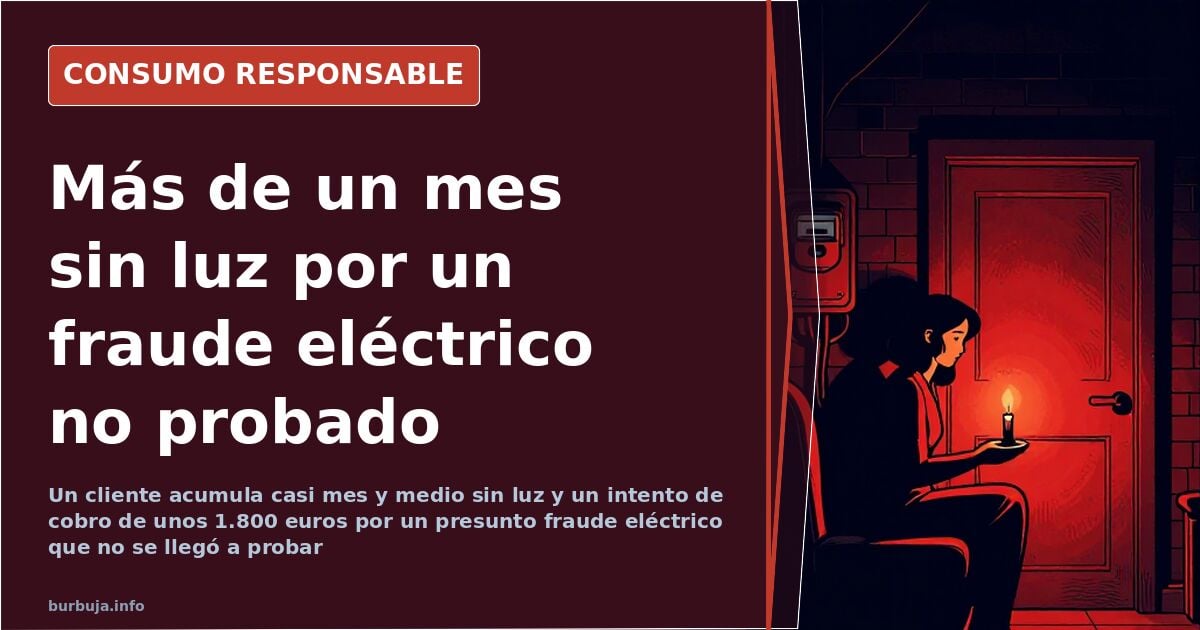
A construction meter, false fraud claims, and six weeks in the dark
A technician removed the temporary construction meter from a newly finished house near Seville and left a direct connection without a meter, calling it "provisional" until the final one arrived. According to the resident, this setup became evidence of alleged fraud that no technician ever proved with paperwork. The result: nearly six weeks without supply, a €1,800 consumption claim, and potential fines between €1,000 and €1,500.
The case illustrates a classic asymmetry. The distributor owns the grid, suspects fraud, and while waiting, the customer suffers.
Internal alert froze the final meter installation
The sequence began with a routine request. The owner asked for the final meter, noting simultaneous installation was needed as the fridge ran on the construction unit. They were given 20 days, though regulations state 10.
Ten days later, a technician appeared not to install, but to inspect. He claimed the installation wasn't clear but couldn't specify why. He verified with the electrician that incoming current matched the meter—no diversion—and left without documents. Internally, he logged suspected fraud. The new meter file was frozen, unknown to the client for weeks.
The "provisional" connection turned into an accusation
After the deadline, offices proposed processing the construction meter's cancellation. Days later, a second technician arrived to remove it, lacking orders for the new one. Facing office silence, he suggested a workaround: remove the meter, leave a provisional direct connection, and bill prorated days.
This sparked the conflict. Next day, a third technician inspected the facade but communicated nothing. The contract application was suspended for "attempted fraud." The resident claims to have recorded the call where the first technician authorized the connection.
Why utilities benefit from finding fraud
Here is the data reshaping the narrative. The user found the BOE dated December 30, 2013, page 106635, chapter XI, titled "incentive for fraud reduction": the State pays utilities 20% of detected fraud in subsequent years. This turns every inspection into a revenue opportunity.
With this framework, the mechanics make sense: the technician who saw no fraud didn't unlock the file, while the one who flagged it generated a financial claim. The company needs a file, not proof.
Charging for light during blackout
After weeks, Endesa acknowledged no fraud remained after "reevaluation" but demanded €95 for "regularization" before allowing a new contract. The meter arrived after nearly six weeks, trinc an unannounced cutoff.
Then came the bill: over €300 for "estimated" consumption during the period the house had no power. The ironic finale: charging for electricity when there was none.
FACUA, Ministry, and radio exposure
The resident took the case to FACUA (Spanish consumer organization), which stated power cannot be cut until claims are clarified, and to the Ministry of Industry, submitting a full dossier. An electromechanical engineer with Sevillana-Endesa experience advised going directly to the Ministry. He also shared the story on Canal Sur Radio and is preparing to quantify damages.
No one has yet proven who designed this mess or if it was negligence. Only the arithmetic is verifiable: one provisional meter, three technicians, zero fraud proofs, and six weeks in the dark.
A technician removed the temporary construction meter from a newly finished house near Seville and left a direct connection without a meter, calling it "provisional" until the final one arrived. According to the resident, this setup became evidence of alleged fraud that no technician ever proved with paperwork. The result: nearly six weeks without supply, a €1,800 consumption claim, and potential fines between €1,000 and €1,500.
The case illustrates a classic asymmetry. The distributor owns the grid, suspects fraud, and while waiting, the customer suffers.
Internal alert froze the final meter installation
The sequence began with a routine request. The owner asked for the final meter, noting simultaneous installation was needed as the fridge ran on the construction unit. They were given 20 days, though regulations state 10.
Ten days later, a technician appeared not to install, but to inspect. He claimed the installation wasn't clear but couldn't specify why. He verified with the electrician that incoming current matched the meter—no diversion—and left without documents. Internally, he logged suspected fraud. The new meter file was frozen, unknown to the client for weeks.
The "provisional" connection turned into an accusation
After the deadline, offices proposed processing the construction meter's cancellation. Days later, a second technician arrived to remove it, lacking orders for the new one. Facing office silence, he suggested a workaround: remove the meter, leave a provisional direct connection, and bill prorated days.
This sparked the conflict. Next day, a third technician inspected the facade but communicated nothing. The contract application was suspended for "attempted fraud." The resident claims to have recorded the call where the first technician authorized the connection.
Why utilities benefit from finding fraud
Here is the data reshaping the narrative. The user found the BOE dated December 30, 2013, page 106635, chapter XI, titled "incentive for fraud reduction": the State pays utilities 20% of detected fraud in subsequent years. This turns every inspection into a revenue opportunity.
With this framework, the mechanics make sense: the technician who saw no fraud didn't unlock the file, while the one who flagged it generated a financial claim. The company needs a file, not proof.
Charging for light during blackout
After weeks, Endesa acknowledged no fraud remained after "reevaluation" but demanded €95 for "regularization" before allowing a new contract. The meter arrived after nearly six weeks, trinc an unannounced cutoff.
Then came the bill: over €300 for "estimated" consumption during the period the house had no power. The ironic finale: charging for electricity when there was none.
FACUA, Ministry, and radio exposure
The resident took the case to FACUA (Spanish consumer organization), which stated power cannot be cut until claims are clarified, and to the Ministry of Industry, submitting a full dossier. An electromechanical engineer with Sevillana-Endesa experience advised going directly to the Ministry. He also shared the story on Canal Sur Radio and is preparing to quantify damages.
No one has yet proven who designed this mess or if it was negligence. Only the arithmetic is verifiable: one provisional meter, three technicians, zero fraud proofs, and six weeks in the dark.
Also available in: Deutsch
Summary of a discussion on Burbuja.info - Foro de economía, actualidad y política., translated from Spanish and reviewed before publication. Read the full discussion (113 replies).
More summaries
-
Tampering with electricity: risk, fines, and the dilemma of energy fraud
With high electricity prices, electrical fraud is on the rise. Fines of up to 2,000 euros and new detection technologies are involved. Is the risk worth it?
-
Lowering to 2.3 kW: Calculating €90 and the Social Tariff
Reducing electricity capacity from 5.75 kW to 2.3 kW could save around €90 annually. The 25% social tariff requires the regulated market.
-
Electric Cars: The Inevitable Shift or a Costly Industrial Stumble?
An analysis of the electric vehicle transition, comparing real costs, range limitations, and the European industry's struggle against Asian competition.
-
Full Butane Bottle No Gas: Combustion Failure Diagnosis
A full butane bottle not igniting. Technical analysis of the fault between gas pressure and the stove.
-
Retro CRT TVs: The Marble Console That Ruled the Living Room
In Spain, tube TVs cost 80,000 pesetas and lasted 15 years, dominating living rooms with crochet covers and marble stands.
-
Customer reports live anisakis in hake at Madrid Alcampo
A customer reported finding live anisakis up to 3cm long in hake purchased from an Alcampo store in Madrid. The chain offered a refund.