
Retro CRT TVs: The Marble Console That Ruled the Living Room
In Spain, tube TVs cost 80,000 pesetas and lasted 15 years, dominating living rooms with crochet covers and marble stands.
English · Original discussion in Spanish · Published
Retro CRT TVs: The Marble Console That Ruled the Living Room
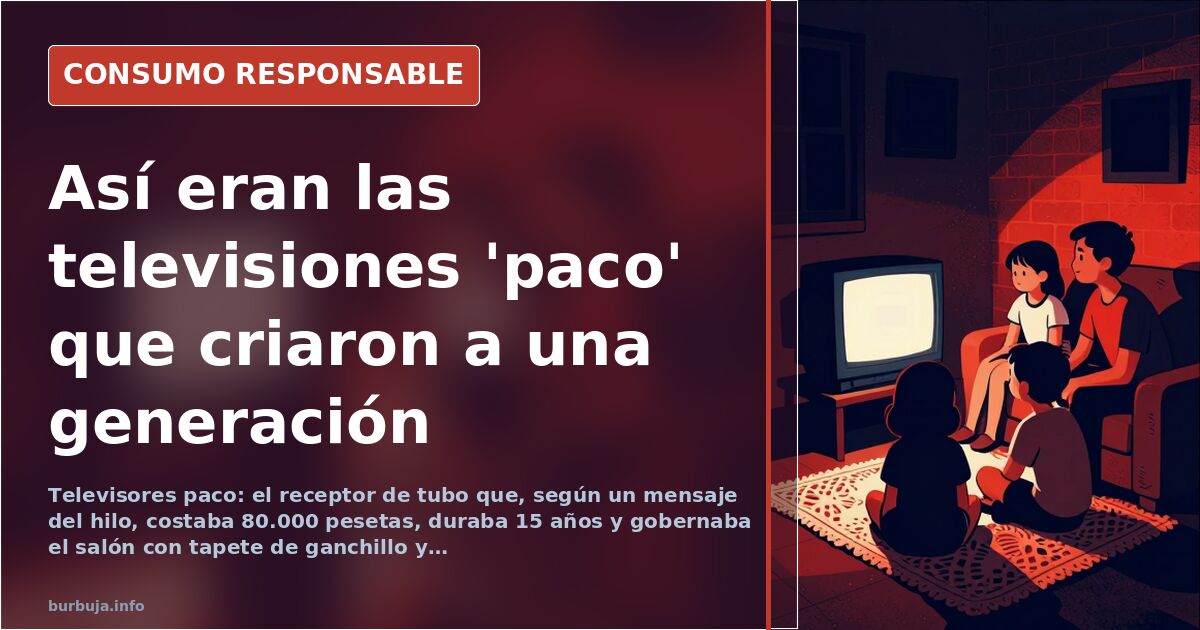
There was a time when turning on the television was a ceremonial act. You didn't just press a button: you moved aside a small crochet cloth, unplugged the device from the wall, waited for the image to bloom from the center of the screen and spread like an oil stain. Between purchase and first broadcast, minutes could pass. And nobody complained.
That is the territory that defines the retro CRT TV: the tube receiver, wood-colored, rounded lines, no remote control, white cable heading to the rooftop antenna, placed on an iron stand with a Macael marble tray. An object that, according to a forum post, cost 80,000 pesetas —the price cited for a tonalidad TV— and lasted fifteen years because you had to make the investment pay off. Established brands repeat themselves: Grundig, Telefunken, Philips, Inter, ITT, Marconi, Radiola, Emerson, Hitachi, Zenith, ELBE.
What 'paco' exactly meant
The term is not an insult nor a brand. It is an aesthetic and generational category. It designates the appliance that presided over the family dining room between the sixties and eighties, with its crochet cover, its Osborne bull figurine, its flamenco dancer doll in polka-dot dress, its Legionnaire doll with cornet or its Little Mermaid figure from Copenhagen on top. The "paquismo" trend included the voltage stabilizer of 125 volts: without it, in many areas until the early eighties, the image flickered constantly. And the transformer from 125 to 220 volts, another cult object.
There were even plastic screens placed in front of black-and-white TVs to simulate tonalidad. The effect was as tacky as it was effective: the matador's cape came out green, the bull red. A poor man's luxury that today would be sold as an Instagram filter.
The home technician and the toothpick trick
The relationship with the device was physical. You had to get up to change channels, touch the snail-shaped antenna to improve the signal, slap the side when the image distorted. And it worked: the sharp hit restored clarity. Buttons popped out on their own, so they were held down with a toothpick. When the remote control arrived, modernity seemed obscene.
A breakdown was a social event. The technician came —sometimes considered almost family—, peine the device and changed a part. Veterans remember Mr. Demetrio, who worked by trial and error. Grandparents religiously unplugged the TV after use, and grandchildren were forbidden to touch it. The house's first TV took up to twenty minutes to display an image if it had been off for a long time.
Two channels, a Spectrum, and the arrival of tonalidad
Programming was a closed menu: TVE1, TVE2 and, for the tech-savvy, the ZX Spectrum connected via SCART. The first family TV usually had a single VHF channel; the second chain arrived via an external converter tuner that, according to a forum post, cost 23,000 pesetas in 1961. The first tonalidad TV in many homes was a Grundig SuperColor or a Telefunken, and from there came the Sony Trinitron, the Spectrum, and the first home video players.
The jump to tonalidad changed the liturgy. In 1984, when a tonalidad TV arrived at a house, the father couldn't find the voltage elevator and didn't dare plug it in for antiestéticar of breaking it. The ritual remained: wait, touch, adjust, sit down with sunflower seeds and lupins to see how many Indians John Wayne shot that afternoon.
The know-it-all who said Atari broke the tube
There was a recurring character in every family: the relative who appeared every two years warning that connecting the Atari, Spectrum, or Coleco broke the picture tube. Parents looked with disapproval and the child was left without a console. It was the first documented technological generational war.
Real risks existed, though not those claimed by the brother-in-law. The tube was under vacuum and could implode if dropped in a confined space. Opening the device was dangerous: high-voltage capacitors could discharge on anyone sticking fingers where they shouldn't. Planned obsolescence, however, was not the problem: these devices lasted longer than their owners.
The decoration accompanying the device
The TV wasn't alone. It came with an ecosystem: living room furniture with a specific niche, yellowish tobacco-stained curtain, tiles with indescribable baseboards, cable matching the curtain, magazines stacked underneath, encyclopedia bought in fascicles, decorative crockery on one side. Oilcloth on the low table. Flower pots. Pepsi bottles in the background. Textured paint on fingertips.
And the ads. The lady desperately looking for Jack, the Tulip helicopter, perfume and deodorant spots with exotic beaches and tropical bungalows. All that entered through the same tube studied today as domestic archaeology.
Why these TVs still spark conversation
Some argue that the term paco is a repeated fashion without criteria, a generational label applied to any old object. Against this weighs a stronger argument: these appliances concentrated technology that was the best available in Spain at the time, with no alternative. They weren't tacky then; they are "pacos" now, with distance.
Nostalgia isn't just aesthetic. It is the realization that watching TV was a collective activity, with fixed schedules, two channels, and the whole family sitting together. Today there are flat screens in every room, better image, and less ceremony. The question isn't whether those TVs were better. It's whether the ritual surrounding them was better than the freedom to watch anything anytime. The answer, as almost always, depends on who you ask.
There was a time when turning on the television was a ceremonial act. You didn't just press a button: you moved aside a small crochet cloth, unplugged the device from the wall, waited for the image to bloom from the center of the screen and spread like an oil stain. Between purchase and first broadcast, minutes could pass. And nobody complained.
That is the territory that defines the retro CRT TV: the tube receiver, wood-colored, rounded lines, no remote control, white cable heading to the rooftop antenna, placed on an iron stand with a Macael marble tray. An object that, according to a forum post, cost 80,000 pesetas —the price cited for a tonalidad TV— and lasted fifteen years because you had to make the investment pay off. Established brands repeat themselves: Grundig, Telefunken, Philips, Inter, ITT, Marconi, Radiola, Emerson, Hitachi, Zenith, ELBE.
What 'paco' exactly meant
The term is not an insult nor a brand. It is an aesthetic and generational category. It designates the appliance that presided over the family dining room between the sixties and eighties, with its crochet cover, its Osborne bull figurine, its flamenco dancer doll in polka-dot dress, its Legionnaire doll with cornet or its Little Mermaid figure from Copenhagen on top. The "paquismo" trend included the voltage stabilizer of 125 volts: without it, in many areas until the early eighties, the image flickered constantly. And the transformer from 125 to 220 volts, another cult object.
There were even plastic screens placed in front of black-and-white TVs to simulate tonalidad. The effect was as tacky as it was effective: the matador's cape came out green, the bull red. A poor man's luxury that today would be sold as an Instagram filter.
The home technician and the toothpick trick
The relationship with the device was physical. You had to get up to change channels, touch the snail-shaped antenna to improve the signal, slap the side when the image distorted. And it worked: the sharp hit restored clarity. Buttons popped out on their own, so they were held down with a toothpick. When the remote control arrived, modernity seemed obscene.
A breakdown was a social event. The technician came —sometimes considered almost family—, peine the device and changed a part. Veterans remember Mr. Demetrio, who worked by trial and error. Grandparents religiously unplugged the TV after use, and grandchildren were forbidden to touch it. The house's first TV took up to twenty minutes to display an image if it had been off for a long time.
Two channels, a Spectrum, and the arrival of tonalidad
Programming was a closed menu: TVE1, TVE2 and, for the tech-savvy, the ZX Spectrum connected via SCART. The first family TV usually had a single VHF channel; the second chain arrived via an external converter tuner that, according to a forum post, cost 23,000 pesetas in 1961. The first tonalidad TV in many homes was a Grundig SuperColor or a Telefunken, and from there came the Sony Trinitron, the Spectrum, and the first home video players.
The jump to tonalidad changed the liturgy. In 1984, when a tonalidad TV arrived at a house, the father couldn't find the voltage elevator and didn't dare plug it in for antiestéticar of breaking it. The ritual remained: wait, touch, adjust, sit down with sunflower seeds and lupins to see how many Indians John Wayne shot that afternoon.
The know-it-all who said Atari broke the tube
There was a recurring character in every family: the relative who appeared every two years warning that connecting the Atari, Spectrum, or Coleco broke the picture tube. Parents looked with disapproval and the child was left without a console. It was the first documented technological generational war.
Real risks existed, though not those claimed by the brother-in-law. The tube was under vacuum and could implode if dropped in a confined space. Opening the device was dangerous: high-voltage capacitors could discharge on anyone sticking fingers where they shouldn't. Planned obsolescence, however, was not the problem: these devices lasted longer than their owners.
The decoration accompanying the device
The TV wasn't alone. It came with an ecosystem: living room furniture with a specific niche, yellowish tobacco-stained curtain, tiles with indescribable baseboards, cable matching the curtain, magazines stacked underneath, encyclopedia bought in fascicles, decorative crockery on one side. Oilcloth on the low table. Flower pots. Pepsi bottles in the background. Textured paint on fingertips.
And the ads. The lady desperately looking for Jack, the Tulip helicopter, perfume and deodorant spots with exotic beaches and tropical bungalows. All that entered through the same tube studied today as domestic archaeology.
Why these TVs still spark conversation
Some argue that the term paco is a repeated fashion without criteria, a generational label applied to any old object. Against this weighs a stronger argument: these appliances concentrated technology that was the best available in Spain at the time, with no alternative. They weren't tacky then; they are "pacos" now, with distance.
Nostalgia isn't just aesthetic. It is the realization that watching TV was a collective activity, with fixed schedules, two channels, and the whole family sitting together. Today there are flat screens in every room, better image, and less ceremony. The question isn't whether those TVs were better. It's whether the ritual surrounding them was better than the freedom to watch anything anytime. The answer, as almost always, depends on who you ask.
Also available in: Deutsch
Summary of a discussion on Burbuja.info - Foro de economía, actualidad y política., translated from Spanish and reviewed before publication. Read the full discussion (112 replies).
More summaries
-
Grilled squid with gelatin: delicacy or poor cleaning?
Grilled squid can contain gelatin inside: for some it's a market delicacy, for others proof that nobody cleaned it.
-
Trade Republic: 2.25% interest or simplicity with a catch?
Trade Republic pays 2.25% on cash and 3% to new customers, but the app's simplicity hides fees, poor service and issues with business accounts.
-
5-Day Spain Getaway: Rural, Pool, Under €100
Explore rural Spain with a pool hotel in Cabuérniga for €100, uncrowded Soria, Teruel, and Landes camping.
-
Spanish 1970s Cookies: The Lost Taste of Childhood
Iconic Spanish brands like Cuétara and Fontaneda have changed. Palm oil, mergers, and quality cuts explain the decline of a national staple.
-
Movistar offers €32 fiber/ADSL to new customers only
Movistar provides fiber or ADSL for €32 incl. VAT and line fee, but only for new sign-ups; the price rises to €53.40 after twelve months.
-
Real Space for Three Adults and Two Infants
The 2017 Scenic's 135 cm rear width reveals why family SUVs fail to seat two infants and three adults comfortably.