
Endesa and Iberdrola to Pay Customers for Reducing Power Use
Endesa and Iberdrola launch offers paying customers to cut consumption during grid stress. A pilot with Ahorramás projects a 25% return on investment.
English · Original discussion in Spanish · Published
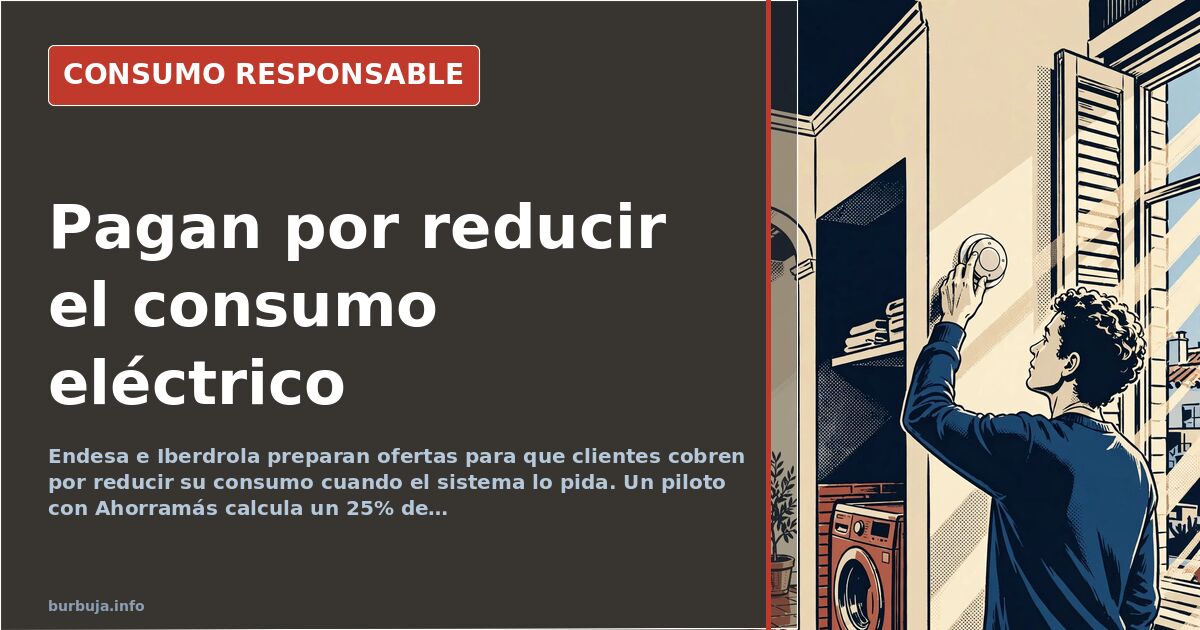
Endesa and Iberdrola to Pay Customers for Reducing Power Use
Endesa and Iberdrola are preparing offers that pay customers to reduce their electricity consumption when the system requires it. The paradox is that this mechanism has existed for years for large industry, but is now opening up to small consumers. Camila Fernandes, Head of Demand Response Product at Endesa X, summarized it at an event by the Electricity Consumers Association: "Demand management will be essential to integrate this renewable generation."
It is not charity. It is a market. The system operator pays for not starting a power plant when demand spikes. This is cheaper than firing up a combined-cycle gas turbine.
What is demand flexibility and why is it arriving now?
The electricity system was designed so that generation trinc demand. Now the goal is the opposite: demand adapts to available supply. The European guideline on electrical balancing pushes for production facilities, aggregated demand, and storage to compete on equal terms, as explained by María Luisa Llorens, Head of the Markets Department at Red Eléctrica (Spain's grid operator).
Endesa brings experience from Enel X: 14,000 managed installations and a flexible consumption capacity of 6.3 GW across 15 countries. Iberdrola, for its part, is preparing products based on monitoring and optimizing load curves. Rafael Bellido, its head of flexibility solutions, confirmed the imminent launch.
Customers who can participate are those who, with 15 to 30 minutes' notice, reduce their power draw for at least one hour. Methods range from temporarily shutting down production lines to slightly increasing temperatures in cooling systems.
The Ahorramás Pilot: 25% Return on Investment in Five Years
The first practical experience in Spain involved the Electricity Consumers Association and Minsait, a subsidiary of Indra, working with the supermarket chain Ahorramás, part of Grupo IFA. The supermarkets are grouped into an aggregator that acts as an intermediary in selling adjustment services to the system.
Managers calculate an internal rate of return close to 25% over a five-year horizon, which would begin to be perceived from the fourth year. Revenue would come 65% from the energy market and 35% from direct savings through load interruption and sensorization. The complete calculation, broken down item by item, underpins the launch plan for a virtual power plant.
The Limits No One Wants to Discuss
Endesa admits that technical requirements, competition with generation, and low remuneration may limit participation in the short term. It is not a blank check. It is a market with tight margins and strict rules.
The most repeated criticism in public discourse is that consumers pay for electricity at fixed prices and then have their supply cut when it suits the system. The technical response is that the alternative is worse: if no one reduces consumption, an expensive power plant must be started, and everyone pays for it on their bill.
Some argue this is the third world disguised as modernity. Opposing this is the argument that interruptibility has existed for years for large industry, and extending it to more consumers is precisely the opposite of a privilege.
The Australian Precedent and the Storm That Doesn't Arrive
Blackouts in South Australia are cited as warnings. The technical diagnosis is different: three thermal plants were out of service and a fourth had a failure. Systems are designed to withstand the loss of the two largest units. Four failed. Added to this is the lack of interconnections with the rest of the country, which is being corrected, along with the installation of one of the world's largest battery plants.
In Spain, 40% of the energy mix is renewable and rising. The question is not whether the system holds, but who pays for the reserve when there is no sun or wind.
What About European Funds and Interconnections?
The TEN-E regulation, in Article 14, allows EU financial aid for projects of common interest, including interconnectors. The European Green Deal mobilizes one billion euros (using the Spanish definition of 'billón' as 10^9) for all types of energy infrastructure. It is not an exclusive fund for interconnections, but they are eligible.
The debate over whether this money arrives or gets diluted in other budget lines remains open. What is clear is that the energy transition is financed through competing funds.
What if the discount for allowing your power to be cut ends up becoming the standard tariff?
Endesa and Iberdrola are preparing offers that pay customers to reduce their electricity consumption when the system requires it. The paradox is that this mechanism has existed for years for large industry, but is now opening up to small consumers. Camila Fernandes, Head of Demand Response Product at Endesa X, summarized it at an event by the Electricity Consumers Association: "Demand management will be essential to integrate this renewable generation."
It is not charity. It is a market. The system operator pays for not starting a power plant when demand spikes. This is cheaper than firing up a combined-cycle gas turbine.
What is demand flexibility and why is it arriving now?
The electricity system was designed so that generation trinc demand. Now the goal is the opposite: demand adapts to available supply. The European guideline on electrical balancing pushes for production facilities, aggregated demand, and storage to compete on equal terms, as explained by María Luisa Llorens, Head of the Markets Department at Red Eléctrica (Spain's grid operator).
Endesa brings experience from Enel X: 14,000 managed installations and a flexible consumption capacity of 6.3 GW across 15 countries. Iberdrola, for its part, is preparing products based on monitoring and optimizing load curves. Rafael Bellido, its head of flexibility solutions, confirmed the imminent launch.
Customers who can participate are those who, with 15 to 30 minutes' notice, reduce their power draw for at least one hour. Methods range from temporarily shutting down production lines to slightly increasing temperatures in cooling systems.
The Ahorramás Pilot: 25% Return on Investment in Five Years
The first practical experience in Spain involved the Electricity Consumers Association and Minsait, a subsidiary of Indra, working with the supermarket chain Ahorramás, part of Grupo IFA. The supermarkets are grouped into an aggregator that acts as an intermediary in selling adjustment services to the system.
Managers calculate an internal rate of return close to 25% over a five-year horizon, which would begin to be perceived from the fourth year. Revenue would come 65% from the energy market and 35% from direct savings through load interruption and sensorization. The complete calculation, broken down item by item, underpins the launch plan for a virtual power plant.
The Limits No One Wants to Discuss
Endesa admits that technical requirements, competition with generation, and low remuneration may limit participation in the short term. It is not a blank check. It is a market with tight margins and strict rules.
The most repeated criticism in public discourse is that consumers pay for electricity at fixed prices and then have their supply cut when it suits the system. The technical response is that the alternative is worse: if no one reduces consumption, an expensive power plant must be started, and everyone pays for it on their bill.
Some argue this is the third world disguised as modernity. Opposing this is the argument that interruptibility has existed for years for large industry, and extending it to more consumers is precisely the opposite of a privilege.
The Australian Precedent and the Storm That Doesn't Arrive
Blackouts in South Australia are cited as warnings. The technical diagnosis is different: three thermal plants were out of service and a fourth had a failure. Systems are designed to withstand the loss of the two largest units. Four failed. Added to this is the lack of interconnections with the rest of the country, which is being corrected, along with the installation of one of the world's largest battery plants.
In Spain, 40% of the energy mix is renewable and rising. The question is not whether the system holds, but who pays for the reserve when there is no sun or wind.
What About European Funds and Interconnections?
The TEN-E regulation, in Article 14, allows EU financial aid for projects of common interest, including interconnectors. The European Green Deal mobilizes one billion euros (using the Spanish definition of 'billón' as 10^9) for all types of energy infrastructure. It is not an exclusive fund for interconnections, but they are eligible.
The debate over whether this money arrives or gets diluted in other budget lines remains open. What is clear is that the energy transition is financed through competing funds.
What if the discount for allowing your power to be cut ends up becoming the standard tariff?
Summary of a discussion on Burbuja.info - Foro de economía, actualidad y política., translated from Spanish and reviewed before publication. Read the full discussion (171 replies).
More summaries
-
Naturgy challenges wholesale market with fixed €60/MWh rate
Naturgy offers a fixed €60/MWh rate for 24 months against a wholesale price of €141.17/MWh, as Iberdrola and Endesa also launch competing bids.
-
Solar panel owners pay up to double for electricity
Retailers charge solar users up to €0.17/kWh versus €0.08 for non-solar homes, doubling the cost per kilowatt-hour.
-
Heating oil: fill the tank now or wait?
Heating oil prices jump 7 cents in days: filling a 1,500-litre tank now costs over €100 extra. When it pays to wait.
-
Lidl launches 2.24 kWh home battery for €299
Lidl sells a 2.24 kWh solar battery for €299. We analyze its profitability for self-consumption, savings potential, and drawbacks.
-
Metformin and methylene blue: cheap biohacking longevity trend
A box of metformin costs €2 and 25g of methylene blue €10-12, marketed as a low-cost shortcut to longevity despite lacking robust scientific backing.
-
Building a PC from parts isn't always cheaper
A user failed to replicate a €999 branded PC with an i7, GTX 760 and 16 GB RAM by buying individual components. DIY builds aren't always the most cost-effective option.