
Empty Riazor stadium highlights women's football attendance gap
Debate on empty stands for Deportivo's women's team versus past male crowds in Segunda B, questioning economic sustainability and TV rights.
English · Original discussion in Spanish · Published
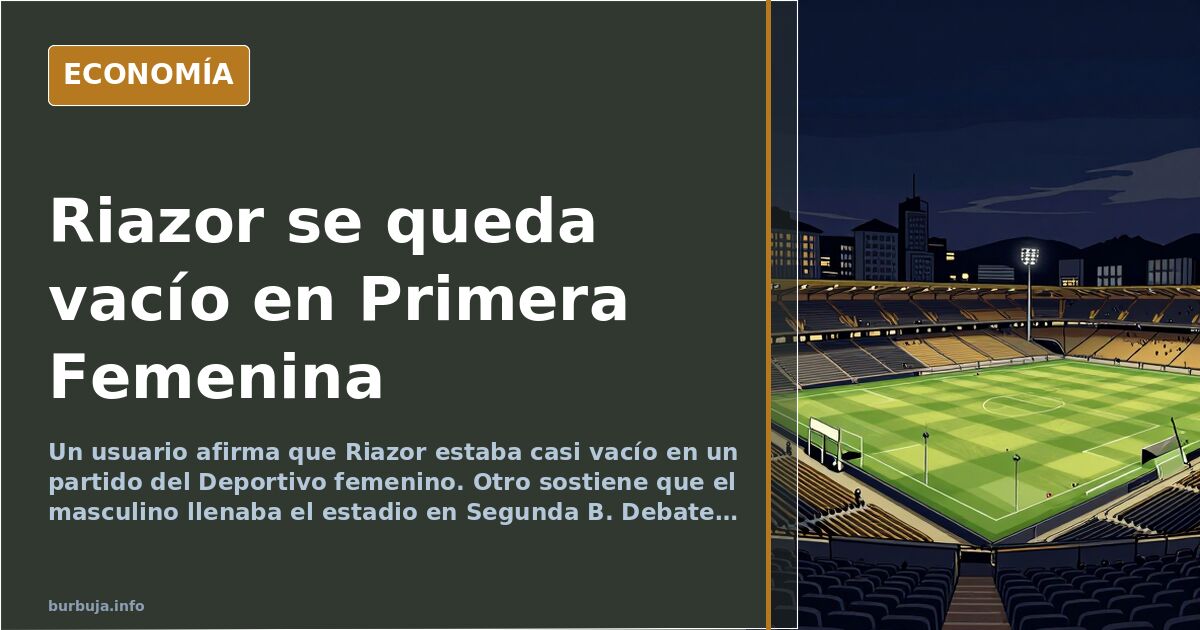
Empty Riazor stadium highlights women's football attendance gap
Deportivo's women's team plays in the Primera División Femenina, yet images from their match against Athletic Club Femenino show nearly empty stands at Riazor. The paradox noted is that the same stadium drew much larger crowds when the men's team played in Segunda B. This scene has reignited debate over the economic sustainability of women's football and its reliance on ticket sales.
Ticket sales don't even cover electricity
The first message summarizes the issue bluntly: "Ticket sales don't even cover the light bill." While it may sound exaggerated, this reflects an uncomfortable reality: keeping a stadium like Riazor lit, staffed, and operational requires an audience size that the Primera División Femenina is not currently generating. Hundreds of people working for an event that, according to several analyses, could take place on a youth pitch without losing essential quality. The lingering question is who pays the difference.
Who bears the cost of playing at Riazor?
According to the agreement cited in the debate, the club itself covers these costs. Real Club Deportivo de La Coruña assumes maintenance expenses for facilities including turf, stands, locker rooms, and offices, excluding metallic structures and roofs. Thus, women's football does not pay rent for Riazor; it is subsidized by the club's structure. This doesn't make ticket sales irrelevant for balancing books, but it disproves the idea that each women's match generates direct losses via rent. The deficit lies elsewhere: in the gap between operating costs and revenue.
Women's football and public television
A recurring argument points to broadcasting rights. It is claimed that public television paid significantly more for women's football than its market value, with those losses eventually socialized. Comparison with men's football is inevitable: if women's viewership is a fraction of men's, why don't rights reflect that difference? The debate suggests this isn't about market forces, but rather an agenda. And ultimately, the taxpayer foots the bill.
The wage equality argument
Discussion quickly shifts to equal pay. Some argue female players should earn the same as men, while others counter with a simple question: if they did, would stadiums be full? The conclusion drawn is that wage equality cannot be sustained by non-existent ticket sales. Men's football generates revenue from rights, sponsorships, and tickets that women's football, today, does not reach. The gap is not an opinion: it is a profit and loss statement.
Comparison with Segunda B
The most repeated data point contrasts the men's team. When Deportivo played in Segunda B, Riazor recorded notably higher attendances than the women's team in the top flight. The paradox is twofold: the women compete in a higher category but draw fewer spectators than the men in a lower one. This fuels the thesis that the product, currently, lacks interest. And that no visibility campaign has managed to reverse this reality.
Debate on institutional imposition
Part of the analysis argues that women's football persists due to institutional imposition, not real demand. It is contended that if a product fails to convince the public, it should disappear or restructure, rather than being sustained by public money. The counterargument, less present in the debate, is that men's football also receives indirect subsidies and that comparing ticket sales ignores decades of investment in men's sports. The deadlock is evident: some speak of markets, others of equality, and neither side moves their position.
The scene of an empty Riazor is not an accident. It is the result of an equation that doesn't balance: large stadium, small audience, high fixed costs, and ticket sales that don't even cover lighting. As long as the gap between discourse and ticket sales remains this wide, the debate will not fade. And the disorienting data point is not how many people go now, but how many went when the men's team played in Segunda B.
Deportivo's women's team plays in the Primera División Femenina, yet images from their match against Athletic Club Femenino show nearly empty stands at Riazor. The paradox noted is that the same stadium drew much larger crowds when the men's team played in Segunda B. This scene has reignited debate over the economic sustainability of women's football and its reliance on ticket sales.
Ticket sales don't even cover electricity
The first message summarizes the issue bluntly: "Ticket sales don't even cover the light bill." While it may sound exaggerated, this reflects an uncomfortable reality: keeping a stadium like Riazor lit, staffed, and operational requires an audience size that the Primera División Femenina is not currently generating. Hundreds of people working for an event that, according to several analyses, could take place on a youth pitch without losing essential quality. The lingering question is who pays the difference.
Who bears the cost of playing at Riazor?
According to the agreement cited in the debate, the club itself covers these costs. Real Club Deportivo de La Coruña assumes maintenance expenses for facilities including turf, stands, locker rooms, and offices, excluding metallic structures and roofs. Thus, women's football does not pay rent for Riazor; it is subsidized by the club's structure. This doesn't make ticket sales irrelevant for balancing books, but it disproves the idea that each women's match generates direct losses via rent. The deficit lies elsewhere: in the gap between operating costs and revenue.
Women's football and public television
A recurring argument points to broadcasting rights. It is claimed that public television paid significantly more for women's football than its market value, with those losses eventually socialized. Comparison with men's football is inevitable: if women's viewership is a fraction of men's, why don't rights reflect that difference? The debate suggests this isn't about market forces, but rather an agenda. And ultimately, the taxpayer foots the bill.
The wage equality argument
Discussion quickly shifts to equal pay. Some argue female players should earn the same as men, while others counter with a simple question: if they did, would stadiums be full? The conclusion drawn is that wage equality cannot be sustained by non-existent ticket sales. Men's football generates revenue from rights, sponsorships, and tickets that women's football, today, does not reach. The gap is not an opinion: it is a profit and loss statement.
Comparison with Segunda B
The most repeated data point contrasts the men's team. When Deportivo played in Segunda B, Riazor recorded notably higher attendances than the women's team in the top flight. The paradox is twofold: the women compete in a higher category but draw fewer spectators than the men in a lower one. This fuels the thesis that the product, currently, lacks interest. And that no visibility campaign has managed to reverse this reality.
Debate on institutional imposition
Part of the analysis argues that women's football persists due to institutional imposition, not real demand. It is contended that if a product fails to convince the public, it should disappear or restructure, rather than being sustained by public money. The counterargument, less present in the debate, is that men's football also receives indirect subsidies and that comparing ticket sales ignores decades of investment in men's sports. The deadlock is evident: some speak of markets, others of equality, and neither side moves their position.
The scene of an empty Riazor is not an accident. It is the result of an equation that doesn't balance: large stadium, small audience, high fixed costs, and ticket sales that don't even cover lighting. As long as the gap between discourse and ticket sales remains this wide, the debate will not fade. And the disorienting data point is not how many people go now, but how many went when the men's team played in Segunda B.
Summary of a discussion on Burbuja.info - Foro de economía, actualidad y política., translated from Spanish and reviewed before publication. Read the full discussion (180 replies).
More summaries
-
Calzetta calls for women-only chess tournaments in Spain
Only one non-Spanish woman ranks in Spain's top 100 chess players. Mónica Calzetta demands separate female competitions.
-
Spain's Football Federation Unifies Men's and Women's Teams
RFEF adopts a single brand for national teams, raising questions about match identification and persistent wage gaps.
-
Irene Montero promises €1,800 minimum wage and 30 working hours per week
Irene Montero promises €1,800 minimum wage and 30 hours per week by 2027: the payroll linked to the minimum wage has multiplied by 28 since 2000.
-
Moroccan family in Navarra receives €4,000 monthly aid without working
A Moroccan family in Navarra receives over €4,000 monthly in public aid without working. Discover the details and benefits.
-
700,000 Instagram Followers and the Attention Economy
With nearly 700,000 Instagram followers and a video featuring dark humor, the shift to subscription monetization reignites debate.
-
Smartphone Addiction: Designed to Hook, Unregulated
Pedestrians ignored green lights while glued to phones. Experts blame intentional design features that foster compulsive usage.