
Calzetta calls for women-only chess tournaments in Spain
Only one non-Spanish woman ranks in Spain's top 100 chess players. Mónica Calzetta demands separate female competitions.
English · Original discussion in Spanish · Published
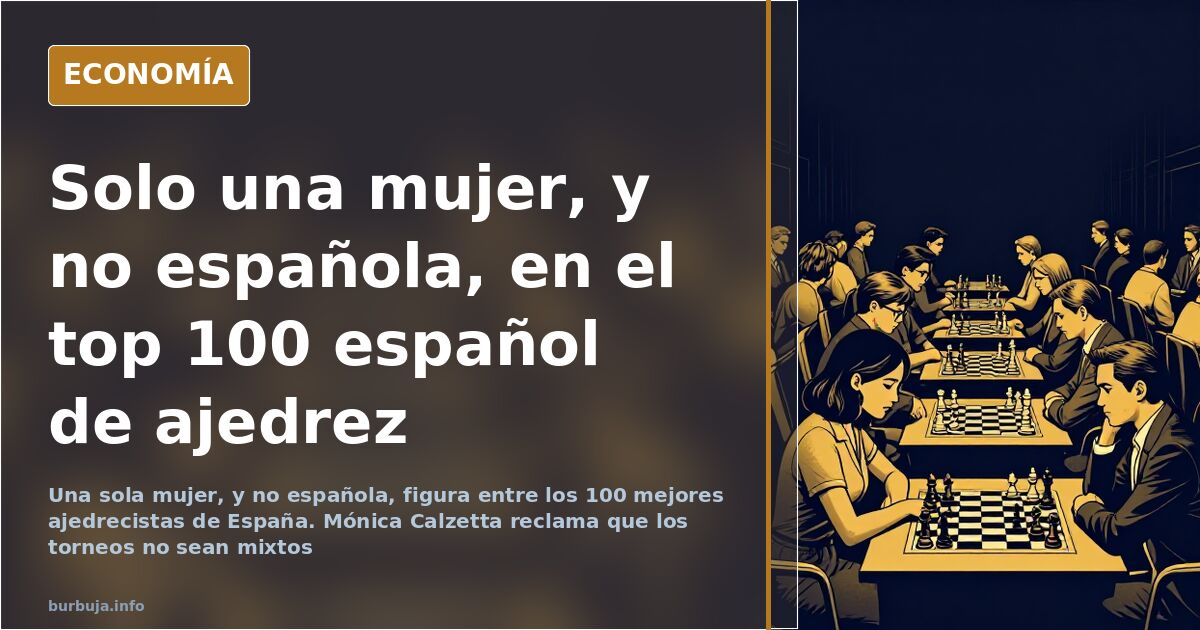
The veteran champion who wants to separate chess by gender
The headline read "Spanish Chess Champion." It was wrong. Mónica Calzetta is the world female champion in the +50 category—veterans, among women—and the national title holder is Sara Khadem, an Iranian. This detail is not a harmless typo: it summarizes the confusion plaguing the debate on why women perform worse at the board, a discussion that resurfaces whenever someone calls for segregated competitions.
Calzetta has made this demand. Her phrase, as circulated: "They ignore me." She argues against mixed tournaments and requests women's championships, similar to those existing in other European countries.
Why do women have poorer results in chess?
The question admits no single answer. One of the most repeated explanations focuses on the base: many girls quit chess during school years, resulting in simply fewer women playing. The consequence is arithmetic. A smaller base means less probability of an elite emerging. And a smaller elite means fewer role models: if you never see a female player winning, who do you want to emulate?
The counterargument uses the same data. Some point out that throughout history there has been only one case of a woman competing on equal footing at the absolute top level. This serves both directions: as proof it is possible, and as proof it is exceptional. Here the discussion stalls.
One woman among Spain's top 100, and she is not Spanish
The numbers are stubborn. In the ranking of Spain's top hundred chess players, there is only one woman, and she does not hold Spanish nationality. Zero Spanish women. International presence at the top is not a minor phenomenon: the second-ranked national player is a naturalized Russian, the fourth is Argentine, and the fifth and eighth are also Russians.
There is also an uncomfortable fact about the protagonist herself: her ELO rating has never exceeded 2400 points. At that level, it is argued, a male player would not have represented Spain nor traveled worldwide funded by federations and tournaments. In the female category, she has competed in team Olympiads, Europeans, and individual events. This is the harshest circulating argument: that segregation not only exists but has sustained mid-level female players for decades.
The parallel with basketball: height doesn't play in separate leagues
The most cited comparison is structural, not biological. In basketball, a short player has a harder time not due to inferiority, but because the game rewards height. No one organizes leagues separated by height. Translated to the board: if women are fewer and start with a base disadvantage, separating by gender guarantees medals to those who wouldn't win them under equality.
Against this, another current insists that sens division in sport has always been justified by physical differences, and in a game of pure logic, that excuse does not exist. If they separate, it is for something else. And if they don't separate, they are accused of the same thing. Separating is sens; not separating is too.
Silence, concentration, and five-hour games
The classic argument about mental endurance also appears: staying concentrated for hours without opening your mouth. The serious version points to the residual physical training needed by elite chess players and the fact that personal coaches aren't paid for fun. The crude version attributes the difference to the ability to remain silent during the game, and some recall Vassily Smyslov, world champion in the fifties, responding along those lines. The joke has aged poorly.
Conversely, a domestic anecdote circulates: a couple plays giant chess in a Caribbean hotel, he wins, and their relationship starts to sour right then. The conclusion drawn, half-seriously, is that the problem wasn't the board.
The federation, the silence, and the deflating interest
In the background lies something less noble than epistemology. Attention is drawn to a conflict with the federation: the request for women's tournaments would serve, among other things, to dominate domestically and be number one in the circuit. In sports with few practitioners—martial arts, for example—separating by gender multiplies medal options without needing to be the best in absolute terms.
Then there is the trend. According to some participants' accounts, a few years ago a TV series about a genius chess player boosted sales of boards and pieces. It lasted as long as these things do: the games ended up in second-hand shops and interest faded with them.
Chess remains one of the few games where the most powerful piece on the board is the queen. It starts moving when everything else is already set. It wins entire games. And it has never needed quotas to do so.
The headline read "Spanish Chess Champion." It was wrong. Mónica Calzetta is the world female champion in the +50 category—veterans, among women—and the national title holder is Sara Khadem, an Iranian. This detail is not a harmless typo: it summarizes the confusion plaguing the debate on why women perform worse at the board, a discussion that resurfaces whenever someone calls for segregated competitions.
Calzetta has made this demand. Her phrase, as circulated: "They ignore me." She argues against mixed tournaments and requests women's championships, similar to those existing in other European countries.
Why do women have poorer results in chess?
The question admits no single answer. One of the most repeated explanations focuses on the base: many girls quit chess during school years, resulting in simply fewer women playing. The consequence is arithmetic. A smaller base means less probability of an elite emerging. And a smaller elite means fewer role models: if you never see a female player winning, who do you want to emulate?
The counterargument uses the same data. Some point out that throughout history there has been only one case of a woman competing on equal footing at the absolute top level. This serves both directions: as proof it is possible, and as proof it is exceptional. Here the discussion stalls.
One woman among Spain's top 100, and she is not Spanish
The numbers are stubborn. In the ranking of Spain's top hundred chess players, there is only one woman, and she does not hold Spanish nationality. Zero Spanish women. International presence at the top is not a minor phenomenon: the second-ranked national player is a naturalized Russian, the fourth is Argentine, and the fifth and eighth are also Russians.
There is also an uncomfortable fact about the protagonist herself: her ELO rating has never exceeded 2400 points. At that level, it is argued, a male player would not have represented Spain nor traveled worldwide funded by federations and tournaments. In the female category, she has competed in team Olympiads, Europeans, and individual events. This is the harshest circulating argument: that segregation not only exists but has sustained mid-level female players for decades.
The parallel with basketball: height doesn't play in separate leagues
The most cited comparison is structural, not biological. In basketball, a short player has a harder time not due to inferiority, but because the game rewards height. No one organizes leagues separated by height. Translated to the board: if women are fewer and start with a base disadvantage, separating by gender guarantees medals to those who wouldn't win them under equality.
Against this, another current insists that sens division in sport has always been justified by physical differences, and in a game of pure logic, that excuse does not exist. If they separate, it is for something else. And if they don't separate, they are accused of the same thing. Separating is sens; not separating is too.
Silence, concentration, and five-hour games
The classic argument about mental endurance also appears: staying concentrated for hours without opening your mouth. The serious version points to the residual physical training needed by elite chess players and the fact that personal coaches aren't paid for fun. The crude version attributes the difference to the ability to remain silent during the game, and some recall Vassily Smyslov, world champion in the fifties, responding along those lines. The joke has aged poorly.
Conversely, a domestic anecdote circulates: a couple plays giant chess in a Caribbean hotel, he wins, and their relationship starts to sour right then. The conclusion drawn, half-seriously, is that the problem wasn't the board.
The federation, the silence, and the deflating interest
In the background lies something less noble than epistemology. Attention is drawn to a conflict with the federation: the request for women's tournaments would serve, among other things, to dominate domestically and be number one in the circuit. In sports with few practitioners—martial arts, for example—separating by gender multiplies medal options without needing to be the best in absolute terms.
Then there is the trend. According to some participants' accounts, a few years ago a TV series about a genius chess player boosted sales of boards and pieces. It lasted as long as these things do: the games ended up in second-hand shops and interest faded with them.
Chess remains one of the few games where the most powerful piece on the board is the queen. It starts moving when everything else is already set. It wins entire games. And it has never needed quotas to do so.
Summary of a discussion on Burbuja.info - Foro de economía, actualidad y política., translated from Spanish and reviewed before publication. Read the full discussion (188 replies).
More summaries
-
Spain's Cricket Team: One Native-Born Player, No Federation
Spain's national cricket team features only one player born in the country. Clubs are concentrated in Catalonia, and operations are conducted in English.
-
Rubiales Kissed Jenni Hermoso Without Consent During World Cup Celebration
Luis Rubiales kissed Jenni Hermoso during the Women's World Cup celebration, while the Spanish Football Federation allegedly removed videos citing copyright.
-
Isabel Alfaro faces charges for calling police officers 'murderers'
The Prosecutor's Office and the Spanish Police Confederation are seeking €4,050 against Isabel Alfaro, president of immigrants' associations, for labeling the police as murderers.
-
Abdellah Mustafa: The Neighbourhood Voice of Ceuta on TV
Abdellah Mustafa, neighbourhood president of Sidi Embarek, has become omnipresent on television while critics accuse him of not mentioning Morocco.
-
Chinese Migrants Leave Spain: The Economic Shift Behind the Exodus
Chinese emigration from Spain rises by 50% as bazaars close. AliExpress competition, high rents, and cash limits signal an economic cycle change.
-
Pipi Estrada Revives Myth of Happy Childhood Under Franco
Pipi Estrada claims a happy childhood under Franco, sparking debate between nostalgia and historical realities like child labor.