
Emigration from Spain hits highest levels since 2014
Spain recorded 339,358 departures in 2021 and 196,827 in the first half of 2022, marking an 11.7% increase.
English · Original discussion in Spanish · Published
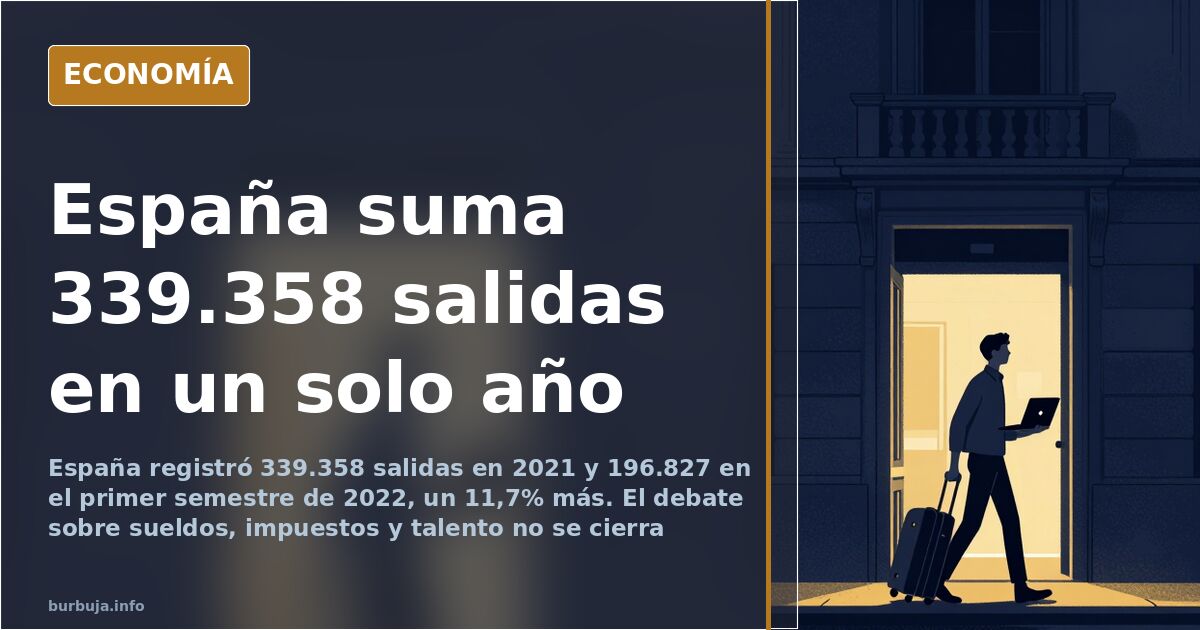
Brain drain: 339,358 people left Spain in 2021
The debate recounts the story of a Venezuelan Uber driver living in the United States who, according to the account, earns $500 net after platform commissions and gasoline by working twelve hours a day. She sends money back to her family. While this anecdote is not a statistic, it reflects the mood of a country that has long been wondering why its people are leaving. The worker exodus now has hard figures: the 219,491 migrants of 2020 rose to 339,358 in 2021, and the first half of 2022 alone saw 196,827 departures, an 11.7% increase compared to the same period the previous year.
These are the highest records since 2014. The peak remains in 2013, with 463,746 emigrants, a recurring argument used to downplay current alarmism. A recurring vocabulary detail: the media has begun calling those leaving "migrants," the same word used for those entering. Two different phenomena, one single label.
How many people are emigrating from Spain and when did the numbers spike?
The jump is concentrated in 2021: departures rose from 219,491 in 2020 to 339,358, and the first half of 2022 was already showing an even faster pace, with 196,827 registrations and a year-on-year increase of 11.7%. To find a weaker year, one must go back to 2014.
The interpretation depends on where the focus is placed. Compared to the 2013 peak, the current series remains below it and fits the label of statistical normality. Compared to the years immediately preceding it, the step is vertical. That is the version prevailing on the streets, and it is not the one typically found in official headlines.
Why Spanish wages are being compared to those in the US
The debate uses figures that are taken for granted: unemployment around 3% in the United States compared to 14% in Spain, and a poverty rate of 10% versus the 30% attributed to Spain. One participant places the US average at $70,000 for their technical position, compared to what is paid for the same work in Spain.
The trick lies in the expenses. Around 1,400 euros per month is the figure cited for a gig economy driver in Spain. The twelve-hour workday mentioned in the initial anecdote also has a downside: accumulated fatigue, risk of accidents, and medical bills in a country without universal public coverage. Some call it the milkmaid's tale.
Taxes, cost of living, and the calculation made before leaving
It is argued that the State keeps more than 60% of what is produced through social security contributions, IRPF (personal income tax), and indirect taxes. This figure is repeated like a slogan in the debate and is not accompanied by a breakdown.
The comparison with Northern Europe always appears. According to one participant, the average Swedish salary is 3,877 euros per month, compared to the 2,300 attributed to Spain. The fine print of the cost of living is provided by another forum user living in France, who points to prices such as cauliflower at 4 euros and a kilo of tangerines at 7 in certain areas. Then there is the case of Dubai, where it is claimed in the debate that private residents do not pay income tax. A complete, item-by-item breakdown of that comparison is what allows one to distinguish gross from net income after social security, rent, and healthcare.
Who is leaving: doctors, engineers, and the nuance that complicates the picture
The debate repeatedly mentions technical profiles: healthcare staff, led by doctors, and software engineers. The underlying complaint is not just the salary, but the gap between the training received and the job offered, especially outside major cities.
And here comes the uncomfortable data. The readings of INE (National Statistics Institute) statistics circulating suggest that more than 80% of those leaving hold foreign nationality. In other words, much of the supposed exodus of Spaniards is, in reality, naturalized citizens returning to their country of origin or trying their luck elsewhere. In parallel, one participant claims that between 3 and 4 million people with Spanish nationality reside abroad, a figure that, in their view, the official count fails to reach because many do not register with their consulate.
With 196,827 departures in just six months, the question is no longer whether Spain is losing people, but whom it is losing. And the answer provided by the numbers unsettles both sides: those who denounce an irreparable brain drain and those who swear that nobody is leaving.
The debate recounts the story of a Venezuelan Uber driver living in the United States who, according to the account, earns $500 net after platform commissions and gasoline by working twelve hours a day. She sends money back to her family. While this anecdote is not a statistic, it reflects the mood of a country that has long been wondering why its people are leaving. The worker exodus now has hard figures: the 219,491 migrants of 2020 rose to 339,358 in 2021, and the first half of 2022 alone saw 196,827 departures, an 11.7% increase compared to the same period the previous year.
These are the highest records since 2014. The peak remains in 2013, with 463,746 emigrants, a recurring argument used to downplay current alarmism. A recurring vocabulary detail: the media has begun calling those leaving "migrants," the same word used for those entering. Two different phenomena, one single label.
How many people are emigrating from Spain and when did the numbers spike?
The jump is concentrated in 2021: departures rose from 219,491 in 2020 to 339,358, and the first half of 2022 was already showing an even faster pace, with 196,827 registrations and a year-on-year increase of 11.7%. To find a weaker year, one must go back to 2014.
The interpretation depends on where the focus is placed. Compared to the 2013 peak, the current series remains below it and fits the label of statistical normality. Compared to the years immediately preceding it, the step is vertical. That is the version prevailing on the streets, and it is not the one typically found in official headlines.
Why Spanish wages are being compared to those in the US
The debate uses figures that are taken for granted: unemployment around 3% in the United States compared to 14% in Spain, and a poverty rate of 10% versus the 30% attributed to Spain. One participant places the US average at $70,000 for their technical position, compared to what is paid for the same work in Spain.
The trick lies in the expenses. Around 1,400 euros per month is the figure cited for a gig economy driver in Spain. The twelve-hour workday mentioned in the initial anecdote also has a downside: accumulated fatigue, risk of accidents, and medical bills in a country without universal public coverage. Some call it the milkmaid's tale.
Taxes, cost of living, and the calculation made before leaving
It is argued that the State keeps more than 60% of what is produced through social security contributions, IRPF (personal income tax), and indirect taxes. This figure is repeated like a slogan in the debate and is not accompanied by a breakdown.
The comparison with Northern Europe always appears. According to one participant, the average Swedish salary is 3,877 euros per month, compared to the 2,300 attributed to Spain. The fine print of the cost of living is provided by another forum user living in France, who points to prices such as cauliflower at 4 euros and a kilo of tangerines at 7 in certain areas. Then there is the case of Dubai, where it is claimed in the debate that private residents do not pay income tax. A complete, item-by-item breakdown of that comparison is what allows one to distinguish gross from net income after social security, rent, and healthcare.
Who is leaving: doctors, engineers, and the nuance that complicates the picture
The debate repeatedly mentions technical profiles: healthcare staff, led by doctors, and software engineers. The underlying complaint is not just the salary, but the gap between the training received and the job offered, especially outside major cities.
And here comes the uncomfortable data. The readings of INE (National Statistics Institute) statistics circulating suggest that more than 80% of those leaving hold foreign nationality. In other words, much of the supposed exodus of Spaniards is, in reality, naturalized citizens returning to their country of origin or trying their luck elsewhere. In parallel, one participant claims that between 3 and 4 million people with Spanish nationality reside abroad, a figure that, in their view, the official count fails to reach because many do not register with their consulate.
With 196,827 departures in just six months, the question is no longer whether Spain is losing people, but whom it is losing. And the answer provided by the numbers unsettles both sides: those who denounce an irreparable brain drain and those who swear that nobody is leaving.
Also available in: Deutsch
Summary of a discussion on Burbuja.info - Foro de economía, actualidad y política., translated from Spanish and reviewed before publication. Read the full discussion (475 replies).
More summaries
-
Trump Announces US Takes Control of Venezuela, No Casualties Reported
Donald Trump declares US control over Venezuela to secure oil and rebuild infrastructure, claiming zero military casualties. Analysis covers costs, reserves, and geopolitical parallels with Ukraine.
-
Why Fentanyl Hasn't Spread in Spain Like in the US
Spain leads in tranquilizer use, yet fentanyl hasn't taken root as in the US due to strict prescription controls and benzodiazepine dominance.
-
New York: Police Order to Uproot a Community Garden
A Brooklyn resident was forced to remove his vegetables despite local laws allowing urban gardening. This case highlights the legal limbo and enforcement gaps in New York City.
-
Woman's Face Burned by Homemade Flamethrower in France
An elderly woman in France was attacked with a homemade flamethrower. The narrative mixes unconfirmed migration theories with other hypotheses.
-
Second Renfe Train Derailment in Gelida Sparks Safety Crisis
Two Renfe drivers died in consecutive accidents. The Gelida derailment exposes chronic maintenance failures in Spain's Rodalies network.
-
Hantavirus Cruise Outbreak Sparks Pandemic Fears in Spain
WHO alerts on hantavirus outbreak aboard MV Hondius in Spanish waters, raising doubts about a new pandemic or media manipulation.