
NYC Mayor Mamdani Faces Budget Crisis Amid Socialist Spending
New York City Mayor Zohran Mamdani announces a severe budget deficit, highlighting the financial limits of expansive municipal spending programs.
English · Original discussion in Spanish · Published
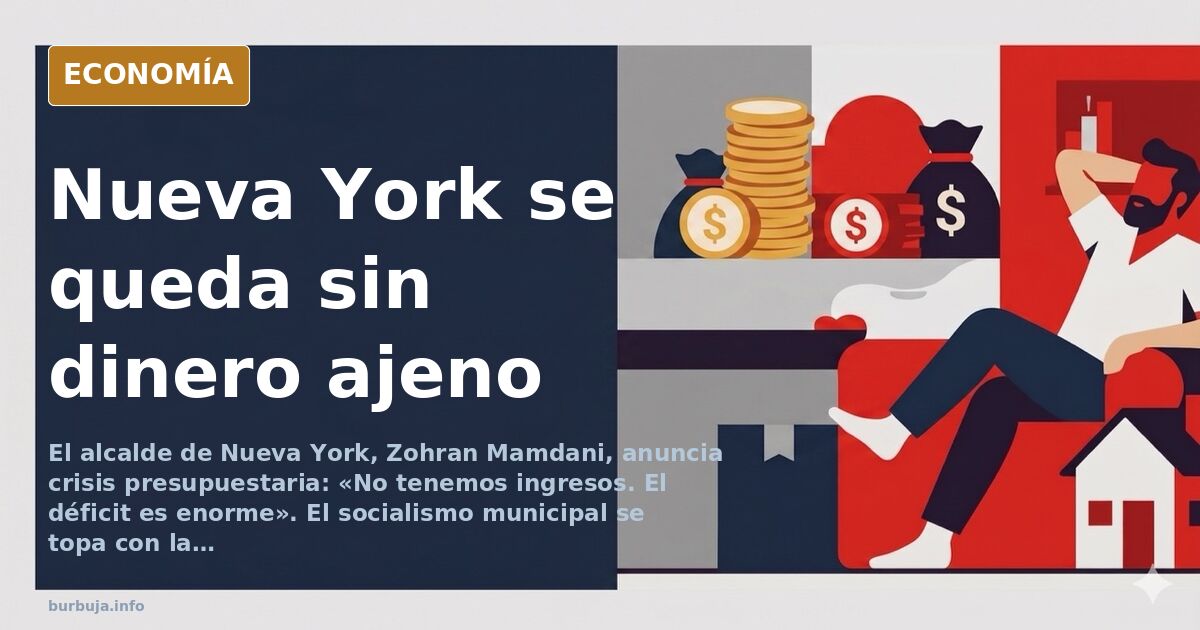
NYC and Socialism Run Out of Other People's Money
New York City Mayor Zohran Mamdani has announced that the city is in a budget crisis: "We have no revenue. The deficit is enormous." The news, spread by commentator Carlo Martin, revived the old axiom attributed to Margaret Thatcher that socialism fails when other people's money runs out. In less than two months, the mayor who promised free transport, childcare, and housing has hit the arithmetic wall. And the reaction was immediate: from those calling for tax hikes to those stating New York survived its biggest terrorist attack but may not survive socialism.
What Peine in New York
The initial message is a tweet: NYC Mayor Zohran Mamdani announces the city has gone bankrupt. "We are facing a budget crisis. We have no revenue. The deficit is enormous," he says. The post is signed by Carlo Martin, who labels the mayor a "communist" and concludes with "this is how socialism ends." The diagnosis is simple: an expansive spending program—free public transport, childcare, housing—crashes against the cash register. There is no room for nuance when the mayor himself acknowledges the hole.
The context does not help. The city carries public spending commitments that, it is argued, include guaranteed pensions for municipal employees. A data point circulating in the analysis: in New York, the average civil servant pension is around $60,000, but new ones approach $100,000. The practice of inflating overtime hours in the final years of service to raise the calculation base is a known trap. The result is a rigid spending structure that cannot be fixed with a tweet.
Socialism as Label and Problem
The discussion quickly shifts to the ideological framework. Part of the analysis argues that communism works until one learns resources are limited and elites hoard most of them, regardless of who governs. Another current sums it up sarcastically: socialism fails when other people's money runs out. The quote, attributed to Margaret Thatcher, is repeated like a mantra. Some go further: the problem is not money, but public education which for decades turned citizens into farm animals incapable of conceiving life without the State.
Not everything is mockery. Some argue more free services are needed, not fewer, and that this money comes from "the stones." The response is immediate: stones do not pay salaries. The exchange reflects a real tension between those who see social spending as investment and those who see it as unsustainable transfer. In the middle, an uncomfortable fact: public workers receive pensions far superior to private sector ones, an asymmetry reaching six figures in New York.
Bankruptcy as Mirror of Other Failures
The New York case is read as a controlled experiment. If municipal socialism bankrupts a city with NYC's fiscal capacity, what will it do to weaker economies? Comparisons with Venezuela and Cuba appear in several messages, though not all agree. One participant recalls Venezuelans lived well before Chávez and asks why capitalism isn't blamed for hunger in Honduras, Nicaragua, or Burundi. The discussion gets heated: some accuse capitalism of being selective, others respond that socialism only worked where there was already other people's money to squeeze.
Local details matter. New York is one of the world's most expensive cities, with municipal taxes on almost everything. Filming a movie scene in its streets is nearly impossible for major studios, which prefer building replicas in Los Angeles or Pinewood rather than paying fees. If taxes rise further, the risk is wealthy taxpayers emigrate, leaving only those living off subsidies. Chicago already did this.
The Trump Factor and Background Noise
The conversation drifts toward national politics. Some ask if Mamdani sought financial aid from Trump, who allegedly replied "sit here and pedal." There is no confirmation in the material. What does appear is the thesis that Trump is not proving to be better: deficit, inflation, and taxes. Defense of the former president rests on his tax cuts, inflation containment, and military-focused spending, which ultimately generates private economy. US growth, it is said, hovers around 4% versus Europe's 0.1%.
Ideological noise sometimes obscures essentials. NYC's bankruptcy is not an abstract debate on communism and capitalism: it is a city unable to pay its commitments. Causes are multiple—guaranteed pensions, rigid spending, narrowing tax base—and solutions scarce. Raising taxes may accelerate flight. Cutting spending may paralyze services. Meanwhile, the clock ticks.
What Might Happen Next
With these elements, the likely scenario is the city attempts to renegotiate pensions, cut non-essential spending, and seek extraordinary revenues. None are popular. If tax pressure rises, Chicago's experience suggests mobile taxpayers will leave. If it doesn't, the deficit will be financed with debt, another way to mortgage the future. Prediction with reservations: New York won't formally bankrupt, but will enter an adjustment cycle eroding its appeal. And the debate on municipal socialism will remain alive, because other people's money, sooner or later, runs out.
New York City Mayor Zohran Mamdani has announced that the city is in a budget crisis: "We have no revenue. The deficit is enormous." The news, spread by commentator Carlo Martin, revived the old axiom attributed to Margaret Thatcher that socialism fails when other people's money runs out. In less than two months, the mayor who promised free transport, childcare, and housing has hit the arithmetic wall. And the reaction was immediate: from those calling for tax hikes to those stating New York survived its biggest terrorist attack but may not survive socialism.
What Peine in New York
The initial message is a tweet: NYC Mayor Zohran Mamdani announces the city has gone bankrupt. "We are facing a budget crisis. We have no revenue. The deficit is enormous," he says. The post is signed by Carlo Martin, who labels the mayor a "communist" and concludes with "this is how socialism ends." The diagnosis is simple: an expansive spending program—free public transport, childcare, housing—crashes against the cash register. There is no room for nuance when the mayor himself acknowledges the hole.
The context does not help. The city carries public spending commitments that, it is argued, include guaranteed pensions for municipal employees. A data point circulating in the analysis: in New York, the average civil servant pension is around $60,000, but new ones approach $100,000. The practice of inflating overtime hours in the final years of service to raise the calculation base is a known trap. The result is a rigid spending structure that cannot be fixed with a tweet.
Socialism as Label and Problem
The discussion quickly shifts to the ideological framework. Part of the analysis argues that communism works until one learns resources are limited and elites hoard most of them, regardless of who governs. Another current sums it up sarcastically: socialism fails when other people's money runs out. The quote, attributed to Margaret Thatcher, is repeated like a mantra. Some go further: the problem is not money, but public education which for decades turned citizens into farm animals incapable of conceiving life without the State.
Not everything is mockery. Some argue more free services are needed, not fewer, and that this money comes from "the stones." The response is immediate: stones do not pay salaries. The exchange reflects a real tension between those who see social spending as investment and those who see it as unsustainable transfer. In the middle, an uncomfortable fact: public workers receive pensions far superior to private sector ones, an asymmetry reaching six figures in New York.
Bankruptcy as Mirror of Other Failures
The New York case is read as a controlled experiment. If municipal socialism bankrupts a city with NYC's fiscal capacity, what will it do to weaker economies? Comparisons with Venezuela and Cuba appear in several messages, though not all agree. One participant recalls Venezuelans lived well before Chávez and asks why capitalism isn't blamed for hunger in Honduras, Nicaragua, or Burundi. The discussion gets heated: some accuse capitalism of being selective, others respond that socialism only worked where there was already other people's money to squeeze.
Local details matter. New York is one of the world's most expensive cities, with municipal taxes on almost everything. Filming a movie scene in its streets is nearly impossible for major studios, which prefer building replicas in Los Angeles or Pinewood rather than paying fees. If taxes rise further, the risk is wealthy taxpayers emigrate, leaving only those living off subsidies. Chicago already did this.
The Trump Factor and Background Noise
The conversation drifts toward national politics. Some ask if Mamdani sought financial aid from Trump, who allegedly replied "sit here and pedal." There is no confirmation in the material. What does appear is the thesis that Trump is not proving to be better: deficit, inflation, and taxes. Defense of the former president rests on his tax cuts, inflation containment, and military-focused spending, which ultimately generates private economy. US growth, it is said, hovers around 4% versus Europe's 0.1%.
Ideological noise sometimes obscures essentials. NYC's bankruptcy is not an abstract debate on communism and capitalism: it is a city unable to pay its commitments. Causes are multiple—guaranteed pensions, rigid spending, narrowing tax base—and solutions scarce. Raising taxes may accelerate flight. Cutting spending may paralyze services. Meanwhile, the clock ticks.
What Might Happen Next
With these elements, the likely scenario is the city attempts to renegotiate pensions, cut non-essential spending, and seek extraordinary revenues. None are popular. If tax pressure rises, Chicago's experience suggests mobile taxpayers will leave. If it doesn't, the deficit will be financed with debt, another way to mortgage the future. Prediction with reservations: New York won't formally bankrupt, but will enter an adjustment cycle eroding its appeal. And the debate on municipal socialism will remain alive, because other people's money, sooner or later, runs out.
Summary of a discussion on Burbuja.info - Foro de economía, actualidad y política., translated from Spanish and reviewed before publication. Read the full discussion (196 replies).
More summaries
-
Madrid's Thatcher Square Revives Spain's Historic Enemy Debate
A Margaret Thatcher plaza in Madrid reopens the debate on Spain's historic enemies, referencing Trafalgar and the Invincible Armada.
-
Mamdani launches first city plan against antisemitism
New York Mayor-elect Zohran Mamdani launches the first municipal plan against antisemitism and visits the grave of the Lubavitcher Rebbe.
-
Officials Flee Ministries to Avoid Signing Illegal Documents
Ministry officials under suspicion request transfers to avoid signing illegal documents. Political pressure and fear of reprisals trigger a mass exodus...
-
Abstention vs. Strategic Voting: A Divided Spanish Electorate
Debate intensifies in Spain over whether abstaining delegitimizes the system, analyzing arguments for strategic voting and low turnout.
-
Hackers claim to have Sánchez’s Pegasus data, but Moncloa remains unmoved
Jabaroot claims to hold 72 GB of Pedro Sánchez’s Pegasus data, yet skepticism prevails. Neither the threat nor the noise shakes Moncloa.
-
Spain extends Almaraz nuclear plant to 2030, breaking coalition pact
Official gazette authorizes Almaraz operation until 2030, overriding Sumar's closure agreement amid €1.3 billion grid adjustment costs.