
Electric car fire explodes windows in Madrid home
An electric car catches fire while charging at a Hoyo de Manzanares home, shattering windows and requiring multiple firefighting applications.
English · Original discussion in Spanish · Published
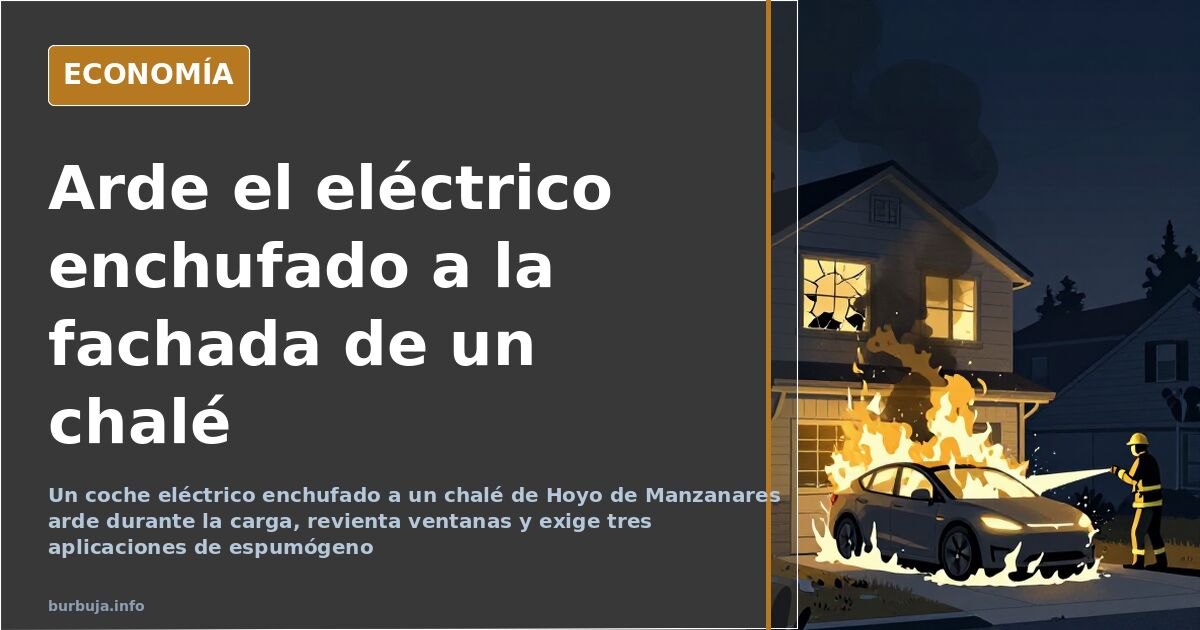
Charged electric vehicle burns and shatters windows of a Madrid home
Eight in the morning in Hoyo de Manzanares. An electric car has been connected to the facade charging point of a home when it catches fire. Neighbors and local police fight the flames with whatever they have until firefighters from the Community of Madrid arrive, who need three applications of foam to put the fire out. The heat shatters several windows and damages the wooden porch. The smoke does not enter the house.
The origin, according to the account of Emergencias Comunidad de Madrid collected by Madridiario, is a fault while the vehicle was charging at a single-family home. No prior collision or known manipulation: a plug, a battery, and a house next door. It is exactly the uncomfortable scenario, because it does not happen on the road, it happens in the garden.
Why is it so hard to extinguish an electric car fire?
The extinction took longer because electric batteries are harder to extinguish. They burn consuming the gases generated by their own chemical reaction, making it extremely difficult to extinguish the fire without cutting off the reaction. Firefighters had to insist with foam on the same vehicle three times.
This is why the technical recommendation that repeats itself in the debate is to have on hand sand or dry powder class D, the specific agent for fires that self-feed. Another guideline circulating among those who have dealt with these disasters, according to a comment on the thread, is simple and brutal: sometimes the best thing is to let it burn and protect what is around. Here the house held, with damage to the porch. One version of the event adds serious burns to a person; the emergency services statement does not detail it.
Charging in the community garage: the unclear rule
A home is a home. A parking space under an apartment building is something else. A participant relates that he asked firefighters if there is specific regulation for installing charging points in collective garages and did not get a concrete answer: he was referred to the Ministry of Industry. With that testimony, the feeling is that installation is moving faster than the fine print that should regulate it.
While it is clarified, the arithmetic is simple: thousands of spaces with an outlet under bedrooms. And the questions multiply. What happens with the rain and a charge on the street? Who is responsible if the neighbor's car catches fire and the smoke goes up the stairwell? Is a smoke alarm in the basement enough?
Statistics do not settle anything either. Loss data are handled with caution on both sides: some remember that thermal cars also burn—a modern combustion car, with the key removed, returns the excess fuel to the tank—and others respond that a battery burning under a concrete slab is a problem on another scale.
From the dreamed 30% to the 10% ceiling attributed to Toyota
The debate cites the president of Toyota, for whom total electric vehicle implementation will not exceed 10% of the global fleet. The initial forecasts mentioned 30%, and now some even doubt that second threshold: electrification is supported by public money and, when subsidies are withdrawn, the electric car would be reduced to an urban niche.
The industrial background weighs. European automotive industry bets much of its fabric and Spain, according to the repeated calculation, around 10% of its GDP. Adding a more expensive, heavier vehicle with insufficient charging infrastructure does not help sell it. And, as almost always, the suspicion is that the subsidy ends up in the same pockets as always.
The power grid remains. Millions of cars charging at night, in winter, with heating at full blast. The objection is known: no system can hold without drawing on backup power plants, and then CO2 does not disappear, it changes place with the label of sustainable.
Insurance, resale, and charging minutes
The economic layer moves below. Insurers price according to risk and, if they perceive more fire danger, the premium rises. Stories circulate about companies avoiding covering these vehicles and shipping lines restricting their embarkation, without official confirmation available.
Resale is another weak point. A participant describes how large rental companies buy by volume, amortize in two years, and release the fleet to the market; a price drop by the manufacturer breaks their margin and precipitates withdrawal. For the individual, the same doubt remains: how much will my car be worth in three years?
And then there is the clock. On long trips, the debate crosses these figures on charging minutes:
The plug that still has no answer
The Hoyo de Manzanares home was saved with shattered windows and a scorched porch, and no regulation is known that prohibits or allows repeating that charge every night under an apartment block. The market ceiling attributed to Toyota's president: 10%. It remains to be seen what is done with the other 90%.
Eight in the morning in Hoyo de Manzanares. An electric car has been connected to the facade charging point of a home when it catches fire. Neighbors and local police fight the flames with whatever they have until firefighters from the Community of Madrid arrive, who need three applications of foam to put the fire out. The heat shatters several windows and damages the wooden porch. The smoke does not enter the house.
The origin, according to the account of Emergencias Comunidad de Madrid collected by Madridiario, is a fault while the vehicle was charging at a single-family home. No prior collision or known manipulation: a plug, a battery, and a house next door. It is exactly the uncomfortable scenario, because it does not happen on the road, it happens in the garden.
Why is it so hard to extinguish an electric car fire?
The extinction took longer because electric batteries are harder to extinguish. They burn consuming the gases generated by their own chemical reaction, making it extremely difficult to extinguish the fire without cutting off the reaction. Firefighters had to insist with foam on the same vehicle three times.
This is why the technical recommendation that repeats itself in the debate is to have on hand sand or dry powder class D, the specific agent for fires that self-feed. Another guideline circulating among those who have dealt with these disasters, according to a comment on the thread, is simple and brutal: sometimes the best thing is to let it burn and protect what is around. Here the house held, with damage to the porch. One version of the event adds serious burns to a person; the emergency services statement does not detail it.
Charging in the community garage: the unclear rule
A home is a home. A parking space under an apartment building is something else. A participant relates that he asked firefighters if there is specific regulation for installing charging points in collective garages and did not get a concrete answer: he was referred to the Ministry of Industry. With that testimony, the feeling is that installation is moving faster than the fine print that should regulate it.
While it is clarified, the arithmetic is simple: thousands of spaces with an outlet under bedrooms. And the questions multiply. What happens with the rain and a charge on the street? Who is responsible if the neighbor's car catches fire and the smoke goes up the stairwell? Is a smoke alarm in the basement enough?
Statistics do not settle anything either. Loss data are handled with caution on both sides: some remember that thermal cars also burn—a modern combustion car, with the key removed, returns the excess fuel to the tank—and others respond that a battery burning under a concrete slab is a problem on another scale.
From the dreamed 30% to the 10% ceiling attributed to Toyota
The debate cites the president of Toyota, for whom total electric vehicle implementation will not exceed 10% of the global fleet. The initial forecasts mentioned 30%, and now some even doubt that second threshold: electrification is supported by public money and, when subsidies are withdrawn, the electric car would be reduced to an urban niche.
The industrial background weighs. European automotive industry bets much of its fabric and Spain, according to the repeated calculation, around 10% of its GDP. Adding a more expensive, heavier vehicle with insufficient charging infrastructure does not help sell it. And, as almost always, the suspicion is that the subsidy ends up in the same pockets as always.
The power grid remains. Millions of cars charging at night, in winter, with heating at full blast. The objection is known: no system can hold without drawing on backup power plants, and then CO2 does not disappear, it changes place with the label of sustainable.
Insurance, resale, and charging minutes
The economic layer moves below. Insurers price according to risk and, if they perceive more fire danger, the premium rises. Stories circulate about companies avoiding covering these vehicles and shipping lines restricting their embarkation, without official confirmation available.
Resale is another weak point. A participant describes how large rental companies buy by volume, amortize in two years, and release the fleet to the market; a price drop by the manufacturer breaks their margin and precipitates withdrawal. For the individual, the same doubt remains: how much will my car be worth in three years?
And then there is the clock. On long trips, the debate crosses these figures on charging minutes:
- 20 minutes: what the app promises for any route.
- 32 minutes: how long a real charge to 91% took, because going past 80% drives up the time.
- 45 minutes: what the app showed at 110 km/h with a Model 3.
The plug that still has no answer
The Hoyo de Manzanares home was saved with shattered windows and a scorched porch, and no regulation is known that prohibits or allows repeating that charge every night under an apartment block. The market ceiling attributed to Toyota's president: 10%. It remains to be seen what is done with the other 90%.
Also available in: Deutsch
Summary of a discussion on Burbuja.info - Foro de economía, actualidad y política., translated from Spanish and reviewed before publication. Read the full discussion (219 replies).
More summaries
-
EU Wine Labeling: Health Concerns vs. Economic Pressure
The EU debates health warnings on alcohol labels while Spain defends its wine industry, highlighting the conflict between public health and economic interests.
-
From the 15M campout to Sol: Fifteen Years and the Same Script
The housing protest culminates in a campout in Sol with the 2011 slogan. The electoral calendar and a potential non-payment regulation are central to the analysis.
-
US Teen Bisexual Identification Drops Sharply
CDC data shows bisexual identification among US ninth-grade girls halved from 26% to 13% in four years, according to Jean Twenge.
-
Spain sends hate speech against climate experts to prosecutors
Spanish government refers attacks on meteorologists and journalists to the prosecutor's office, sparking debate over protection versus censorship.
-
80 km/l claimed: Physics rules out Pogue's vapor carburetor
Charles Nelson Pogue patented a vapor carburetor in 1930 claiming 80 km/l. Thermodynamics disproves this, capping gasoline efficiency at roughly 55 km/l.
-
Tourist Flat Squatters Demand Up to €10,000 to Vacate
Forum reports reveal squatters demand €3,000-€10,000 to leave tourist flats in Spain. Overburdened courts and organized gangs worsen the crisis.