
Combustion cars decline: European gas stations lose 2.5 million customers
European gas stations lost 2.5 million customers in a year as Brent stays at $60. EVs grow, but the used market and subsidies remain key factors.
English · Original discussion in Spanish · Published
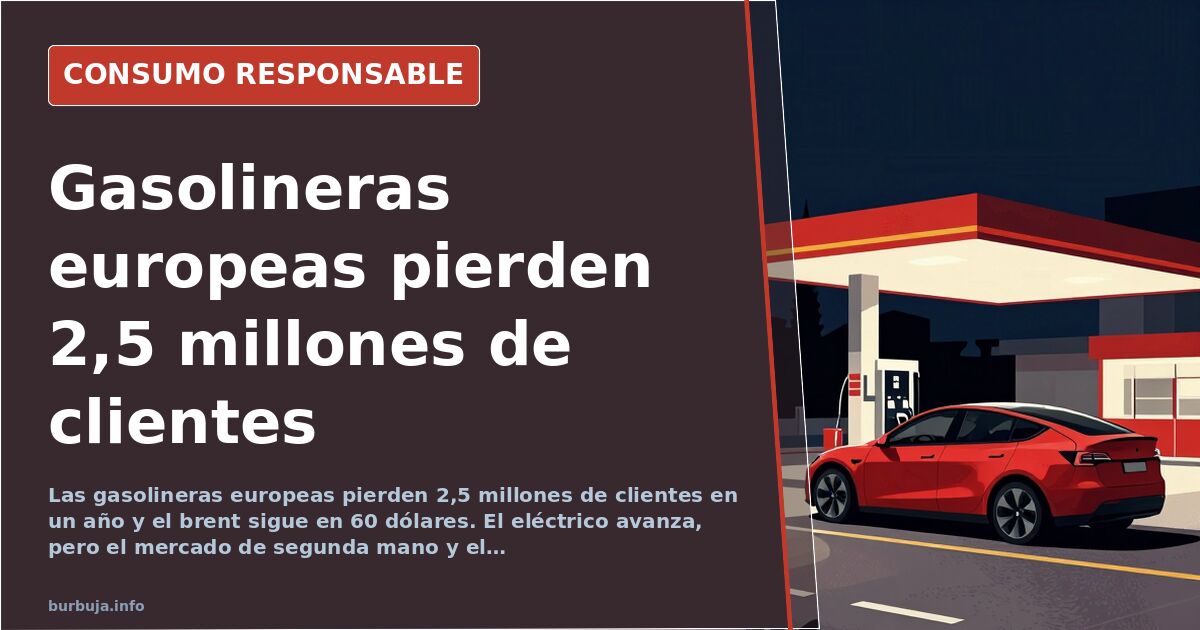
Combustion cars decline: European gas stations lose 2.5 million customers
European gas stations have lost 2.5 million customers over the past year, with an additional 1.2 million drivers switching to plug-in hybrids who will further reduce visits before taking the next step. The thesis opening this issue is blunt: combustion engine vehicles will soon hold little value. The underlying argument is not ideological but market-driven: electric vehicle sales in Europe between January and October explain why Brent remains stuck at $60 despite wars, instability, and geopolitical conflicts that should theoretically drive prices up.
The reaction was immediate. Many responses deny the premise, pointing to an electric vehicle second-hand market that they argue is virtually non-existent: no one is going to buy your used washing machine, summarizes one of the most repeated messages. Others add an uncomfortable nuance: according to some participants, half or more of EV or hybrid buyers are motivated by subsidies and free city parking, not conviction. They warn: we will see what happens when public funding stops.
What does an electric car really cost without help?
The axis of skepticism is economic. An electric vehicle without subsidies, without a private charging point, and without tax advantages ceases to make sense for many users. Those living in rural areas with solar panels and a plug, however, have an advantage: they charge at near-zero marginal cost and move around cheaply. The problem is that this model is not exportable to everyone or everywhere, and it requires infrastructure that will take years to arrive.
Some go further, arguing that no technology totally superior to its predecessor needs subsidies to succeed. If something is subsidized, they argue, it is because it is not the best option under equal conditions. The counter-argument cites the Norwegian case: there, EVs dominate, but the average Norwegian earns several times more than the average Spaniard and has decades of political pressure and significant aid behind them. The comparison, they say, does not hold.
Cold weather, range anxiety, and trips that don't work
User experience dismantles enthusiasm. One user recounts the case of an acquaintance with a BYD: charging on a standard domestic socket takes over 20 hours from 10%; at a fast charger, it takes thirty minutes but at a very high price. In cold weather, the battery drops to about 250 kilometers. On long trips, the car dictates the route based on where to charge: you serve the car, not the other way around.
In contrast, EV advocates tell a different story. A driver with years of experience assures that battery degradation was less than 10% over eight years, losing about 45 kilometers of range. He describes long trips with stops of less than ten minutes at 300 kWh chargers. The gap between these experiences is not about data: it is about user profile.
Parking as a thermometer: empty spots
One of the most cited testimonies comes from within the industry: someone working in a parking garage assures that spaces reserved for electric vehicles are almost always empty, with one, two, or no cars. Nearly 100% of the vehicles he sees are combustion engines. His conclusion is that, at least in Spain, people ignore these cars... unless the others are banned and imposed by law. There, he says, people obey and bury the old ways without fuss in just two days.
This argument has a flip side. On the highway, seeing a 500-horsepower, €130,000 electric vehicle languishing at just over 100 km/h to avoid being overtaken by trucks gives pause. For urban routes and controlled environments, however, the electric vehicle works. The problem arises when you leave those contexts.
China, Denmark, and prices that haven't reached Spain
International data tightens the narrative. In China, more than half of the cars sold this year have a plug. In Denmark, 74% of November sales were electric, compared to 70% the previous month. These are figures that skeptical narratives find hard to fit, although the recourse of saying they are different markets always remains.
And they are, at least regarding price. A model like the Leapmotor B05 launches in China for the equivalent of €12,000-€12,800, while in Spain it is expected to hover around €27,000-€30,000. The joint venture with Stellantis for the rest of the world explains the jump: here they hit us with European prices. That differential, more than any discourse, decides what gets bought and what doesn't.
The lingering question is not whether the electric vehicle is better or worse, but for whom. With a garage, solar panels, and short commutes, it wins easily. Without any of that, the math doesn't add up. Meanwhile, Brent remains at $60 and gas stations keep losing customers every month.
European gas stations have lost 2.5 million customers over the past year, with an additional 1.2 million drivers switching to plug-in hybrids who will further reduce visits before taking the next step. The thesis opening this issue is blunt: combustion engine vehicles will soon hold little value. The underlying argument is not ideological but market-driven: electric vehicle sales in Europe between January and October explain why Brent remains stuck at $60 despite wars, instability, and geopolitical conflicts that should theoretically drive prices up.
The reaction was immediate. Many responses deny the premise, pointing to an electric vehicle second-hand market that they argue is virtually non-existent: no one is going to buy your used washing machine, summarizes one of the most repeated messages. Others add an uncomfortable nuance: according to some participants, half or more of EV or hybrid buyers are motivated by subsidies and free city parking, not conviction. They warn: we will see what happens when public funding stops.
What does an electric car really cost without help?
The axis of skepticism is economic. An electric vehicle without subsidies, without a private charging point, and without tax advantages ceases to make sense for many users. Those living in rural areas with solar panels and a plug, however, have an advantage: they charge at near-zero marginal cost and move around cheaply. The problem is that this model is not exportable to everyone or everywhere, and it requires infrastructure that will take years to arrive.
Some go further, arguing that no technology totally superior to its predecessor needs subsidies to succeed. If something is subsidized, they argue, it is because it is not the best option under equal conditions. The counter-argument cites the Norwegian case: there, EVs dominate, but the average Norwegian earns several times more than the average Spaniard and has decades of political pressure and significant aid behind them. The comparison, they say, does not hold.
Cold weather, range anxiety, and trips that don't work
User experience dismantles enthusiasm. One user recounts the case of an acquaintance with a BYD: charging on a standard domestic socket takes over 20 hours from 10%; at a fast charger, it takes thirty minutes but at a very high price. In cold weather, the battery drops to about 250 kilometers. On long trips, the car dictates the route based on where to charge: you serve the car, not the other way around.
In contrast, EV advocates tell a different story. A driver with years of experience assures that battery degradation was less than 10% over eight years, losing about 45 kilometers of range. He describes long trips with stops of less than ten minutes at 300 kWh chargers. The gap between these experiences is not about data: it is about user profile.
Parking as a thermometer: empty spots
One of the most cited testimonies comes from within the industry: someone working in a parking garage assures that spaces reserved for electric vehicles are almost always empty, with one, two, or no cars. Nearly 100% of the vehicles he sees are combustion engines. His conclusion is that, at least in Spain, people ignore these cars... unless the others are banned and imposed by law. There, he says, people obey and bury the old ways without fuss in just two days.
This argument has a flip side. On the highway, seeing a 500-horsepower, €130,000 electric vehicle languishing at just over 100 km/h to avoid being overtaken by trucks gives pause. For urban routes and controlled environments, however, the electric vehicle works. The problem arises when you leave those contexts.
China, Denmark, and prices that haven't reached Spain
International data tightens the narrative. In China, more than half of the cars sold this year have a plug. In Denmark, 74% of November sales were electric, compared to 70% the previous month. These are figures that skeptical narratives find hard to fit, although the recourse of saying they are different markets always remains.
And they are, at least regarding price. A model like the Leapmotor B05 launches in China for the equivalent of €12,000-€12,800, while in Spain it is expected to hover around €27,000-€30,000. The joint venture with Stellantis for the rest of the world explains the jump: here they hit us with European prices. That differential, more than any discourse, decides what gets bought and what doesn't.
The lingering question is not whether the electric vehicle is better or worse, but for whom. With a garage, solar panels, and short commutes, it wins easily. Without any of that, the math doesn't add up. Meanwhile, Brent remains at $60 and gas stations keep losing customers every month.
Summary of a discussion on Burbuja.info - Foro de economía, actualidad y política., translated from Spanish and reviewed before publication. Read the full discussion (148 replies).
More summaries
-
Electric Cars: €2 per 100 km vs. €12 for Combustion
Electric cars cost €2 per 100 km, combustion €12. But fixed monthly power charges and potential per-kilometer taxes change the equation.
-
Electric quadricycle vs. EV: can it really save money?
A family with four cars and solar panels considers a small electric quadricycle to cut costs. Does it make sense versus a conventional EV? A cost analysis.
-
Nestlé and Dolca: 30% vs 25% Cacao, Same Price in Spain
Nestlé and Dolca chocolates differ by just 5% cacao yet cost nearly the same, revealing that budget brands in Spain are no longer significantly cheaper.
-
International blocks disrupt ebook platforms
Global crackdowns on ebook sites force users to adopt complex digital access methods.
-
Disneyland Paris Trip Costs: Real Spending Breakdown
Breakdown of Disneyland Paris costs, from budget packages to premium experiences. We analyze tickets, accommodation, and transport.
-
Idealized rural life clashes with reality: mosquitoes and illegal homes
A buyer seeking self-sufficiency found an unlicensed house, empty villages, and swarms of insects. This account challenges common defenses of rural living.