
El Salvador deploys 2,300 troops to Haiti after UN peacekeepers kidnapped
El Salvador sends about 2,300 soldiers to Haiti following the kidnapping of four peacekeepers by an armed gang, under a vague UN framework.
English · Original discussion in Spanish · Published
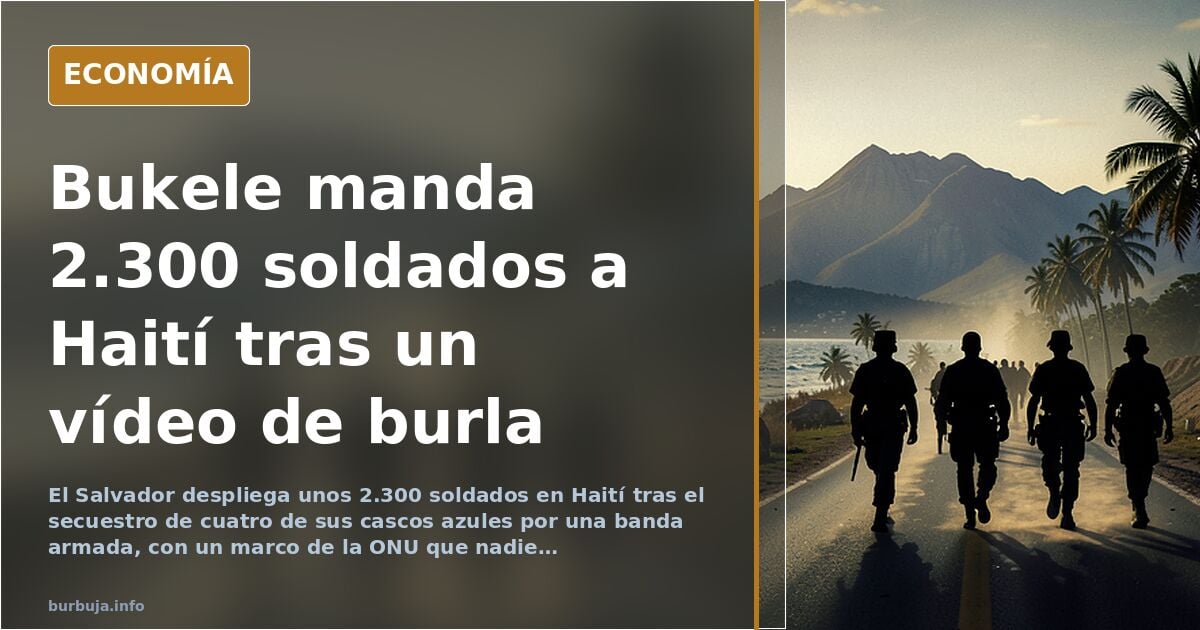
El Salvador moves 2,300 troops to Haiti after four of its own are kidnapped
Four Salvadoran soldiers operating helicopters for the UN mission in Haiti were kidnapped by one of the armed gangs controlling the country. The response from Salvadoran President Nayib Bukele was not a diplomatic note: he ordered the deployment of some **2,300 personnel** within the —diffuse— framework of international intervention. The gang leader had responded with a video mocking him. From that point on, gangs ceased to be a police problem and became a military target.
The paradox is textbook: the smallest country in the Americas mobilizes troops against the continent's poorest, despite sharing no border. In between lies a Haitian state that barely exists, warlords with territorial control, private armies hired by various actors, drones hovering over targets, and what remains of an overwhelmed police force.
How many personnel has El Salvador deployed to Haiti?
Some **2,300 soldiers**, according to counts circulating in discussions. The figure matters less for its size than for its legal fit: the deployment is presented under the umbrella of the United Nations, though that framework is not entirely clear either. With 2,300 men you do not occupy a country of 12 million inhabitants; you occupy what can be occupied. And that, in territory fragmented by gangs, basically means the points where there is something to protect.
Some read the move as more of an image operation than a military campaign. Bukele has built his political capital on the display of iron fist, and a mocking video from a gang boss is, in that script, a challenge that cannot be ignored. The question is how much real deployment there is versus staging for domestic consumption.
The non-state of Haiti: how long does a society without government last?
What is truly striking is not the invasion. It is that Haiti continues to exist as a society without a functioning State. Armed gangs, warlords, private militias, and a residual police coexist in an equilibrium that no one designed and yet sustains itself. People continue to live. Not as in Switzerland, evidently, but they continue to live.
The Haitian case—and before it, the Somali one—suggests that the threshold of chaos a society tolerates is **wide**. Very wide. That is the uncomfortable lesson: institutional collapse models taught in textbooks fall short. Life reorganizes around whoever controls the street, the port, or the market, and the State becomes just another actor, not the referee.
Who restores order and with what legitimacy?
The intervention has peine the debate on what the UN is for. Its forces have been in Haiti for years without visible results, and now it is a national army that moves the needle. Some argue that Bukele is achieving in weeks what the international community has failed to achieve in three decades; against this weighs the fact that no one has clarified under what exact mandate those 2,300 men operate or who is responsible for their actions.
US backing is taken for granted in many readings, although operational details are conspicuously absent. And there lies the fundamental problem: an intervention that changes the rules of the game without making it clear who writes them.
The model tested far from home
The operation has something of a laboratory. On one hand, an authoritarian state exporting its method; on the other, a stateless territory where any intervention becomes an experiment. Results, if they arrive, will be read as validation or warning. For now, gangs are being attacked militarily and that, objectively, has changed the board.
Are 2,300 soldiers enough to put a country back on the map, or only to demonstrate that the map hadn't been updated in a long time?
Also available in: Deutsch
Summary of a discussion on Burbuja.info - Foro de economía, actualidad y política., translated from Spanish and reviewed before publication. Read the full discussion (23 replies).
More summaries
-
Nayib Bukele's El Salvador ranked world's second-best tourist destination
The claim that El Salvador is the world's second-best tourist destination has sparked debate. We examine the economic context and the figures behind it.
-
Bukele challenges France: 'I could save it in a week'
Nayib Bukele claims El Salvador overcame 'a problem a hundred times worse' than France's and could save it in a week. The debate over his model and its cost is reigniting.
-
US threatens "devastating" retaliation if EU restricts Starlink
The US ambassador to the EU warns of a "devastating" response if Brussels restricts Starlink. The threat adds to trade tensions and pressure on Europe.
-
Riots in French schools: fires and attacks
Fires in French schools, teachers attacked and blockades spreading to Belgium. The unrest is attributed to the education strike and radical groups.
-
Texas Diesel Shortage Hits Trump Harder Than Rhetoric
Texas declared a disaster over diesel shortages, but the indifferent response triggered an electoral collapse in this Republican stronghold.
-
El Debate teases non-existent exclusive in front page announcement
Spanish outlet El Debate teased a historic exclusive without details, sparking skepticism about expectation-based journalism.