
US military official warns of defense strategy misalignment with capital markets
A US Air Force official argues that misaligned defense and financial interests could lead to a military disadvantage against China.
English · Original discussion in Spanish · Published
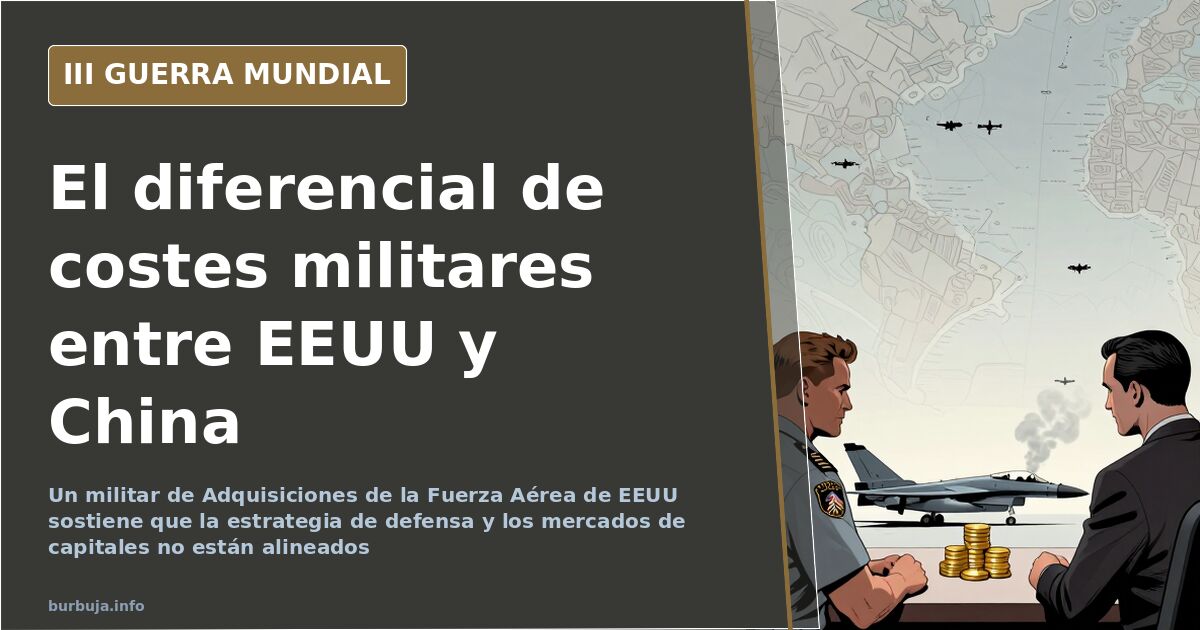
The same weapon costs 20 times more in the US than in China, according to the debate
Could the United States lose a war against China despite spending more on defense than anyone else? An American military official argues that it could, and his reasoning isn't about better or worse aircraft. Cameron Holt, Deputy Assistant Secretary of Acquisitions for the US Air Force —the department responsible for purchasing everything from drones to nuclear missiles— warned at a conference that his country faces a fundamental disadvantage: the national defense strategy and the interests of capital markets are not aligned. The analysis was reported by Esteban Hernández in El Confidencial on August 6, 2022, while the fallout from Nancy Pelosi's visit to Taiwan was still fresh.
Holt described the struggle as an existential threat to the Western way of life, contrasting two models: one where "individual rights preexist the State" and another that prioritizes collective strength. However, his argument took a turn when discussing money.
Wall Street and the Pentagon: two engines, not rivals
The most common view of this clash is that Wall Street looks complacently on China while the Pentagon hardens its tone. This is a myth, argues the speaker: both are the two major engines of the same flawed economy and they feed off each other. The market turns to the Federal Reserve, and the military buys whatever is being pitched to them.
This creates an ecosystem, according to this view, where it is more profitable to manufacture expensive weapons that require continuous spare parts than to build efficient ones. It is the same incentive as a corrupt public works contractor: if a major repair is needed in two years, it is better for business.
Why does the same weapon cost one-twentieth in China?
Trinc this same thesis, corruption in the US is, to a large extent, legal: paying a congressman or a senator would not be a crime. Furthermore, the central bank only needs to issue currency, leaving inflation to be absorbed by everyone else. Half a century of unchecked prices. The US Department of Defense has never been audited, and studies place its real budget at double the official figure.
Under this premise, the Chinese industry cannot afford such luxuries, making it more efficient in both quantity and quality. Huawei, 5G, the batteries used by Tesla, BYD electric vehicles, or Apple's manufacturing are cited as proof that the country does not merely produce cheap trinkets.
The 400,000 euro helmet and the Vietnam-era helicopters
The specific bill is what is staggering. The debate cites that an F-35 pilot's helmet costs 400,000 euros. The maintenance cost and flight hour for the aircraft remain unknown, and as noted in the thread, even Trump once said "we've gone too far" with the program, which they nicknamed the penguin. The upgrade for the CH-53, helicopters that were already flying in Vietnam, costs more per unit than it costs the Chinese to build brand-new helicopters.
This is not an isolated case, according to the examples cited: prices within the military-industrial complex skyrocket in every line item, and the full breakdown of these purchases reveals a gap that explains why the qualitative superiority of a US aircraft carrier may not be enough to close the divide.
Trafalgar is in the past: better ships, more expensive and fewer
There is a historical parallel that emerges with the data. The British won the naval war during the 18th and 19th centuries by producing somewhat inferior ships at one-third the Spanish cost. Spanish shipbuilding was superior in quality —even Nelson acknowledged it— but the arsenals were less efficient and ships were often in dry dock. At the death of Charles III, Spain had 76 ships of the line; by Trafalgar, it had fewer than 30 fully equipped and ready to sail.
After the Battle of San Vicente in 1797, there was no reaction. It is the same pattern seen with the Invencible: 25 ships lost and centuries of silence, while Drake lost more than double the trinc year and, it is argued, no one speaks of that.
The world's largest fleet is not the most powerful
China has the largest fleet in the world, but its aircraft carriers still lag behind those of the US. Beijing has much to lose in a direct clash, so it is logical that it resorts to symbolic displays of strength. Some add the demographic factor —1.5 billion inhabitants compared to one-fifth in the US— while others argue, at the opposite extreme, that it is all a setup to distract from China's economic disaster. No evidence for the latter version was provided in the debate.
One detail slips in almost unnoticed: some claim that US Navy officers have been taught to navigate by the stars again. One might say someone antiestéticars losing GPS. Or that they antiestéticar it themselves.
Could the United States lose a war against China despite spending more on defense than anyone else? An American military official argues that it could, and his reasoning isn't about better or worse aircraft. Cameron Holt, Deputy Assistant Secretary of Acquisitions for the US Air Force —the department responsible for purchasing everything from drones to nuclear missiles— warned at a conference that his country faces a fundamental disadvantage: the national defense strategy and the interests of capital markets are not aligned. The analysis was reported by Esteban Hernández in El Confidencial on August 6, 2022, while the fallout from Nancy Pelosi's visit to Taiwan was still fresh.
Holt described the struggle as an existential threat to the Western way of life, contrasting two models: one where "individual rights preexist the State" and another that prioritizes collective strength. However, his argument took a turn when discussing money.
Wall Street and the Pentagon: two engines, not rivals
The most common view of this clash is that Wall Street looks complacently on China while the Pentagon hardens its tone. This is a myth, argues the speaker: both are the two major engines of the same flawed economy and they feed off each other. The market turns to the Federal Reserve, and the military buys whatever is being pitched to them.
This creates an ecosystem, according to this view, where it is more profitable to manufacture expensive weapons that require continuous spare parts than to build efficient ones. It is the same incentive as a corrupt public works contractor: if a major repair is needed in two years, it is better for business.
Why does the same weapon cost one-twentieth in China?
Trinc this same thesis, corruption in the US is, to a large extent, legal: paying a congressman or a senator would not be a crime. Furthermore, the central bank only needs to issue currency, leaving inflation to be absorbed by everyone else. Half a century of unchecked prices. The US Department of Defense has never been audited, and studies place its real budget at double the official figure.
Under this premise, the Chinese industry cannot afford such luxuries, making it more efficient in both quantity and quality. Huawei, 5G, the batteries used by Tesla, BYD electric vehicles, or Apple's manufacturing are cited as proof that the country does not merely produce cheap trinkets.
The 400,000 euro helmet and the Vietnam-era helicopters
The specific bill is what is staggering. The debate cites that an F-35 pilot's helmet costs 400,000 euros. The maintenance cost and flight hour for the aircraft remain unknown, and as noted in the thread, even Trump once said "we've gone too far" with the program, which they nicknamed the penguin. The upgrade for the CH-53, helicopters that were already flying in Vietnam, costs more per unit than it costs the Chinese to build brand-new helicopters.
This is not an isolated case, according to the examples cited: prices within the military-industrial complex skyrocket in every line item, and the full breakdown of these purchases reveals a gap that explains why the qualitative superiority of a US aircraft carrier may not be enough to close the divide.
Trafalgar is in the past: better ships, more expensive and fewer
There is a historical parallel that emerges with the data. The British won the naval war during the 18th and 19th centuries by producing somewhat inferior ships at one-third the Spanish cost. Spanish shipbuilding was superior in quality —even Nelson acknowledged it— but the arsenals were less efficient and ships were often in dry dock. At the death of Charles III, Spain had 76 ships of the line; by Trafalgar, it had fewer than 30 fully equipped and ready to sail.
After the Battle of San Vicente in 1797, there was no reaction. It is the same pattern seen with the Invencible: 25 ships lost and centuries of silence, while Drake lost more than double the trinc year and, it is argued, no one speaks of that.
The world's largest fleet is not the most powerful
China has the largest fleet in the world, but its aircraft carriers still lag behind those of the US. Beijing has much to lose in a direct clash, so it is logical that it resorts to symbolic displays of strength. Some add the demographic factor —1.5 billion inhabitants compared to one-fifth in the US— while others argue, at the opposite extreme, that it is all a setup to distract from China's economic disaster. No evidence for the latter version was provided in the debate.
One detail slips in almost unnoticed: some claim that US Navy officers have been taught to navigate by the stars again. One might say someone antiestéticars losing GPS. Or that they antiestéticar it themselves.
Also available in: Deutsch
Summary of a discussion on Burbuja.info - Foro de economía, actualidad y política., translated from Spanish and reviewed before publication. Read the full discussion (101 replies).
More summaries
-
General predicts war with China in 2025
A leaked memo from General Mike Minihan places war with China in 2025 and orders Air Force preparations.
-
Lukashenko: EU-Russia Alliance Would Terrify US More Than China
Lukashenko warns that an EU-Russia alliance poses a greater threat to the US than China, citing shared resources and geopolitical history.
-
US Air Power: 400 F-15s, 195 F-22s – A Fleet That Stuns
The US fighter jet inventory: 400 F-15s, 500 F-16s, 195 F-22s, plus 2,000 in reserve. Russia's air defense is the counterweight.
-
Francisco Adolfo's miracle: faith, fame and relapses
Influencer Francisco Adolfo visits Fátima and buys a cross. Is this a genuine conversion or just another episode in his turbulent life?
-
Beirut: debate over bunker-buster missiles and depleted uranium
Recent explosions in Beirut have reignited debates regarding the use of bunker-buster missiles and depleted uranium in urban areas.
-
Online forum debates killing of five alleged Hamas terrorists
Analysis of forum discussions regarding Gaza, including allegations of war crimes, child fatalities, and racist rhetoric.