
Eduardo Garzón: "Unlimited" Money for Pensions, But Inflation is the Real Limit
Economist Eduardo Garzón argues money is unlimited for pensions, sparking debate on MMT, inflation, and the true limits of monetary sovereignty.
English · Original discussion in Spanish · Published
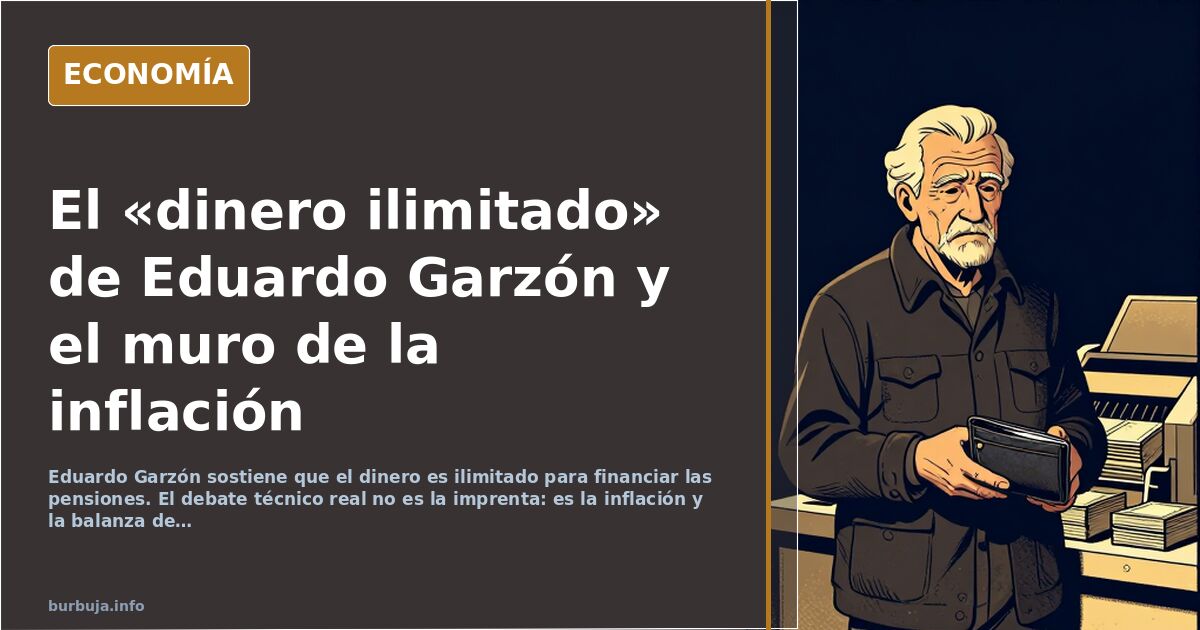
Eduardo Garzón Says There Is Money for Pensions
An economist tweets that money is unlimited and therefore sufficient to pay pensions. The response came in a cascade, mentioning two key terms: inflation and Venezuela. Eduardo Garzón, brother of fellow economist and politician Alberto Garzón, brought Modern Monetary Theory (MMT) back into the spotlight. MMT posits that a state with monetary sovereignty can never "run out of money." Critics, however, argue the issue isn't the printing press itself, but how expensive it becomes. The conversation has just begun.
In a second message, Garzón reinforced his argument with a viral analogy: "Can you imagine a math teacher saying they can't teach because they've run out of numbers? It's the same when a ruler says they've run out of money."
What is Modern Monetary Theory, Cited by Garzón
MMT, in its simplest form, starts with a basic premise: a state that issues its own currency doesn't collect taxes to spend, but rather spends first and collects later. Under this framework, the limit on public spending isn't money, but the economy's real productive capacity and the inflation generated by overspending.
This is where the disagreement begins. A number is not a good; money is a claim on scarce goods and services. This is where the analogy breaks down. "That money isn't backed by anything, so print, print, and inflation will be the least of your problems," summarizes one of the most frequent responses. Critics don't deny that the state can create money. They deny that creating money is free.
Where the Circulating Money Truly Comes From
It's worth noting a fact often lost in barstool debates: most money isn't printed by any central bank. According to a breakdown by a participant in the discussion, around 97% of fiat money originates from private credit—a bank and a borrower create it out of thin air when signing a mortgage—and only 2% is generated by the state. Money, in this sense, is debt payable to the bearer: whoever accepts it does so trusting that the other party produces and can pay.
This leads to an idea proposed by another participant: when money is printed, the margin doesn't come from nowhere; it comes from people's savings in the bank. First, the purchasing power of deposits is diluted, and when these private savings are gone, open inflation appears in prices. It's not magic. It's a silent tax that no one votes for.
Venezuela, Argentina, and the Argument MMT Sidesteps
The most obvious counterargument involves country names. For critics, Argentina, Venezuela, and Cuba issue their own currencies, yet they are almost worthless. If money were truly unlimited, why can't a Venezuelan bill buy a loaf of bread? MMT proponents' response is nuanced and rarely appears in tweets: monetary sovereignty requires not having debt denominated in foreign currency, something they claim these three economies fail to meet.
Even conceding this nuance, the core issue remains. "If you pay me with invented money, I'll give you invented goods and services," summarizes another user: confidence in a currency cannot be decreed. And when it's lost, what trinc is imported inflation.
The External Sector: Where MMT Does Have a Flaw
There is one point where even critics acknowledge an identifiable limit to the diagnosis: the balance of payments. A country with monetary sovereignty can finance its spending in its own currency, yes, but if it imports far more than it exports and also expands the money supply, some of the new money ends up buying foreign products denominated in other currencies. The result: imported inflation.
Using Germany and Japan as examples, the argument is refined. The Japanese will accept euros as long as the eurozone produces something they want to buy. Only a combination of a severe trade deficit and aggressive monetary expansion unleashes the storm. There, and not in the printing press, lies the true weak point of the narrative.
From Money to Revolutions: How the Conversation Shifted
As often happens, the subject veered off course. From MMT, the discussion jumped to the history of liberal revolutions, whether England became a superpower due to peace or by advancing its political evolution, the three revolutionary cycles of the 19th century, and the Peace of Westphalia. A leap that confirms something: when an economic debate doesn't conclude, it opens up a historical one.
In between, the usual corrosive humor. Jokes about paying pensions with Panini stickers or the state handing out a million to every citizen. Little jest for a topic that sustains a good part of the clientele in any neighborhood bar. Closing those bars costs less than shutting off the printing press.
If Garzón is partially right, why doesn't anyone from a central bank loudly defend it? Perhaps the question was never whether there is money, but how much value remains once you've finished manufacturing it.
An economist tweets that money is unlimited and therefore sufficient to pay pensions. The response came in a cascade, mentioning two key terms: inflation and Venezuela. Eduardo Garzón, brother of fellow economist and politician Alberto Garzón, brought Modern Monetary Theory (MMT) back into the spotlight. MMT posits that a state with monetary sovereignty can never "run out of money." Critics, however, argue the issue isn't the printing press itself, but how expensive it becomes. The conversation has just begun.
In a second message, Garzón reinforced his argument with a viral analogy: "Can you imagine a math teacher saying they can't teach because they've run out of numbers? It's the same when a ruler says they've run out of money."
What is Modern Monetary Theory, Cited by Garzón
MMT, in its simplest form, starts with a basic premise: a state that issues its own currency doesn't collect taxes to spend, but rather spends first and collects later. Under this framework, the limit on public spending isn't money, but the economy's real productive capacity and the inflation generated by overspending.
This is where the disagreement begins. A number is not a good; money is a claim on scarce goods and services. This is where the analogy breaks down. "That money isn't backed by anything, so print, print, and inflation will be the least of your problems," summarizes one of the most frequent responses. Critics don't deny that the state can create money. They deny that creating money is free.
Where the Circulating Money Truly Comes From
It's worth noting a fact often lost in barstool debates: most money isn't printed by any central bank. According to a breakdown by a participant in the discussion, around 97% of fiat money originates from private credit—a bank and a borrower create it out of thin air when signing a mortgage—and only 2% is generated by the state. Money, in this sense, is debt payable to the bearer: whoever accepts it does so trusting that the other party produces and can pay.
This leads to an idea proposed by another participant: when money is printed, the margin doesn't come from nowhere; it comes from people's savings in the bank. First, the purchasing power of deposits is diluted, and when these private savings are gone, open inflation appears in prices. It's not magic. It's a silent tax that no one votes for.
Venezuela, Argentina, and the Argument MMT Sidesteps
The most obvious counterargument involves country names. For critics, Argentina, Venezuela, and Cuba issue their own currencies, yet they are almost worthless. If money were truly unlimited, why can't a Venezuelan bill buy a loaf of bread? MMT proponents' response is nuanced and rarely appears in tweets: monetary sovereignty requires not having debt denominated in foreign currency, something they claim these three economies fail to meet.
Even conceding this nuance, the core issue remains. "If you pay me with invented money, I'll give you invented goods and services," summarizes another user: confidence in a currency cannot be decreed. And when it's lost, what trinc is imported inflation.
The External Sector: Where MMT Does Have a Flaw
There is one point where even critics acknowledge an identifiable limit to the diagnosis: the balance of payments. A country with monetary sovereignty can finance its spending in its own currency, yes, but if it imports far more than it exports and also expands the money supply, some of the new money ends up buying foreign products denominated in other currencies. The result: imported inflation.
Using Germany and Japan as examples, the argument is refined. The Japanese will accept euros as long as the eurozone produces something they want to buy. Only a combination of a severe trade deficit and aggressive monetary expansion unleashes the storm. There, and not in the printing press, lies the true weak point of the narrative.
From Money to Revolutions: How the Conversation Shifted
As often happens, the subject veered off course. From MMT, the discussion jumped to the history of liberal revolutions, whether England became a superpower due to peace or by advancing its political evolution, the three revolutionary cycles of the 19th century, and the Peace of Westphalia. A leap that confirms something: when an economic debate doesn't conclude, it opens up a historical one.
In between, the usual corrosive humor. Jokes about paying pensions with Panini stickers or the state handing out a million to every citizen. Little jest for a topic that sustains a good part of the clientele in any neighborhood bar. Closing those bars costs less than shutting off the printing press.
If Garzón is partially right, why doesn't anyone from a central bank loudly defend it? Perhaps the question was never whether there is money, but how much value remains once you've finished manufacturing it.
Summary of a discussion on Burbuja.info - Foro de economía, actualidad y política., translated from Spanish and reviewed before publication. Read the full discussion (256 replies).
More summaries
-
Modern Monetary Theory: Money Printing or Mirage?
MMT argues that the state can print money without taxes. Inflation or control? The debate dividing economics.
-
Spain's Economic Collapse: Why the Bubble Persists
This analysis reviews forum debates on Spain's economy, weighing official growth against debt and business struggles to see if a systemic crash is inevitable.
-
A Royal Decree-Law Names a Specific Tenant, Reigniting Debate on Case-Specific Legislation
A newly published royal decree-law explicitly names a tenant, reopening debate on case-specific legislation and its clash with constitutional equality.
-
Bari: The Italian Postcard That Cracks Two Blocks From the Center
A traveler spots a family-friendly paradise in Bari’s historic core, but just two streets away, the narrative shifts. Italy vs. Spain compared.
-
Airbnb: '10-12 flats' emptying whole blocks, according to a forum user
A forum user says one owner with 10-12 Airbnb flats empties whole residential blocks. In Lugo or Teruel, prices also rise without mass tourism.
-
Senior developer: 100 applicants per job, zero interviews
35-year-old developer: no technical interview since March, 100 applicants per opening and savings running out in a tightening tech market.