
Modern Monetary Theory: Money Printing or Mirage?
MMT argues that the state can print money without taxes. Inflation or control? The debate dividing economics.
English · Original discussion in Spanish · Published
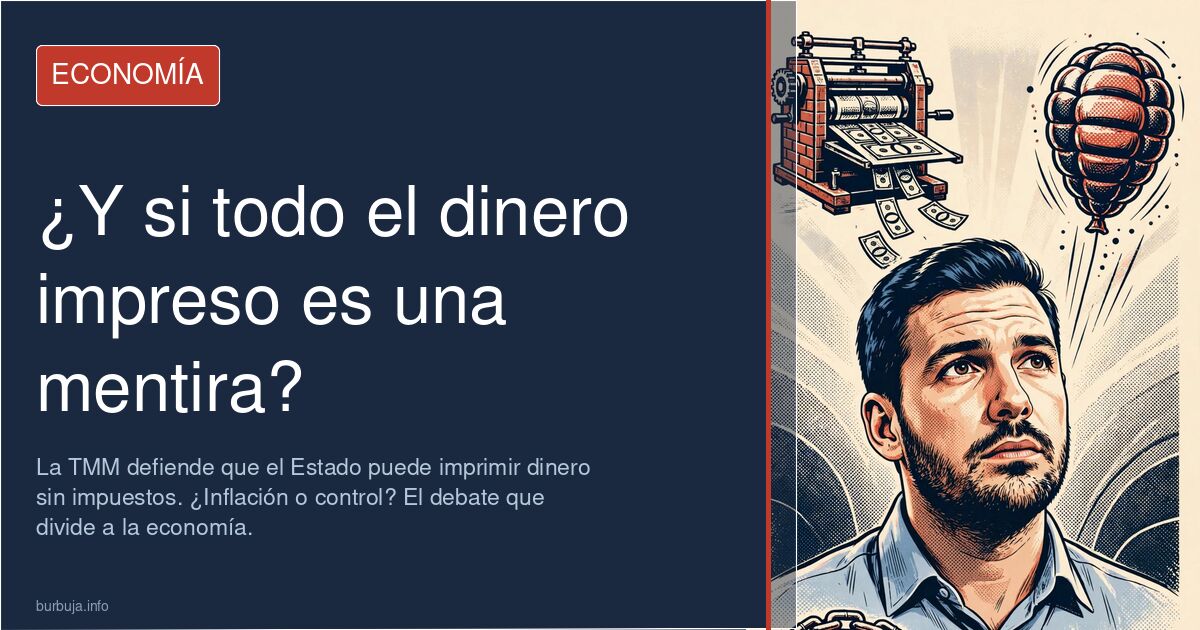
Printing money to spend: the theory challenging taxes
The states that issue their own currency do not need to collect taxes before they spend. This is the central premise of Modern Monetary Theory (MMT), advocated by Eduardo Garzón. According to this current, taxes do not fund public spending; their function is to withdraw money from circulation to control inflation and redistribute wealth.
The analogy of the counterfeiter who makes his own signatures is suggestive: he does not need to collect them in order to sign more.
The price of the printer: inflation and trust
But the objection is immediate: who accepts printed notes without backing? Trust in currency is the true foundation. A seller will only accept those slips of paper if they believe others will accept them. The Argentine case is cited as a warning: when the state prints without restraint, citizens flee to the dollar and inflation erodes the currency.
However, some point out that money is continuously created: the ECB prints and private banking creates money by issuing mortgages. So, is it merely a matter of who controls the printer?
The most uncomfortable answer points to production: a country's value lies in what it produces, not the paper it issues. Meanwhile, debt sustains the system, and GDP might be more fiction than reality. The final question remains open: are we facing a system sustained by a tolerable lie, or an uncomfortable truth that we prefer to ignore?
The states that issue their own currency do not need to collect taxes before they spend. This is the central premise of Modern Monetary Theory (MMT), advocated by Eduardo Garzón. According to this current, taxes do not fund public spending; their function is to withdraw money from circulation to control inflation and redistribute wealth.
The analogy of the counterfeiter who makes his own signatures is suggestive: he does not need to collect them in order to sign more.
The price of the printer: inflation and trust
But the objection is immediate: who accepts printed notes without backing? Trust in currency is the true foundation. A seller will only accept those slips of paper if they believe others will accept them. The Argentine case is cited as a warning: when the state prints without restraint, citizens flee to the dollar and inflation erodes the currency.
However, some point out that money is continuously created: the ECB prints and private banking creates money by issuing mortgages. So, is it merely a matter of who controls the printer?
The most uncomfortable answer points to production: a country's value lies in what it produces, not the paper it issues. Meanwhile, debt sustains the system, and GDP might be more fiction than reality. The final question remains open: are we facing a system sustained by a tolerable lie, or an uncomfortable truth that we prefer to ignore?
Summary of a discussion on Burbuja.info - Foro de economía, actualidad y política., translated from Spanish and reviewed before publication. Read the full discussion (133 replies).
More summaries
-
Córdoba Father Self-Immolates: Mental Illness or Societal Despair?
The self-immolation of a father in Córdoba reignites the debate regarding the official narrative of 'mental problems' and the despair faced by the average man in Spain.
-
Euthanasia in Old Age: Autonomy vs. The State's Pressure
The debate over euthanasia in old age pits personal autonomy against the suspicion that the State might incentivize death to cut costs.
-
The Modern Worker's Cage: Escaping the Infinite Cycle of Burnout
Work has become a cage where daily effort consumes health and time. Discover why we push ourselves so hard and how to break the cycle.
-
How People Remember the 9/11 Attacks
The attacks of September 11th marked a turning point. Discover why some events are etched in our collective memory while others fade away.
-
Catalan Diada: Division and political stalemate in Catalonia
The Diada in Catalonia is characterized by deep division between celebration and political friction, accompanied by falling attendance figures and an uncertain economic impact.
-
Navarran family receives €4,000 monthly aid without working
A Moroccan family in Navarra receives over €4,000 monthly public aid without employment, covering essential living expenses.