
Eduardo Casanova Reveals HIV Status, Sparking Debate in Spain
Spanish actor Eduardo Casanova discloses his HIV status, reigniting discussions on stigma, treatment costs, and the undetectable equals untransmittable message.
English · Original discussion in Spanish · Published
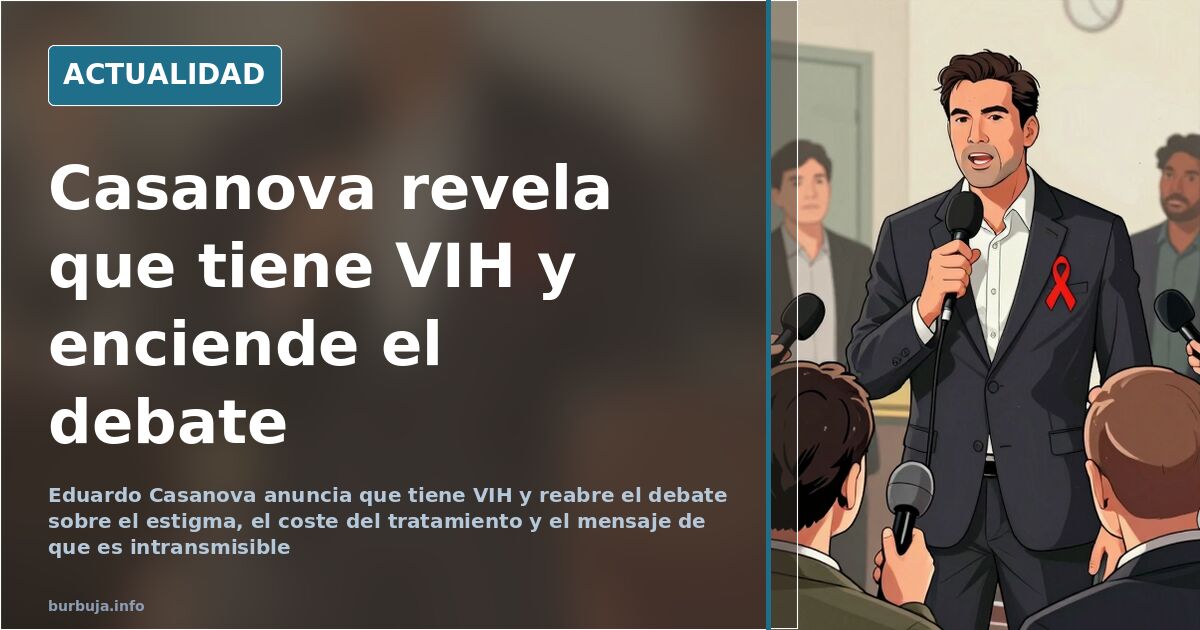
Eduardo Casanova Announces HIV Status Amid Criticism and Skepticism
What happens when a well-known actor reveals on Instagram that he has lived with HIV for years? The conversation splits in two: those applauding the visibility and those questioning the message. Eduardo Casanova, director and actor, announced on his account that he is seropositive, accompanied by a video teaser for a documentary about his life directed by journalist Jordi Évole. "Today I break this unpleasant and painful silence after MANY years," he wrote. He stated he does so "when I want, when I can" and "in my own way, through cinema."
The announcement comes amid underlying controversy: the assertion that HIV is today undetectable and therefore untransmittable. Some celebrate it as a step against stigma. Others view it as trivializing a chronic disease that still exists.
What Eduardo Casanova Said About His HIV
The actor's message is explicit: breaking years of silence to highlight a reality shared by many. The announcement relies on a documentary directed by Jordi Évole, turning the revelation into an audiovisual product as well as a personal confession. The choice of format is not accidental: Casanova says cinema is his way of communicating.
Public reaction has been mixed. Some value a public figure speaking openly about a condition that still carries social stigma. Others believe the tone, presenting the illness as manageable, may minimize risks. The debate over whether this is visibility or propaganda is set.
The Argument That HIV Is Untransmittable: What It Claims and What Is Questioned
The cornerstone of the message is that a person with HIV on treatment with an undetectable viral load does not transmit the bicho. This is current scientific consensus, but in public discourse it mixes with another idea: that HIV is no longer serious. That is where sparks fly.
One viewpoint argues such messages encourage relaxing precautions, especially among the young. They claim PrEP (pre-exposure prophylaxis) and modern treatments have restored the feeling that unprotected sens has no consequences. Against this, the medical response is clear: HIV today is a treatable chronic disease, but it is not harmless nor free. And treatment costs are shared by all.
Healthcare Costs and Who Pays for Treatment
Here appears the economic argument, which fundamentally raises the most eyebrows. Antiretroviral treatment is not cheap, and in Spain it is covered by the public health system. Some see this as a logical consequence of universal healthcare. Others point to it as a perverse incentive: if the State pays, individual risk dilutes.
The full calculation, including annual pharmaceutical cost per patient and the number of people in treatment, yields a figure that surprises those unaware of it. It is not a new debate, but Casanova's announcement has brought it back to the forefront.
Stigma Has Not Disappeared, Only Changed Form
The paradox is that the same announcement seeking to break stigma has triggered comments reinforcing it. Disclosing a health condition remains, in certain circles, a reason for mockery or suspicion. And this occurs in a country where HIV was supposed to cease being a taboo years ago.
Some argue the problem is not HIV itself, but how it is used: turning it into a banner, spectacle, or excuse. Countering this is the argument that silence never helped anyone. Between both positions, the conversation remains open.
In the end, the question is not whether Casanova has HIV. The question is what we do with that information. And there, everyone looks away.
What happens when a well-known actor reveals on Instagram that he has lived with HIV for years? The conversation splits in two: those applauding the visibility and those questioning the message. Eduardo Casanova, director and actor, announced on his account that he is seropositive, accompanied by a video teaser for a documentary about his life directed by journalist Jordi Évole. "Today I break this unpleasant and painful silence after MANY years," he wrote. He stated he does so "when I want, when I can" and "in my own way, through cinema."
The announcement comes amid underlying controversy: the assertion that HIV is today undetectable and therefore untransmittable. Some celebrate it as a step against stigma. Others view it as trivializing a chronic disease that still exists.
What Eduardo Casanova Said About His HIV
The actor's message is explicit: breaking years of silence to highlight a reality shared by many. The announcement relies on a documentary directed by Jordi Évole, turning the revelation into an audiovisual product as well as a personal confession. The choice of format is not accidental: Casanova says cinema is his way of communicating.
Public reaction has been mixed. Some value a public figure speaking openly about a condition that still carries social stigma. Others believe the tone, presenting the illness as manageable, may minimize risks. The debate over whether this is visibility or propaganda is set.
The Argument That HIV Is Untransmittable: What It Claims and What Is Questioned
The cornerstone of the message is that a person with HIV on treatment with an undetectable viral load does not transmit the bicho. This is current scientific consensus, but in public discourse it mixes with another idea: that HIV is no longer serious. That is where sparks fly.
One viewpoint argues such messages encourage relaxing precautions, especially among the young. They claim PrEP (pre-exposure prophylaxis) and modern treatments have restored the feeling that unprotected sens has no consequences. Against this, the medical response is clear: HIV today is a treatable chronic disease, but it is not harmless nor free. And treatment costs are shared by all.
Healthcare Costs and Who Pays for Treatment
Here appears the economic argument, which fundamentally raises the most eyebrows. Antiretroviral treatment is not cheap, and in Spain it is covered by the public health system. Some see this as a logical consequence of universal healthcare. Others point to it as a perverse incentive: if the State pays, individual risk dilutes.
The full calculation, including annual pharmaceutical cost per patient and the number of people in treatment, yields a figure that surprises those unaware of it. It is not a new debate, but Casanova's announcement has brought it back to the forefront.
Stigma Has Not Disappeared, Only Changed Form
The paradox is that the same announcement seeking to break stigma has triggered comments reinforcing it. Disclosing a health condition remains, in certain circles, a reason for mockery or suspicion. And this occurs in a country where HIV was supposed to cease being a taboo years ago.
Some argue the problem is not HIV itself, but how it is used: turning it into a banner, spectacle, or excuse. Countering this is the argument that silence never helped anyone. Between both positions, the conversation remains open.
In the end, the question is not whether Casanova has HIV. The question is what we do with that information. And there, everyone looks away.
Also available in: Deutsch
Summary of a discussion on Burbuja.info - Foro de economía, actualidad y política., translated from Spanish and reviewed before publication. Read the full discussion (127 replies).
More summaries
-
Casanova sparks debate on Spanish state-funded cinema
Eduardo Casanova's documentary 'Sidosa' drew only 381 viewers in 79 theaters, reigniting controversy over public subsidies for Spanish film.
-
Zapatero's daughter photographs reporter after jewellery question
One of Zapatero's daughters photographs a reporter after he asks about jewellery; the prison sentences circulating are unconfirmed
-
Forum poll shows Vox at 45.1% after sample expansion
A forum vote tally places Vox at 45.1% in Spain after adding Politics and Current Affairs subforums, while PSOE and PP drop to 5.4%.
-
Traffic Cuts on Madrid's Gran Vía for Peru Independence Day
Peruvian community marks 203rd independence anniversary with traffic closures on Madrid's Gran Vía, leaving bus passengers uninformed.
-
Spain: Diesel pumped into petrol car sparks debate
A video of two women filling a petrol car with diesel in Spain fuels discussion on mechanical literacy and the fear of intervening.
-
France warns of catastrophic economic outlook
French Prime Minister admits insufficient production and work, citing the world's highest public spending amid warnings circulating in...