
Earning €1,350 while a benefit brings home €1,650
A tweet compares a €1,350 salary with a €1,650 payment under Spain's minimum vital income scheme: the clash between the IMV, the minimum wage and rent prices
English · Original discussion in Spanish · Published
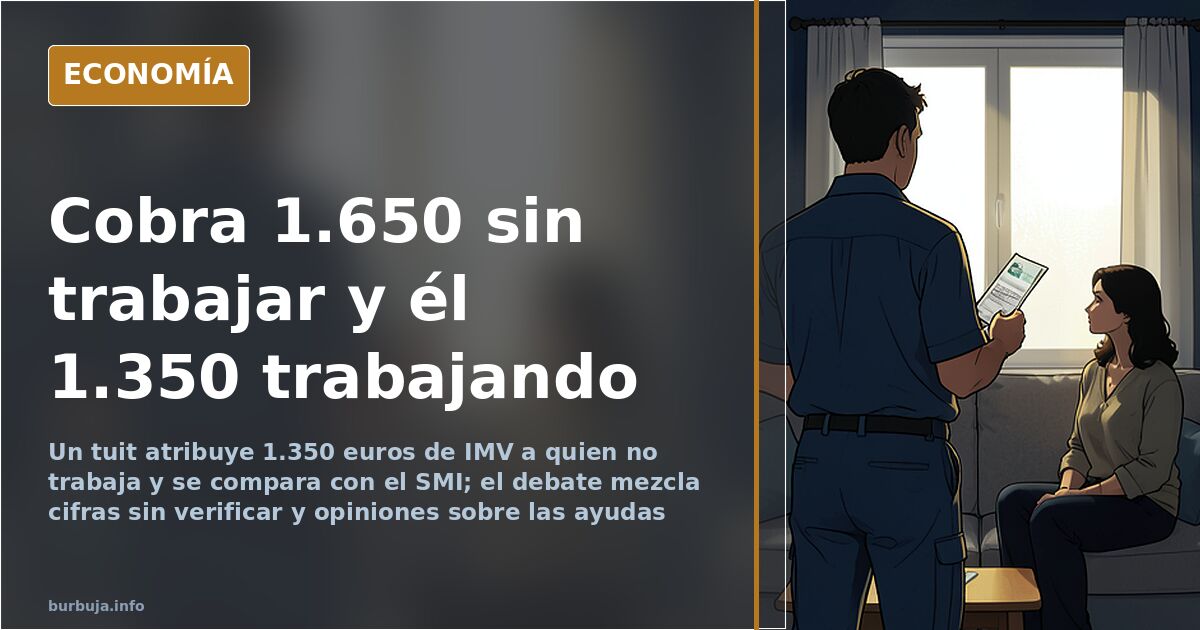
When the benefit for not working matches a €1,350 salary
How much does a government have to pay for staying at home to be worthwhile? The question stopped being rhetorical with a message attributed to writer Lucía Etxebarria: "my partner doesn't work, but receives €1,350 under the minimum vital income scheme." From there comes the comparison that stings: a salary of €1,350 versus a benefit that, in the most widely shared version of the case, reaches €1,650 without clocking in. The story comes with no attached document —just a tweet and a figure doing the rounds— but it works as a trigger because it hits the exact nerve: the gap between what the labour market pays and what the State pays for staying out of it.
The IMV doesn't look at the home you live in
The design of Spain's minimum vital income (ingreso mínimo vital, a means-tested benefit) has a antiestéticature that surprises anyone looking at it for the first time: your main residence doesn't count as wealth. The home you live in —a €50,000 flat or a one-million-euro property, at the extreme cited— doesn't reduce your entitlement. What is looked at is cash, shares and other assets: from around €22,000, the approximate figure used in this discussion, the door closes.
From that asymmetry comes the most repeated reproach: the system treats better those who run down their savings than those who save. The practical consequence, according to that account, is that the benefit stops being a safety net and becomes a subsidy for bad management. The example given is of an acquaintance, 57, with a flat in Chamberí who would keep the over-52s payment (a benefit for long-term unemployed people over 52) because the calculation looks at income and contributions: €500,000 in a deposit at 1% wouldn't reach the required minimum. Whether the case is accurate or not, it comes with no documentation whatsoever. The suspicion, however, is already circulating without needing proof.
Is the problem solved by raising the minimum wage to €2,500?
The most widespread answer is that the shame lies not in the benefit but in the wage: €2,500 as the minimum wage in a country where renting a flat "is above €1,000." The objection comes immediately and undeveloped: what would happen the day after imposing that figure? It's left hanging, which is where good intentions usually stay.
The counterpoint comes from the other side: raising the wage floor levels downwards, makes everything more expensive under the excuse of funding benefits, and leaves the worker with the same purchasing power as before. And then there's the small-scale evidence, the kind that doesn't make it into reports: someone quit rowing for €1,290 with Sundays and public holidays included and days off on Mondays or Tuesdays. That calculation —hours, weekends, rent prices— is what really drives decisions, not headline incentives.
Rent, the factor almost nobody disputes
With rent above a thousand euros in the areas where there are jobs, the debate shifts on its own. One camp argues that prices rise because of scarcity and that the demographic pressure of the last decade —five million people arriving in six years, it is said— explains why no more tenants fit in the same housing stock. Another responds that what was built during the bubble and tourist rentals weigh more, and that blaming the latest arrival is convenient and probably false. Neither thesis is quantified here. Both, however, agree on the essentials: housing has swallowed the wage debate.
Against that backdrop, public debt approaching two trillion euros stops being a distant headline and becomes the fine print of every proposal. The benefit, the minimum wage, rent and the fraud suspected without proof always end up in the same ledger.
With €1,350 you clock in; with €1,650, you don't. If that no longer grates on anyone, the problem isn't the incentive: it's that we've normalised the salary being the worst offer on the market.
Also available in: Deutsch
Summary of a discussion on Burbuja.info - Foro de economía, actualidad y política., translated from Spanish and reviewed before publication. Read the full discussion (41 replies).
More summaries
-
Spanish Minimum Income Benefit Exceeds Most Common Salary: Who Gets What
The Spanish Minimum Income Benefit (IMV) is 20% higher than the most common salary, but €1,195 is for a family of three, while €1,200 is for a single worker. Key details explained.
-
Spain's Minimum Living Income to rise by around 14% in 2027
The Minimum Living Income (Ingreso Mínimo Vital) for a single adult will rise from 733.60 to around 836 euros per month in 2027, a 14% increase, due to its legal link to non-contributory pensions.
-
Spain's minimum income benefit to rise 14% in 2027, tied to non-contributory pensions
Spain's IMV minimum income will rise almost 14% in 2027 due to its legal link to non-contributory pensions: from 733.60 to 836 euros per month for a single person.
-
Italy: diesel hits 3 euros as truckers' protests bring traffic to a halt
Diesel is nearing 3 euros on Italian motorways, trucks are blocking roads and supermarkets in southern Italy are emptying out. In Turin, police used tear gas against students.
-
Le Pen: foreign workers who lose their job should leave France
Marine Le Pen argues that foreigners working in France should return to their home country if they lose their job. It is her take on the principle of labour migration.
-
Sahrawi candidate caught asking for weapons for Hamas in Spain
A tweet attributes to Tesh Sidi, number 2 on the Frente Amplio list, an internal message about asking for weapons for Hamas. Here is what is known and what is not.