
Earning an 'easy' 15% a year in the stock market: the promise of investment courses
A course promises 15% a year in the stock market and students making 50%, while 90% of managers fail to beat the S&P 500 over 10 years.
English · Original discussion in Spanish · Published
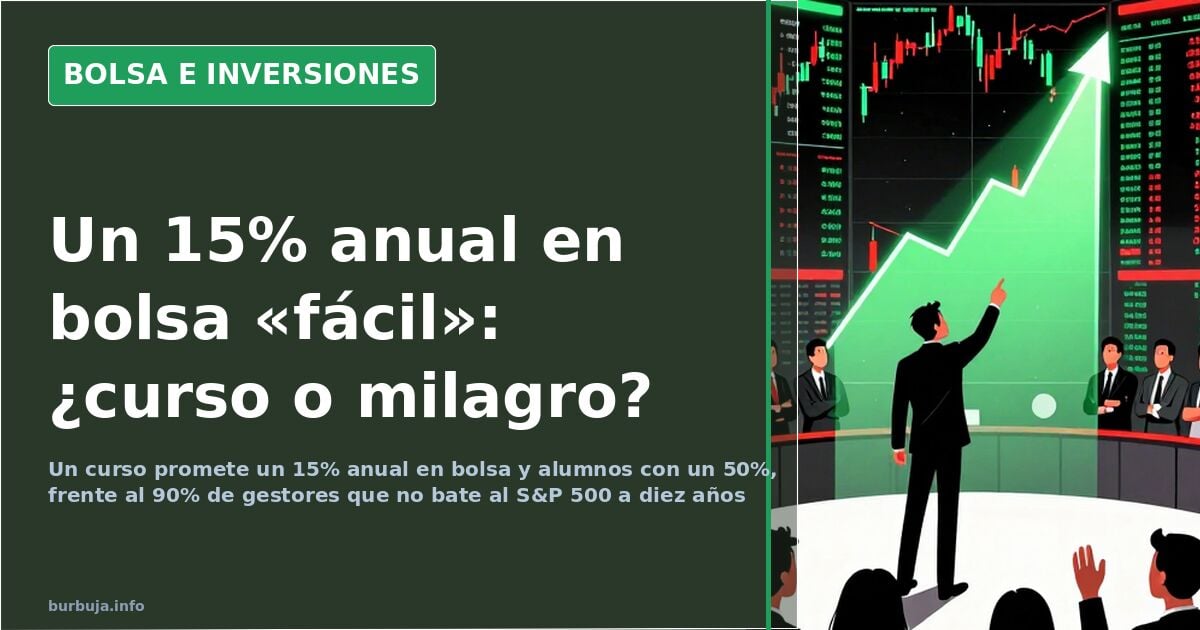
An 'easy' 15% a year in the stock market versus the 90% who don't beat the S&P 500
Can you earn 15% a year in the stock market sustainably? No one has proved it, but some sell it. An investment course 'from scratch' promises that return and boasts of students making 50% a year, with charts of good companies that leave the S&P 500 and Nasdaq in the dust. On the other side, another commentator argues the opposite: 90% of professional investors fail to beat the index over ten years. His recipe is to index, contribute every month and let compound interest do the work. The question left hanging is the ordinary saver's: study balance sheets or spend that time hustling income and putting it into a fund?
What the 15% course promises and why it sounds alarm bells
Promising above-market average returns that are sustained over time is, for many who have been trading for years, the most recognisable alarm signal there is: some sum it up by saying that such an offer is Ponzi 101. The reasoning is simple. If someone really made 50% a year, the logical thing would be to leverage up to infinity and in twenty years buy an autonomous community (Spanish region), not sell courses. Whoever teaches the method makes money from the method, not the market.
And there is an uncomfortable detail that almost never appears in the charts: those percentages do not deduct fees, taxes or expenses. Gross appreciation and the money that ends up in the account are not the same thing, however much they are presented as if they were.
Why 90% of managers don't beat the S&P 500
The data point that underpins passive investing is uncomfortable for stock picking: 90% of professional investors fail to beat the S&P 500 over periods of ten years or more. The few who have managed it consistently are names like **Warren Buffett** or Ray Dalio, and even they accumulate bad years. The most widely accepted explanation is that the index self-corrects: growing companies gain weight and pull the whole along, while the active manager pays fees and fails at rotations.
On the other side there are those who deny the main premise. That 95% of people who trade lose money would only show how weak the competition is, not that beating the index is impossible. With dedication, tolerance for error and a willingness to learn, they even claim, you can beat an index fund 'with fairly little effort'. It remains unanswered how many of the thousands who try end up in the winning percentage.
What an S&P 500 index fund really returns
The figures circulating are specific: the S&P 500 has returned a historical average of **10% a year**, and in the last fifteen years it has closed negative only twice. On that basis, a popular calculation argues that by taking advantage of corrections and putting money in during dips, that 10% becomes 'without much effort' 15%. Over thirty years, they add, no interval of the index falls below 6% and the average stays at 10%.
That is where the equal-weighted variant comes in. Comparing since 1990, the cap-weighted index returns an average **9,3%** a year and multiplies by 20,74, while the equal-weighted one —same weight for each stock— returns **10,4%** and multiplies by 28,83, 40% more. The downside: it depends on the period chosen. Over the last decade large growth stocks won, and equal weighting reduces their influence; and equal weighting dilutes the momentum factor, which is precisely what makes the winners pull the cart.
Gold, Treasury bills and money that isn't idle
Another current gets out of the market altogether: hold **95% in US Treasury bills** and the rest in gold and dividend-paying energy stocks, earning 5-6% a year with almost no risk, while waiting for the stock market to 'take such a hit'. Gold deserves its own section. Some argue it should trade at double and blame its price on ETFs, which would sell 'paper gold' multiplying the real exposure.
The classic reminder also appears: anyone who bought at the 2008 highs stayed in losses for years, and something similar peine with the Nikkei. That a drop recovers does not say when. And on parked money, a technical nuance: the 'cash' of large funds is not a wad gathering dust, it is maturities at one week, one month or one year.
Active management or DCA into an index fund: the calculation that decides
The most repeated mistake is confusing appreciation with profit. A defensive dividend portfolio shows **7% net** with a target of 4% net to withstand inflation; the **17% appreciation in 2024** is something else, because you don't collect it unless you sell. Just like a house: it has appreciated, but you live in it.
The star case on the active side —a portfolio liquidated in December with a heavy weight in Nvidia— is, for sceptics, an exercise in hindsight: anyone makes millions by choosing in 2024 the champion of the decade. Framed from today over five years, the mathematical expectation of stock picking would be negative. Opportunity cost closes the circle: every hour spent on balance sheets is an hour not devoted to your own business.
With these ingredients, the winning strategy seems to be that of someone who doesn't need to sell any course to apply it. And the 'easy' 15% will still have a queue.
Can you earn 15% a year in the stock market sustainably? No one has proved it, but some sell it. An investment course 'from scratch' promises that return and boasts of students making 50% a year, with charts of good companies that leave the S&P 500 and Nasdaq in the dust. On the other side, another commentator argues the opposite: 90% of professional investors fail to beat the index over ten years. His recipe is to index, contribute every month and let compound interest do the work. The question left hanging is the ordinary saver's: study balance sheets or spend that time hustling income and putting it into a fund?
What the 15% course promises and why it sounds alarm bells
Promising above-market average returns that are sustained over time is, for many who have been trading for years, the most recognisable alarm signal there is: some sum it up by saying that such an offer is Ponzi 101. The reasoning is simple. If someone really made 50% a year, the logical thing would be to leverage up to infinity and in twenty years buy an autonomous community (Spanish region), not sell courses. Whoever teaches the method makes money from the method, not the market.
And there is an uncomfortable detail that almost never appears in the charts: those percentages do not deduct fees, taxes or expenses. Gross appreciation and the money that ends up in the account are not the same thing, however much they are presented as if they were.
Why 90% of managers don't beat the S&P 500
The data point that underpins passive investing is uncomfortable for stock picking: 90% of professional investors fail to beat the S&P 500 over periods of ten years or more. The few who have managed it consistently are names like **Warren Buffett** or Ray Dalio, and even they accumulate bad years. The most widely accepted explanation is that the index self-corrects: growing companies gain weight and pull the whole along, while the active manager pays fees and fails at rotations.
On the other side there are those who deny the main premise. That 95% of people who trade lose money would only show how weak the competition is, not that beating the index is impossible. With dedication, tolerance for error and a willingness to learn, they even claim, you can beat an index fund 'with fairly little effort'. It remains unanswered how many of the thousands who try end up in the winning percentage.
What an S&P 500 index fund really returns
The figures circulating are specific: the S&P 500 has returned a historical average of **10% a year**, and in the last fifteen years it has closed negative only twice. On that basis, a popular calculation argues that by taking advantage of corrections and putting money in during dips, that 10% becomes 'without much effort' 15%. Over thirty years, they add, no interval of the index falls below 6% and the average stays at 10%.
That is where the equal-weighted variant comes in. Comparing since 1990, the cap-weighted index returns an average **9,3%** a year and multiplies by 20,74, while the equal-weighted one —same weight for each stock— returns **10,4%** and multiplies by 28,83, 40% more. The downside: it depends on the period chosen. Over the last decade large growth stocks won, and equal weighting reduces their influence; and equal weighting dilutes the momentum factor, which is precisely what makes the winners pull the cart.
Gold, Treasury bills and money that isn't idle
Another current gets out of the market altogether: hold **95% in US Treasury bills** and the rest in gold and dividend-paying energy stocks, earning 5-6% a year with almost no risk, while waiting for the stock market to 'take such a hit'. Gold deserves its own section. Some argue it should trade at double and blame its price on ETFs, which would sell 'paper gold' multiplying the real exposure.
The classic reminder also appears: anyone who bought at the 2008 highs stayed in losses for years, and something similar peine with the Nikkei. That a drop recovers does not say when. And on parked money, a technical nuance: the 'cash' of large funds is not a wad gathering dust, it is maturities at one week, one month or one year.
Active management or DCA into an index fund: the calculation that decides
The most repeated mistake is confusing appreciation with profit. A defensive dividend portfolio shows **7% net** with a target of 4% net to withstand inflation; the **17% appreciation in 2024** is something else, because you don't collect it unless you sell. Just like a house: it has appreciated, but you live in it.
The star case on the active side —a portfolio liquidated in December with a heavy weight in Nvidia— is, for sceptics, an exercise in hindsight: anyone makes millions by choosing in 2024 the champion of the decade. Framed from today over five years, the mathematical expectation of stock picking would be negative. Opportunity cost closes the circle: every hour spent on balance sheets is an hour not devoted to your own business.
With these ingredients, the winning strategy seems to be that of someone who doesn't need to sell any course to apply it. And the 'easy' 15% will still have a queue.
Summary of a discussion on Burbuja.info - Foro de economía, actualidad y política., translated from Spanish and reviewed before publication. Read the full discussion (273 replies).
More summaries
-
Finding Visigothic gold coins in Spain: the math doesn't add up
Finding Visigothic gold coins can be worth €80 when melted down versus over €600 as a piece: the law doesn't reward reporting the find
-
Buying the Dip or Waiting for Crash: The 2025 Market Dilemma
Centene experienced a 25% fall, AI technology is dividing investors, and market crash predictions are mounting for November. The 2025 investment dilemma: buy now or wait?
-
Gold stuck at 0.382 as bitcoin takes the spotlight
Gold stuck at 0.382 and unable to recover while bitcoin hits 6.000 dollars; thresholds at 1.250 and 1.050 set the scene.
-
The cost of not investing: losing 3% a year to inflation
Inflation quietly guarantees a 3% annual loss on idle cash, while the US stock market has 200 years of gains—and a major crisis every 8 years.
-
Extra virgin olive oil falls to €6.35 a litre at Mercadona
Extra virgin olive oil is now €6.35/litre at Mercadona, down from €6.75 months ago, while the origin price of picual is €4.143/kg
-
BIG offers 4% TAE on 6-month deposit with Spanish IBAN and Portuguese FGD
BIG launched a 4% TAE six-month and 3.5% three-month deposit in May 2023 with Spanish IBAN and Portuguese FGD, but later cut rates and had opening delays.