
Driving on a dirt track: fines of €500 to €3,000
Driving a car on a dirt track is punishable by fines of €500 to €3,000: two national laws ban it unless you have permission or it's private land
English · Original discussion in Spanish · Published
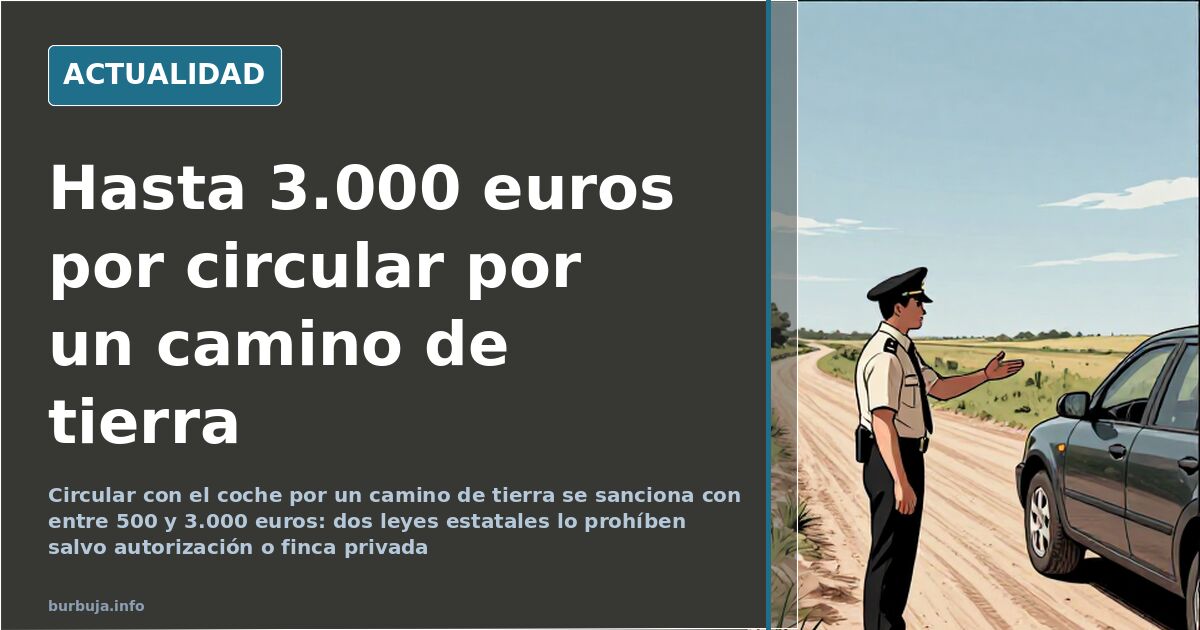
€500 to €3,000 for driving on a dirt track
There is a national rule that turns almost any drive into the countryside into an offence, and then a local council decides how much it costs you. The Ley de Montes 43/2003 (Spain's forestry law), of 21 November, and the Ley de Vías Pecuarias 3/1995 (Spain's livestock routes law), of 23 March, ban driving motor vehicles off-road, whether the track is in the middle of the hills or perfectly fit for traffic. The fine ranges from €500 to €3,000. Only two doors are open: the track is private or you have the relevant permission. The problem is almost never the track. It is the door you use to get onto it.
What the Ley de Montes and the Ley de Vías Pecuarias ban
Both rules are national in scope and agree on the same thing: you do not drive a motor vehicle through what is popularly understood as the countryside. The livestock routes law protects the drovers' roads and tracks along which livestock historically passed; the forestry law adds forest land. The exceptions are repeated in the fine print and are essentially two: private tracks and permits.
The rest depends on the municipal ordinance, which sets out when you can pass and how to get permission. That detail is not minor. The same track can be passable in one municipality and off-limits in the neighbouring one, with the land registry line a hand's breadth away. Hence the useful question is not whether it is prohibited, but where it is banned and by whom.
€500 to €3,000: who sets the amount
The fine is not single or automatic. The range runs from €500 to €3,000 and each local council lands it, so the final bill changes depending on where you put your wheel. The most widespread reading is that recreational off-roading is heading for extinction in Spain, drowned by fines that many drivers would already have paid.
Against that, those who work in forestry recall that there are tracks with authorised access that nobody patrols systematically. If you have the paperwork, you go. If you improvise, you're taking your chances. And amid the noise slips in a political debate: some attribute the zeal for fines to the ideology of the regional government of the day. The restrictive rule is national, so that argument only half holds, although, on that reading, the political colour changes how strictly it is applied.
What wrecks a forest track, the 4x4 or the rain?
One of the most technical parts of the discussion almost never makes the headlines. The idea that the recreational vehicle is the great enemy of the forest track clashes with another version: what leaves huge ruts is heavy machinery on soft ground and, above all, heavy rain, which eats away at the verges with an efficiency no tyre can match.
It is also argued that forest tracks do not become overgrown unless abandoned for a long time, and that if a track disappears under the rockrose it is because nobody uses it any more. The conclusion is uncomfortable for the easy headline: banning traffic does not automatically save the track. Sometimes it condemns it to oblivion.
Private tracks, chains and estates: the countryside has owners
Here the landscape becomes a land registry. Some point out that there are paths and tracks with public right of way crossing private estates that cannot legally be closed; yet it is common to come across chains, ropes and gates that do so anyway. The livestock routes regulations give rise to that dispute, and the reality of the countryside turns it into a daily tug-of-war between landowners, hikers, hunters and cyclists.
The minimal consensus that emerges is uncomfortable for everyone: the countryside is not everyone's, it has owners, and those who use it carelessly pay the bill or pass it on to others. The paradox deepens when those same closed tracks should serve as access for firefighting resources.
The picnic by the river that can no longer be repeated
Some people still keep the same scene. Several families would put the children in the car, drive a few hundred metres along a dirt track and eat beside a river. Today that is an offence liable to a fine. Nostalgia has its accounting version: that countryside belonged to everyone and no one, and now every metre has an owner and every owner has a lawyer.
The question hovering over the matter is no longer whether the rule protects the hills. It is whom it really protects: the ecosystem, the owner or the habit of not letting anyone drive without paying up.
What will happen to recreational off-roading
With this range of penalties and enforcement shared between the Guardia Civil, local councils and neighbours keen to report people, the reasonable expectation would be a clear decline in the practice. The tracks tell another story. There are still 4x4s, there is still dust and there are still those who risk €3,000 for an afternoon in the countryside. How long that habit will last, nobody will sign off on.
There is a national rule that turns almost any drive into the countryside into an offence, and then a local council decides how much it costs you. The Ley de Montes 43/2003 (Spain's forestry law), of 21 November, and the Ley de Vías Pecuarias 3/1995 (Spain's livestock routes law), of 23 March, ban driving motor vehicles off-road, whether the track is in the middle of the hills or perfectly fit for traffic. The fine ranges from €500 to €3,000. Only two doors are open: the track is private or you have the relevant permission. The problem is almost never the track. It is the door you use to get onto it.
What the Ley de Montes and the Ley de Vías Pecuarias ban
Both rules are national in scope and agree on the same thing: you do not drive a motor vehicle through what is popularly understood as the countryside. The livestock routes law protects the drovers' roads and tracks along which livestock historically passed; the forestry law adds forest land. The exceptions are repeated in the fine print and are essentially two: private tracks and permits.
The rest depends on the municipal ordinance, which sets out when you can pass and how to get permission. That detail is not minor. The same track can be passable in one municipality and off-limits in the neighbouring one, with the land registry line a hand's breadth away. Hence the useful question is not whether it is prohibited, but where it is banned and by whom.
€500 to €3,000: who sets the amount
The fine is not single or automatic. The range runs from €500 to €3,000 and each local council lands it, so the final bill changes depending on where you put your wheel. The most widespread reading is that recreational off-roading is heading for extinction in Spain, drowned by fines that many drivers would already have paid.
Against that, those who work in forestry recall that there are tracks with authorised access that nobody patrols systematically. If you have the paperwork, you go. If you improvise, you're taking your chances. And amid the noise slips in a political debate: some attribute the zeal for fines to the ideology of the regional government of the day. The restrictive rule is national, so that argument only half holds, although, on that reading, the political colour changes how strictly it is applied.
What wrecks a forest track, the 4x4 or the rain?
One of the most technical parts of the discussion almost never makes the headlines. The idea that the recreational vehicle is the great enemy of the forest track clashes with another version: what leaves huge ruts is heavy machinery on soft ground and, above all, heavy rain, which eats away at the verges with an efficiency no tyre can match.
It is also argued that forest tracks do not become overgrown unless abandoned for a long time, and that if a track disappears under the rockrose it is because nobody uses it any more. The conclusion is uncomfortable for the easy headline: banning traffic does not automatically save the track. Sometimes it condemns it to oblivion.
Private tracks, chains and estates: the countryside has owners
Here the landscape becomes a land registry. Some point out that there are paths and tracks with public right of way crossing private estates that cannot legally be closed; yet it is common to come across chains, ropes and gates that do so anyway. The livestock routes regulations give rise to that dispute, and the reality of the countryside turns it into a daily tug-of-war between landowners, hikers, hunters and cyclists.
The minimal consensus that emerges is uncomfortable for everyone: the countryside is not everyone's, it has owners, and those who use it carelessly pay the bill or pass it on to others. The paradox deepens when those same closed tracks should serve as access for firefighting resources.
The picnic by the river that can no longer be repeated
Some people still keep the same scene. Several families would put the children in the car, drive a few hundred metres along a dirt track and eat beside a river. Today that is an offence liable to a fine. Nostalgia has its accounting version: that countryside belonged to everyone and no one, and now every metre has an owner and every owner has a lawyer.
The question hovering over the matter is no longer whether the rule protects the hills. It is whom it really protects: the ecosystem, the owner or the habit of not letting anyone drive without paying up.
What will happen to recreational off-roading
With this range of penalties and enforcement shared between the Guardia Civil, local councils and neighbours keen to report people, the reasonable expectation would be a clear decline in the practice. The tracks tell another story. There are still 4x4s, there is still dust and there are still those who risk €3,000 for an afternoon in the countryside. How long that habit will last, nobody will sign off on.
Summary of a discussion on Burbuja.info - Foro de economía, actualidad y política., translated from Spanish and reviewed before publication. Read the full discussion (221 replies).
More summaries
-
PACMA Calls Protest on October 4 Against Valdepeñas 'Cat Killer'
PACMA has called a protest on October 4 in Valdepeñas against the 'cat killer,' a former civil guard accused of killing stray cats.
-
Guardia Civil: Deaths in Service and the End of OCON Sur
OCON-Sur disappeared in 2022, and the Guardia Civil has suffered casualties in Barbate, Jerez, Huelva, and Almería.
-
Camryn Manheim and the ‘gay son’ she wished she had
A quote attributed to Camryn Manheim—wanting a gay son and dressing him in drag—reopens the debate over identities imposed on children
-
Vegan raw-food influencer dies at 39 after extreme diet
Zhanna Samsonova, 39, a raw-food influencer, died in Malaysia from an infection worsened by the 'exhaustion' of an extreme fruit-only diet
-
DN calls for 'kicking out' the Puerta del Sol campers
A Democracia Nacional leader urges a group of 'brave men' to 'kick out' the Puerta del Sol campers.
-
Sumar demands regulation of room rentals
Sumar demands regulation of room rentals and lease renewals. An investor warns that property maths no longer add up.