
Drivers Ignore Warnings, Enter Flooded Tunnels in Spain
A driver entered a flooded tunnel in Alicante despite clear signs. Debate arises over individual negligence versus systemic failures.
English · Original discussion in Spanish · Published
Drivers ignore warnings and enter flooded tunnels
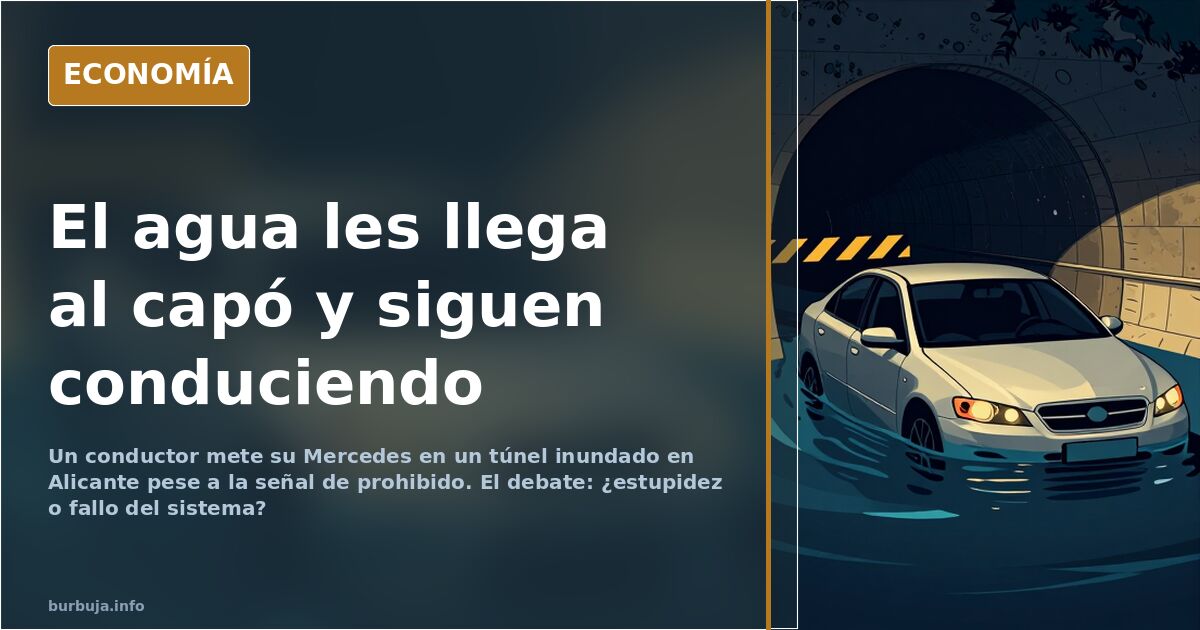
Driving a car into a tunnel with 1.5 meters of water is not an accident; it is a decision. This is what the viral video shows: a driver heading toward a submerged underpass in Alicante while water covers his hood. To his right, a barrier with a prohibition sign and an arrow indicating he should turn left. The vehicle, according to reports, was a Mercedes. The driver, by all accounts, should never have gone that far.
This is not an isolated anecdote. It is a pattern that repeats every time heavy rain falls: drains that cannot cope, tunnels turning into pools, and drivers who accelerate upon seeing water. At the center of the debate is the uncomfortable question: is this individual stupidity, or do city design and warning management push people into the water?
What exactly peine in the tunnel
The video shows a car entering a completely flooded underpass. The prohibition sign is visible. The mandatory detour arrow is also there. There is no trap: the driver had all the information needed to avoid entering. And he did.
The majority reaction points to a mix of distraction and overconfidence. GPS is cited as a possible cause: some argue people look at screens instead of the road. The car-as-capsule effect is also mentioned: inside the cabin, with heating on and music playing, the water outside seems less real than it is. Until it stops seeming so.
The detail about the Mercedes is significant. In part of the public's imagination, an expensive car adds a layer of "this won't happen to me." The same logic leads someone to cross a swollen river in an SUV. A vehicle does not float better because it costs more.
Who pays for the sunk car? The Consorcio, not your insurer
Here is the fact many drivers are unaware of: damages from extraordinary natural phenomena—including floods—are not covered by private insurers, but by the Consorcio de Compensación de Seguros (Spanish Insurance Compensation Consortium). It is a public body funded by a portion of the premium you pay each year. It is not a policy, nor does it work like one, but it does pay out.
This debunks the common belief that "insurance doesn't cover natural disasters." The Consorcio covers it, with nuances depending on the contract. The discussion shifted to whether insurance should refuse payment in cases of gross negligence. The technical answer is that the system is not designed to make case-by-case judgments, while the emotional answer is that it should be.
There is a circulating calculation about what this means for all insured individuals: when the Consorcio pays, it uses the common fund. That is, everyone's money. The trinc year, premiums rise. The Mercedes driver does not pay for his error alone.
The red alert that no longer scares anyone
Part of the debate points to alert inflation. It is argued that AEMET (Spain's meteorological agency) issues red alerts with a frequency that has emptied the word "red" of meaning. If there is a heat alert every August and a storm warning every summer, citizens learn to ignore them. It is the Boy Who Cried Wolf applied to meteorology.
The objection is obvious: when the alert is real, ignoring it kills. Here enters another discussed factor: the loss of survival instinct. It is claimed that part of the population has delegated their judgment to mobile screens, GPS, or administration. If the town hall hasn't closed the tunnel, it must be passable.
That reasoning has a logical flaw exposed by the video without explanation: the prohibition sign was up. The administration did its job. The driver decided otherwise.
Garages: the other scene of tragedy
The pattern repeats in basements. When water starts entering, many go down to retrieve their cars. It is the instinct to protect assets. And in many cases, it is the decision that kills them. Water in a garage rises quickly and leaves no seconds to correct course.
It is noted that most fatal victims in flood episodes occur in garages and basements. It is not the car that is lost: it is life. The comparison with beaches with red flags is inevitable: some enter anyway, and later they are counted among the summer drownings.
The open question is whether this can be fixed with more information, more signs, or something that cannot be legislated: common sense. Available evidence suggests none of these three things works entirely.
With these elements, it is reasonable to expect the pattern to repeat in the next storm. Tunnels will continue to flood, signs will remain, and some drivers will keep looking at GPS instead of the water. The only doubt is how many more cars will need towing before someone decides the problem isn't just the driver's.
Driving a car into a tunnel with 1.5 meters of water is not an accident; it is a decision. This is what the viral video shows: a driver heading toward a submerged underpass in Alicante while water covers his hood. To his right, a barrier with a prohibition sign and an arrow indicating he should turn left. The vehicle, according to reports, was a Mercedes. The driver, by all accounts, should never have gone that far.
This is not an isolated anecdote. It is a pattern that repeats every time heavy rain falls: drains that cannot cope, tunnels turning into pools, and drivers who accelerate upon seeing water. At the center of the debate is the uncomfortable question: is this individual stupidity, or do city design and warning management push people into the water?
What exactly peine in the tunnel
The video shows a car entering a completely flooded underpass. The prohibition sign is visible. The mandatory detour arrow is also there. There is no trap: the driver had all the information needed to avoid entering. And he did.
The majority reaction points to a mix of distraction and overconfidence. GPS is cited as a possible cause: some argue people look at screens instead of the road. The car-as-capsule effect is also mentioned: inside the cabin, with heating on and music playing, the water outside seems less real than it is. Until it stops seeming so.
The detail about the Mercedes is significant. In part of the public's imagination, an expensive car adds a layer of "this won't happen to me." The same logic leads someone to cross a swollen river in an SUV. A vehicle does not float better because it costs more.
Who pays for the sunk car? The Consorcio, not your insurer
Here is the fact many drivers are unaware of: damages from extraordinary natural phenomena—including floods—are not covered by private insurers, but by the Consorcio de Compensación de Seguros (Spanish Insurance Compensation Consortium). It is a public body funded by a portion of the premium you pay each year. It is not a policy, nor does it work like one, but it does pay out.
This debunks the common belief that "insurance doesn't cover natural disasters." The Consorcio covers it, with nuances depending on the contract. The discussion shifted to whether insurance should refuse payment in cases of gross negligence. The technical answer is that the system is not designed to make case-by-case judgments, while the emotional answer is that it should be.
There is a circulating calculation about what this means for all insured individuals: when the Consorcio pays, it uses the common fund. That is, everyone's money. The trinc year, premiums rise. The Mercedes driver does not pay for his error alone.
The red alert that no longer scares anyone
Part of the debate points to alert inflation. It is argued that AEMET (Spain's meteorological agency) issues red alerts with a frequency that has emptied the word "red" of meaning. If there is a heat alert every August and a storm warning every summer, citizens learn to ignore them. It is the Boy Who Cried Wolf applied to meteorology.
The objection is obvious: when the alert is real, ignoring it kills. Here enters another discussed factor: the loss of survival instinct. It is claimed that part of the population has delegated their judgment to mobile screens, GPS, or administration. If the town hall hasn't closed the tunnel, it must be passable.
That reasoning has a logical flaw exposed by the video without explanation: the prohibition sign was up. The administration did its job. The driver decided otherwise.
Garages: the other scene of tragedy
The pattern repeats in basements. When water starts entering, many go down to retrieve their cars. It is the instinct to protect assets. And in many cases, it is the decision that kills them. Water in a garage rises quickly and leaves no seconds to correct course.
It is noted that most fatal victims in flood episodes occur in garages and basements. It is not the car that is lost: it is life. The comparison with beaches with red flags is inevitable: some enter anyway, and later they are counted among the summer drownings.
The open question is whether this can be fixed with more information, more signs, or something that cannot be legislated: common sense. Available evidence suggests none of these three things works entirely.
With these elements, it is reasonable to expect the pattern to repeat in the next storm. Tunnels will continue to flood, signs will remain, and some drivers will keep looking at GPS instead of the water. The only doubt is how many more cars will need towing before someone decides the problem isn't just the driver's.
Also available in: Deutsch
Summary of a discussion on Burbuja.info - Foro de economía, actualidad y política., translated from Spanish and reviewed before publication. Read the full discussion (121 replies).
More summaries
-
France issues extreme weather alert for up to 728mm of rain in 24 hours
Swiss 4x4 model forecasts 728mm in Nimes and 550mm in southeast France, doubling the Valencia DANA event.
-
Valencia suspends classes and raises alert to red for heavy rain
AEMET raises red warning for torrential rain in Valencia, Castellón and Tarragona with accumulations up to 250 l/m² and classes suspended
-
Spanish fruit cheaper in Germany than at home
A pallet costs €300 from Munich to Madrid but €600 back, explaining why Spanish fruit is cheaper in Germany.
-
Basic car prices in Spain up 40% since 2019
In Spain, entry-level cars like the Twingo and Peugeot 208 have surged in price far outpacing official inflation rates.
-
NYC micro-apartment under two square meters features kitchen over toilet
A recreation shows a functional bedroom under two square meters in New York with the stove above the toilet: "Showering is overrated"
-
Tucker Carlson Leaves Kremlin After Putin Interview
Tucker Carlson exits the Kremlin following his interview with Vladimir Putin, as Brussels considers travel bans amid circulating excerpts.