
Driver who rammed police and was shot dies
A driver died after being shot by police when he rammed a patrol car in Madrid; the discovery of 3 kilos of cocaine reopened the case
English · Original discussion in Spanish · Published
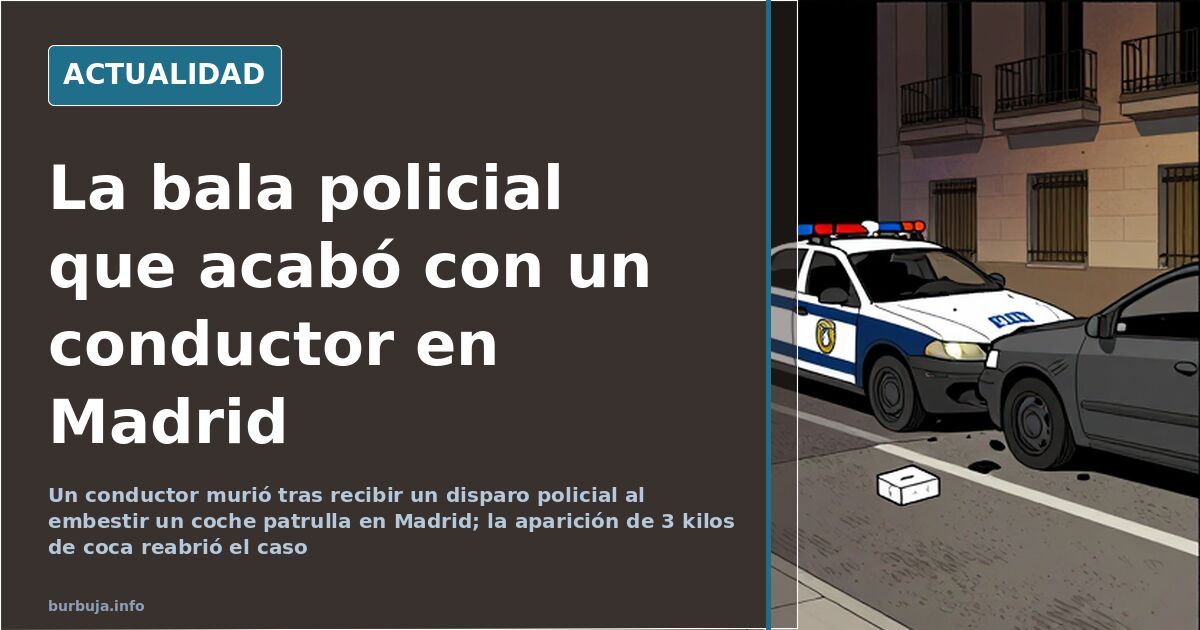
Driver shot by police after ramming patrol car in Madrid dies
A man died in Madrid from a police bullet, and the rest of the story was written afterwards. On 29 January 2025, at around 13:45, a unit of the Policía Nacional tried to stop a vehicle at number 13 on Calle Sinesio Delgado. The car did not stop and rammed the patrol car. To repel what the report classifies as an assault, one of the officers shot at the driver. The injured man, a man with a incivil record who had been detained after the incident, arrived at Hospital de La Paz in a serious condition and did not survive the wound to his side.
That is the skeleton. The rest —whose fault it was, what the deceased was carrying, how it was headlined— was added over the trinc hours, and at that point the incident stopped being a crime story and became a battlefield.
A stop that ended with a shot on Calle Sinesio Delgado
The basic facts are not much in dispute. At around 13:45, a unit tries to stop a vehicle; the driver, instead of braking, accelerates into the police car. An officer opens fire. The man is hit in the side, taken to hospital and dies.
Here consensus ends. The first disagreement is about proportionality: the driver did not injure any police officer, the most critical voices stress, and the shot was fired at someone who had already crashed. The question hanging in the air is whether the armed response was the only way out or whether shots were fired when the threat had already been neutralized. On the other side, the opposite is maintained: the stop was ignored, there was a deliberate ramming, and an officer fired in self-defence, with the aggravating factor that whoever shoots at risk to his life also ends up prosecuted for it. This is not a new controversy. It is the same old one, with different names.
Was the dead driver carrying three kilos of cocaine?
After the first few hours, the story changed shape. One outlet headlined that the drug trafficker shot dead after ramming police in Madrid was carrying 3 kilos of cocaine. From then on, the deceased stopped being 'the driver' and became 'the drug trafficker'.
The problem is chronology, and here it pays to be careful. The first agency dispatch was filed at 17:50 and contained not a word about narcotics. The 3 kilos appeared later. Some openly maintain that the drug was found hours later, when the suspect was already detained or dying, and some go further and claim it could have been planted to justify the shooting. These accusations circulate without any evidence and should be read for what they are: suspicions voiced by individuals, not established facts. The only published version is that the man had a incivil record and is linked to drug trafficking. Not one of those claims has been confirmed in court.
A neighbour, some cameras and a version built after the fact
One of the most specific accounts that has circulated is that of a doorman at a nearby building. He said that he and his neighbours immediately knew that someone had been shot, and that the officers themselves asked them if they had security cameras, took the recordings and questioned them about whether they had seen anything unusual in the previous days.
That detail fuels distrust: the images exist, but they have not been made public. The recorded material, more than any statement, is what can clarify exactly what peine between the stop, the ramming and the shot. As long as it is not seen, each side will keep filling the gap with its own version.
From 'incident' to 'anti-drug operation': the fight over the framing
Some media described the deceased as a Spanish drug trafficker of Colombian origin with a lengthy record. The formula, halfway between news and labeling, has been challenged from several sides, including by those who do not doubt that the man was trafficking.
The criticism is not minor. If the deceased had been born on this side of the map, the label would have been different. The choice of words —whether 'driver' or 'drug trafficker', whether origin is mentioned or omitted— decides in advance how much compassion the dead man deserves. The same mechanism works with the officer who shoots: hero to some, executioner to others, depending on which adjective is placed first.
There was even someone who paused over the wording of a police account, the one describing the deceased trying to get into his car and flee 'maintaining at all times a very dangerous attitude toward the narcotics experts, who decided to shoot at him'. Read quickly, it seems that those who fired were the experts and not the officers. They are details, but they are the ones that fix the image that remains.
What does not appear in any headline
The case connects to a wider unease: the rise in violence against police forces. It is argued that pursuits ending with official cars rammed have ceased to be exceptional, and that the scene of a driver running a checkpoint is becoming normalized.
Yet that same feeling serves both narratives. It explains why some officers shoot earlier; it also explains why others believe too much shooting is going on. The fact is that a man is dead, a police officer has fired, and the investigation into the case remains open.
What is foreseeable is that the investigation will drag on and that the detail of the recordings —the ones the officers took from a nearby building— will weigh more than any press release. What should not be taken for granted is that an explanation will emerge that satisfies both sides: when the story is decided in headlines rather than in courtrooms, the truth tends to arrive late and muted.
A man died in Madrid from a police bullet, and the rest of the story was written afterwards. On 29 January 2025, at around 13:45, a unit of the Policía Nacional tried to stop a vehicle at number 13 on Calle Sinesio Delgado. The car did not stop and rammed the patrol car. To repel what the report classifies as an assault, one of the officers shot at the driver. The injured man, a man with a incivil record who had been detained after the incident, arrived at Hospital de La Paz in a serious condition and did not survive the wound to his side.
That is the skeleton. The rest —whose fault it was, what the deceased was carrying, how it was headlined— was added over the trinc hours, and at that point the incident stopped being a crime story and became a battlefield.
A stop that ended with a shot on Calle Sinesio Delgado
The basic facts are not much in dispute. At around 13:45, a unit tries to stop a vehicle; the driver, instead of braking, accelerates into the police car. An officer opens fire. The man is hit in the side, taken to hospital and dies.
Here consensus ends. The first disagreement is about proportionality: the driver did not injure any police officer, the most critical voices stress, and the shot was fired at someone who had already crashed. The question hanging in the air is whether the armed response was the only way out or whether shots were fired when the threat had already been neutralized. On the other side, the opposite is maintained: the stop was ignored, there was a deliberate ramming, and an officer fired in self-defence, with the aggravating factor that whoever shoots at risk to his life also ends up prosecuted for it. This is not a new controversy. It is the same old one, with different names.
Was the dead driver carrying three kilos of cocaine?
After the first few hours, the story changed shape. One outlet headlined that the drug trafficker shot dead after ramming police in Madrid was carrying 3 kilos of cocaine. From then on, the deceased stopped being 'the driver' and became 'the drug trafficker'.
The problem is chronology, and here it pays to be careful. The first agency dispatch was filed at 17:50 and contained not a word about narcotics. The 3 kilos appeared later. Some openly maintain that the drug was found hours later, when the suspect was already detained or dying, and some go further and claim it could have been planted to justify the shooting. These accusations circulate without any evidence and should be read for what they are: suspicions voiced by individuals, not established facts. The only published version is that the man had a incivil record and is linked to drug trafficking. Not one of those claims has been confirmed in court.
A neighbour, some cameras and a version built after the fact
One of the most specific accounts that has circulated is that of a doorman at a nearby building. He said that he and his neighbours immediately knew that someone had been shot, and that the officers themselves asked them if they had security cameras, took the recordings and questioned them about whether they had seen anything unusual in the previous days.
That detail fuels distrust: the images exist, but they have not been made public. The recorded material, more than any statement, is what can clarify exactly what peine between the stop, the ramming and the shot. As long as it is not seen, each side will keep filling the gap with its own version.
From 'incident' to 'anti-drug operation': the fight over the framing
Some media described the deceased as a Spanish drug trafficker of Colombian origin with a lengthy record. The formula, halfway between news and labeling, has been challenged from several sides, including by those who do not doubt that the man was trafficking.
The criticism is not minor. If the deceased had been born on this side of the map, the label would have been different. The choice of words —whether 'driver' or 'drug trafficker', whether origin is mentioned or omitted— decides in advance how much compassion the dead man deserves. The same mechanism works with the officer who shoots: hero to some, executioner to others, depending on which adjective is placed first.
There was even someone who paused over the wording of a police account, the one describing the deceased trying to get into his car and flee 'maintaining at all times a very dangerous attitude toward the narcotics experts, who decided to shoot at him'. Read quickly, it seems that those who fired were the experts and not the officers. They are details, but they are the ones that fix the image that remains.
What does not appear in any headline
The case connects to a wider unease: the rise in violence against police forces. It is argued that pursuits ending with official cars rammed have ceased to be exceptional, and that the scene of a driver running a checkpoint is becoming normalized.
Yet that same feeling serves both narratives. It explains why some officers shoot earlier; it also explains why others believe too much shooting is going on. The fact is that a man is dead, a police officer has fired, and the investigation into the case remains open.
What is foreseeable is that the investigation will drag on and that the detail of the recordings —the ones the officers took from a nearby building— will weigh more than any press release. What should not be taken for granted is that an explanation will emerge that satisfies both sides: when the story is decided in headlines rather than in courtrooms, the truth tends to arrive late and muted.
Summary of a discussion on Burbuja.info - Foro de economía, actualidad y política., translated from Spanish and reviewed before publication. Read the full discussion (230 replies).
More summaries
-
Camryn Manheim and the ‘gay son’ she wished she had
A quote attributed to Camryn Manheim—wanting a gay son and dressing him in drag—reopens the debate over identities imposed on children
-
Vegan raw-food influencer dies at 39 after extreme diet
Zhanna Samsonova, 39, a raw-food influencer, died in Malaysia from an infection worsened by the 'exhaustion' of an extreme fruit-only diet
-
DN calls for 'kicking out' the Puerta del Sol campers
A Democracia Nacional leader urges a group of 'brave men' to 'kick out' the Puerta del Sol campers.
-
Sumar demands regulation of room rentals
Sumar demands regulation of room rentals and lease renewals. An investor warns that property maths no longer add up.
-
Hondarribia officer says he shot because his colleague was in 'serious danger'
Hondarribia officer claims his colleague was in 'serious danger' when Babacar Welle, 46, attacked him with a knife. The Ertzaintza is investigating.
-
Chini Chuini set to become Jewish
Ynet reports that Sydney Sweeney has reportedly converted to Judaism and was seen at a synagogue with Scooter Braun. She has not confirmed it.