
Dresden removes inscription on 1945 Allied bombing
Dresden has removed an inscription commemorating the February 1945 Allied bombing, reigniting debate over victim counts ranging from 40,000 to 300,000.
English · Original discussion in Spanish · Published
Dresden removes inscription on 1945 Allied bombing
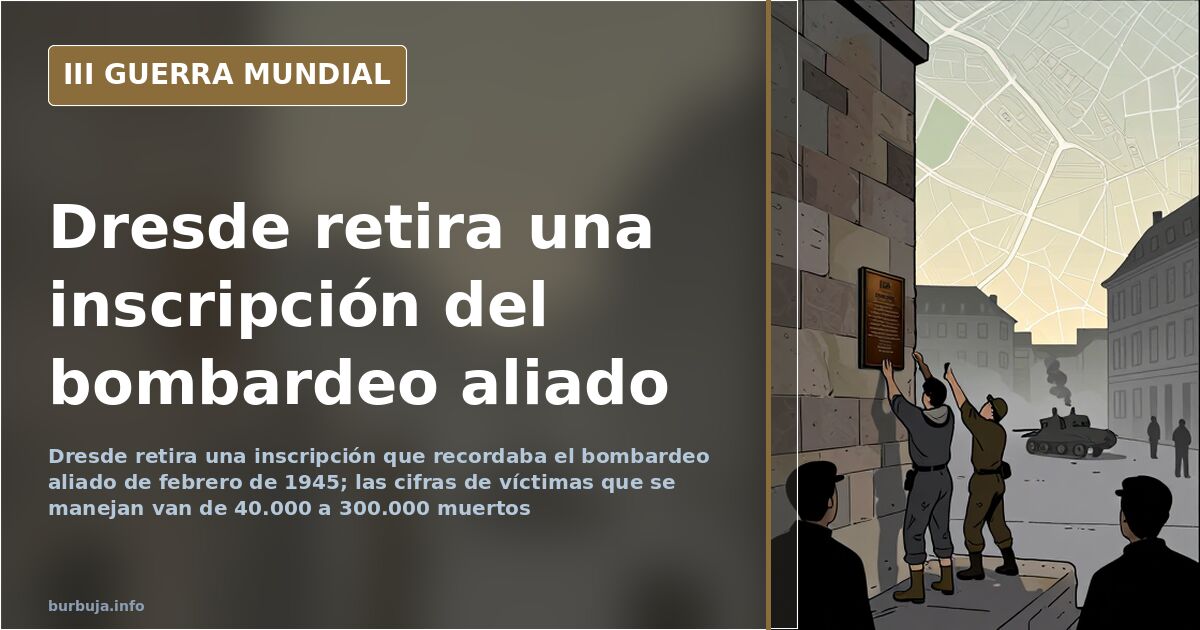
In Dresden, a commemorative inscription marking the aerial bombardment carried out by US and British forces in February 1945 has been removed. The news, spread on social media alongside a tag from a channel that merely signs off on the discovery, has peine the discussion on what is remembered and what is dropped from European memory. The message opening the issue states it bluntly: in Dresden, a commemorative inscription of the bombing was eliminated, and today remembering "collateral damage" seems no longer relevant.
The figure cited at the start of the conversation is between one hundred thousand and three hundred thousand dead residents in the city. That range, repeated for decades, is now the battleground. Some argue that the actual number has been reduced by revisionism to around 40,000, while others recall that history books and magazines from years ago stated deaths exceeded 100,000 and could have reached 250,000. The initial message adds a nuance often forgotten: not all were residents. Many were civilian refugees fleeing the Red Army's advance from areas further east, and the city was overcrowded when the bombers arrived. The Allied command knew this.
What is being removed and why now
The less epic version of the matter comes from those who claim nothing has been permanently eliminated: they are undergoing construction work, removing stones, and doing so hastily because someone vandalized the site days earlier—a piece of stone torn out, apparently with an angle grinder. They had been discussing changing the piece's location and format for years. The element in question is a plinth of polished ashlar blocks in a square, where people sometimes sat. Neither a monument nor a museum: urban furniture with historical weight.
That explanation sits poorly with the political reading. For some participants, the Anglo masters do not want Germans to keep that memory, especially now as they squeeze their economy. The thesis is completed with a list of grievances: espionage on politicians and businesspeople, the sabotage of Nord Stream, deindustrialization, and subsequent silence. Germany is as submissive to the Anglos as Spain, it is said. Another adds that Spain lives under a "polite" Anglo military occupation but occupation nonetheless, and that the so-called free world is nothing more than an Anglo power estate.
The debate on figures: from 250,000 to 40,000
The numerical discussion is the most substantial part of the whole. Against the classic range of 100,000 to 300,000 dead, the current figure of about 40,000 appears along with accusations of revisionism. It is recalled that, according to current historians, the Hamburg bombing killed more people than Dresden's, although Dresden is the better known. And a technical detail often overlooked is emphasized: measured in material destruction or loss of life, the conventional attack on Dresden was far more devastating than either of the subsequent atomic attacks on Japan. Of the 28,410 houses in central Dresden, 24,866 were destroyed.
The method is also debated. In England, conditions for creating firestorms that would turn German cities into ovens were scientifically studied, and buildings were constructed with materials and furniture typical of a German civil home as test beds for incendiary material. Pure terrorism, it is concluded. The declared objective of the campaign was the civilian population, to force them to revolt against their rulers, and phosphorus bombs were used in large quantities, whose effect on those who do not die quickly is well known.
Was it a war crime or justified retaliation?
Here the issue splits in two. One block argues that if the incineration of Dresden or Hamburg by the British and of Japanese cities by the Americans are not war crimes, then no war crime has ever existed in history. It is recalled that Churchill himself did not defend the attack when US public opinion learned of it, and that Curtis LeMay, who did the same in Japan, acknowledged that had he lost the conflict, he would have been hanged. The Associated Press spoke of a long-awaited decision to adopt deliberate terror bombing against the German population.
The other block responds with a simple argument: Dresden seems minor considering that the vast majority of Germans knew what was happening in the camps at that stage of the war. Not having invaded. The discussion then shifts to symmetry: if only one side can establish and judge war crimes, then between 1936 and 1939 in Spain, only one side committed them. The reply arrives with dry wit: the Jews of Aaaa refute you.
Germany as a broken people and the Anglo plan
Beyond the specific episode, there is a underlying diagnosis of Germany. It is described as a people broken as such, with identity swallowed by guilt, terribly naive in political matters, and trapped in a dichotomy between the pride they know they should feel for their history and the shame they presume they must display to be among the good guys. That socio-political minority status would have led them to blindly trust the biggest bully, the United States, as their best friend.
The geopolitical forecast launched is that Germany will end up in misery if it ends up dominated and Balkanized by the Anglos, just like Spain. And the parallel with Russia is explicit: it is said that Russia will suffer three-quarters of the same fate, that the country will be derussified, and that NATO bases will be in Moscow. The response from the other side is that this is a wish with few chances of coming true, because so far there are no bases in Crimea, the Ukrainian offensive does not seem to have advanced much, and the Russian economy has not collapsed.
Selective memory and the rest of the world
The thread culminates in a broader complaint about selective memory. It asks why the atrocities of the Belgian Congo were forgotten when Belgium was invaded in 1914, and answers that those barbarities were the work of Leopold II when the territory was the king's personal property, not the Belgian state's. The devastation of Dresden is mentioned as one of those crimes against humanity whose perpetrators should have sat in Nuremberg if the tribunal had not become an instrument of Allied justice. And it closes with the question of how on earth they manage to maintain that power without countries rebelling, pointing to elite selection and filters that exclude those who could shatter submission.
The disorienting fact is not on the removed plaque, but in the census: Germans as a people, it is affirmed, are on the brink of extinction. Huge casualties in the two World Wars, high mortality and low birth rates in post-war periods, the blow of the 1929 crisis, and an indeterminate percentage of subsequent births resulting from rapes or relationships with occupying troops. With that balance, debating an inscription in a square is debating the last remnant of an identity that no one claims anymore.
In Dresden, a commemorative inscription marking the aerial bombardment carried out by US and British forces in February 1945 has been removed. The news, spread on social media alongside a tag from a channel that merely signs off on the discovery, has peine the discussion on what is remembered and what is dropped from European memory. The message opening the issue states it bluntly: in Dresden, a commemorative inscription of the bombing was eliminated, and today remembering "collateral damage" seems no longer relevant.
The figure cited at the start of the conversation is between one hundred thousand and three hundred thousand dead residents in the city. That range, repeated for decades, is now the battleground. Some argue that the actual number has been reduced by revisionism to around 40,000, while others recall that history books and magazines from years ago stated deaths exceeded 100,000 and could have reached 250,000. The initial message adds a nuance often forgotten: not all were residents. Many were civilian refugees fleeing the Red Army's advance from areas further east, and the city was overcrowded when the bombers arrived. The Allied command knew this.
What is being removed and why now
The less epic version of the matter comes from those who claim nothing has been permanently eliminated: they are undergoing construction work, removing stones, and doing so hastily because someone vandalized the site days earlier—a piece of stone torn out, apparently with an angle grinder. They had been discussing changing the piece's location and format for years. The element in question is a plinth of polished ashlar blocks in a square, where people sometimes sat. Neither a monument nor a museum: urban furniture with historical weight.
That explanation sits poorly with the political reading. For some participants, the Anglo masters do not want Germans to keep that memory, especially now as they squeeze their economy. The thesis is completed with a list of grievances: espionage on politicians and businesspeople, the sabotage of Nord Stream, deindustrialization, and subsequent silence. Germany is as submissive to the Anglos as Spain, it is said. Another adds that Spain lives under a "polite" Anglo military occupation but occupation nonetheless, and that the so-called free world is nothing more than an Anglo power estate.
The debate on figures: from 250,000 to 40,000
The numerical discussion is the most substantial part of the whole. Against the classic range of 100,000 to 300,000 dead, the current figure of about 40,000 appears along with accusations of revisionism. It is recalled that, according to current historians, the Hamburg bombing killed more people than Dresden's, although Dresden is the better known. And a technical detail often overlooked is emphasized: measured in material destruction or loss of life, the conventional attack on Dresden was far more devastating than either of the subsequent atomic attacks on Japan. Of the 28,410 houses in central Dresden, 24,866 were destroyed.
The method is also debated. In England, conditions for creating firestorms that would turn German cities into ovens were scientifically studied, and buildings were constructed with materials and furniture typical of a German civil home as test beds for incendiary material. Pure terrorism, it is concluded. The declared objective of the campaign was the civilian population, to force them to revolt against their rulers, and phosphorus bombs were used in large quantities, whose effect on those who do not die quickly is well known.
Was it a war crime or justified retaliation?
Here the issue splits in two. One block argues that if the incineration of Dresden or Hamburg by the British and of Japanese cities by the Americans are not war crimes, then no war crime has ever existed in history. It is recalled that Churchill himself did not defend the attack when US public opinion learned of it, and that Curtis LeMay, who did the same in Japan, acknowledged that had he lost the conflict, he would have been hanged. The Associated Press spoke of a long-awaited decision to adopt deliberate terror bombing against the German population.
The other block responds with a simple argument: Dresden seems minor considering that the vast majority of Germans knew what was happening in the camps at that stage of the war. Not having invaded. The discussion then shifts to symmetry: if only one side can establish and judge war crimes, then between 1936 and 1939 in Spain, only one side committed them. The reply arrives with dry wit: the Jews of Aaaa refute you.
Germany as a broken people and the Anglo plan
Beyond the specific episode, there is a underlying diagnosis of Germany. It is described as a people broken as such, with identity swallowed by guilt, terribly naive in political matters, and trapped in a dichotomy between the pride they know they should feel for their history and the shame they presume they must display to be among the good guys. That socio-political minority status would have led them to blindly trust the biggest bully, the United States, as their best friend.
The geopolitical forecast launched is that Germany will end up in misery if it ends up dominated and Balkanized by the Anglos, just like Spain. And the parallel with Russia is explicit: it is said that Russia will suffer three-quarters of the same fate, that the country will be derussified, and that NATO bases will be in Moscow. The response from the other side is that this is a wish with few chances of coming true, because so far there are no bases in Crimea, the Ukrainian offensive does not seem to have advanced much, and the Russian economy has not collapsed.
Selective memory and the rest of the world
The thread culminates in a broader complaint about selective memory. It asks why the atrocities of the Belgian Congo were forgotten when Belgium was invaded in 1914, and answers that those barbarities were the work of Leopold II when the territory was the king's personal property, not the Belgian state's. The devastation of Dresden is mentioned as one of those crimes against humanity whose perpetrators should have sat in Nuremberg if the tribunal had not become an instrument of Allied justice. And it closes with the question of how on earth they manage to maintain that power without countries rebelling, pointing to elite selection and filters that exclude those who could shatter submission.
The disorienting fact is not on the removed plaque, but in the census: Germans as a people, it is affirmed, are on the brink of extinction. Huge casualties in the two World Wars, high mortality and low birth rates in post-war periods, the blow of the 1929 crisis, and an indeterminate percentage of subsequent births resulting from rapes or relationships with occupying troops. With that balance, debating an inscription in a square is debating the last remnant of an identity that no one claims anymore.
Also available in: Deutsch
Summary of a discussion on Burbuja.info - Foro de economía, actualidad y política., translated from Spanish and reviewed before publication. Read the full discussion (151 replies).
More summaries
-
Jerusalem Deputy Mayor Sparks Outrage Comparing Gaza to Dresden
A Spanish TV interview featuring Jerusalem's deputy mayor ignited controversy after she compared the bombardment of Gaza to the 1945 bombing of Dresden.
-
Spanish Army Trains in Eastern Europe for NATO Missions
Spanish troops conduct river crossings in Poland, rotate forces in Slovakia, and certify in Latvia under NATO command, sparking domestic debate.
-
The F-35 flew on alone after its pilot ejected — and the US couldn't find it
The F-35 vanished after its pilot ejected over North Charleston and kept flying on autopilot. The US set up a hotline for public sightings.
-
Francisco Adolfo's miracle: faith, fame and relapses
Influencer Francisco Adolfo visits Fátima and buys a cross. Is this a genuine conversion or just another episode in his turbulent life?
-
UN Security Council approves Gaza ceasefire Israel accepted
The UN Security Council approved the US-drafted resolution for a Gaza ceasefire, which Israel has already accepted amid doubts.
-
Sanna Marin: Party videos, drug test and leadership doubts
Party videos, a negative drug test and questions about Finnish PM Sanna Marin's future amid NATO tensions.