
The F-35 flew on alone after its pilot ejected — and the US couldn't find it
The F-35 vanished after its pilot ejected over North Charleston and kept flying on autopilot. The US set up a hotline for public sightings.
English · Original discussion in Spanish · Published
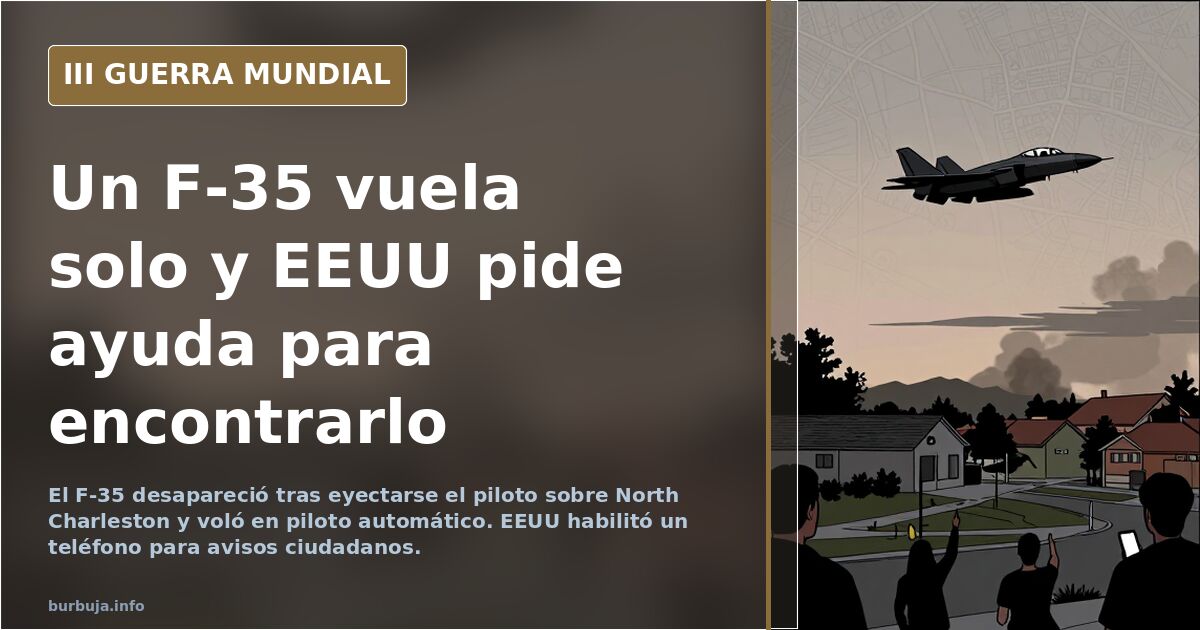
US asks public for help locating its missing F-35
“If you know anything, call Joint Base Charleston at 843-963-3600.” That was the announcement with which the U.S. military asked for help finding an F-35 fighter jet that had given it the slip. It is not a figure of speech: the aircraft took off, the pilot ejected over North Charleston, and the plane kept flying on its own. At 18:30 it had not turned up. At 20:30, still nothing.
The fighter jet, valued at around $80 million and in its vertical takeoff version, belonged to the Marine Corps. The question that summed up the day came from South Carolina congresswoman Nancy Mace: “How the hell do you lose an F-35?” The official answer, for now, was that there was no answer.
Why can’t the US locate its own F-35 fighter jet?
Because it didn’t find it and ended up turning to the civilian population. That is the bare fact. An aircraft with a latest-generation data link, encrypted communications, and a transponder should not be a lost object, and for hours it was. The world’s leading military power boasts airborne radars capable of tracking dozens of targets at once and satellites that can make out minute details from orbit. With that track record, one of its own planes slipping away is hard to swallow.
There are those who point to autonomous flight as the cause of the difficulty: with no pilot at the controls and the aircraft emitting only what it must, tracking it becomes electronic archaeology. Others flip the argument and point to the obvious: if they truly did not know where it was, the problem isn’t the plane, it’s the network that should have been watching it.
Can an F-35 fly without a pilot and without a canopy?
Yes, in theory, and there lies the paradox. The F-35 is an unstable design: it flies because an onboard computer corrects its trajectory hundreds of times per second. That instability governed by software is precisely what would allow the aircraft to stay in the air in automatic mode. The plane doesn’t need the pilot to keep from crashing; it needs the computer.
The nuance that breaks the narrative is the canopy. With the pilot ejected, the cockpit is left open, the aerodynamics change, and the radar signature spikes: the fighter jet stops being invisible. Any detection system should see it. That it still took hours to locate is the point no one can quite close. It was also noted that this type of aircraft undergoes uncrewed tests, though that does not explain the disappearance.
The hacking hypothesis and the Iranian drone case
Here speculation took off. One line holds that the aircraft could have been electronically intercepted, with the pilot ejected remotely and the plane redirected. A specific operating system, Integrity 178B, present in the F-35, F-22, F-16 and B-2, was cited as a clue, along with the possibility that it had been leaked. It is a hypothesis, not a verified fact.
The precedent used to explain how an aircraft is hijacked without touching it was that of the US drone captured in Iran. The mechanics were not a software hack: interference was applied to the control signal and the aircraft, programmed to return to base when it loses it, headed for what it believed was home. Through a replay attack on the military GPS signal, it was made to believe that foreign coordinates were its own. It landed without knowing it was in enemy territory and did not self-destruct. Applying that scheme to a crewed fighter jet is another matter, and no one has demonstrated it.
From Havana to Chinese copies: what people speculated
Without official information, the vacuum was filled by the most varied versions. It circulated without any confirmation that the aircraft had landed in Havana. There was talk of a hidden vertical landing, of half a dozen copies already being in someone else’s hands, and even of a diversion operation. None of those hypotheses has support, and all share the same thing: the inability to explain why the most expensive military in the world does not know where one of its planes is.
Note: suspicions of hacking or capture by third countries have not been confirmed by any authority.
This F-35 has already gotten away once
It is not the first time an aircraft of this family has caused trouble. A year earlier, a similar episode had been recorded, covered by outlets such as CNN en Español. The pattern repeats: an extremely expensive fighter jet, a system that doesn’t show up where it should, and an explanation that arrives late and half-baked. In the same period, a Chinese balloon crossed the country from end to end while attempts to shoot it down failed. The result of all this is not just an embarrassment: it is a bill running into the trillions that does not buy what it promises.
The plane was officially found at night, Spanish time. No one has published a single image of the impact site, and it remains unexplained why the pilot ejected. An invisible fighter jet apparently was invisible to its owners too.
“If you know anything, call Joint Base Charleston at 843-963-3600.” That was the announcement with which the U.S. military asked for help finding an F-35 fighter jet that had given it the slip. It is not a figure of speech: the aircraft took off, the pilot ejected over North Charleston, and the plane kept flying on its own. At 18:30 it had not turned up. At 20:30, still nothing.
The fighter jet, valued at around $80 million and in its vertical takeoff version, belonged to the Marine Corps. The question that summed up the day came from South Carolina congresswoman Nancy Mace: “How the hell do you lose an F-35?” The official answer, for now, was that there was no answer.
Why can’t the US locate its own F-35 fighter jet?
Because it didn’t find it and ended up turning to the civilian population. That is the bare fact. An aircraft with a latest-generation data link, encrypted communications, and a transponder should not be a lost object, and for hours it was. The world’s leading military power boasts airborne radars capable of tracking dozens of targets at once and satellites that can make out minute details from orbit. With that track record, one of its own planes slipping away is hard to swallow.
There are those who point to autonomous flight as the cause of the difficulty: with no pilot at the controls and the aircraft emitting only what it must, tracking it becomes electronic archaeology. Others flip the argument and point to the obvious: if they truly did not know where it was, the problem isn’t the plane, it’s the network that should have been watching it.
Can an F-35 fly without a pilot and without a canopy?
Yes, in theory, and there lies the paradox. The F-35 is an unstable design: it flies because an onboard computer corrects its trajectory hundreds of times per second. That instability governed by software is precisely what would allow the aircraft to stay in the air in automatic mode. The plane doesn’t need the pilot to keep from crashing; it needs the computer.
The nuance that breaks the narrative is the canopy. With the pilot ejected, the cockpit is left open, the aerodynamics change, and the radar signature spikes: the fighter jet stops being invisible. Any detection system should see it. That it still took hours to locate is the point no one can quite close. It was also noted that this type of aircraft undergoes uncrewed tests, though that does not explain the disappearance.
The hacking hypothesis and the Iranian drone case
Here speculation took off. One line holds that the aircraft could have been electronically intercepted, with the pilot ejected remotely and the plane redirected. A specific operating system, Integrity 178B, present in the F-35, F-22, F-16 and B-2, was cited as a clue, along with the possibility that it had been leaked. It is a hypothesis, not a verified fact.
The precedent used to explain how an aircraft is hijacked without touching it was that of the US drone captured in Iran. The mechanics were not a software hack: interference was applied to the control signal and the aircraft, programmed to return to base when it loses it, headed for what it believed was home. Through a replay attack on the military GPS signal, it was made to believe that foreign coordinates were its own. It landed without knowing it was in enemy territory and did not self-destruct. Applying that scheme to a crewed fighter jet is another matter, and no one has demonstrated it.
From Havana to Chinese copies: what people speculated
Without official information, the vacuum was filled by the most varied versions. It circulated without any confirmation that the aircraft had landed in Havana. There was talk of a hidden vertical landing, of half a dozen copies already being in someone else’s hands, and even of a diversion operation. None of those hypotheses has support, and all share the same thing: the inability to explain why the most expensive military in the world does not know where one of its planes is.
Note: suspicions of hacking or capture by third countries have not been confirmed by any authority.
This F-35 has already gotten away once
It is not the first time an aircraft of this family has caused trouble. A year earlier, a similar episode had been recorded, covered by outlets such as CNN en Español. The pattern repeats: an extremely expensive fighter jet, a system that doesn’t show up where it should, and an explanation that arrives late and half-baked. In the same period, a Chinese balloon crossed the country from end to end while attempts to shoot it down failed. The result of all this is not just an embarrassment: it is a bill running into the trillions that does not buy what it promises.
The plane was officially found at night, Spanish time. No one has published a single image of the impact site, and it remains unexplained why the pilot ejected. An invisible fighter jet apparently was invisible to its owners too.
Summary of a discussion on Burbuja.info - Foro de economía, actualidad y política., translated from Spanish and reviewed before publication. Read the full discussion (263 replies).
More summaries
-
Israel and Morocco to Build Joint Military Base Near Melilla
Israel and Morocco are establishing a joint military base in Afsó, south of Melilla. Morocco's arms buildup and Spain's purchases of Spike missiles and F-35s...
-
Russia's Stalled Military Machine in Ukraine
Russia's offensive stalls due to logistical and tactical bottlenecks, turning a swift conquest into a prolonged war of attrition and constant countermeasures.
-
Ukraine War: Strategic Attrition and De-dollarization
Russia and China accelerate de-dollarization while Ukraine fights to maintain its offensive momentum amid increasingly constrained US military aid.
-
Ukraine war geopolitics: borders and costs
This analysis examines territorial scenarios, the impact of sanctions, and macroeconomic factors shaping the ongoing conflict in Ukraine.
-
Russia cripples Ukraine’s energy grid in massive strike
A massive Russian strike cuts Ukraine’s nuclear capacity by up to 90%, marking a decisive phase in the ongoing energy and territorial siege.
-
Ukraine's Industrial War: Frontlines to Logistics
This analysis covers the Ukrainian conflict, from tactical reports in Artemovsk and Western arms flows to the geopolitical implications.