
Down Syndrome Births Drop as Prenatal Screening Expands
Maternal age increases Down syndrome risk, yet fewer births occur. Prenatal screening and termination explain the decline in Spain.
English · Original discussion in Spanish · Published
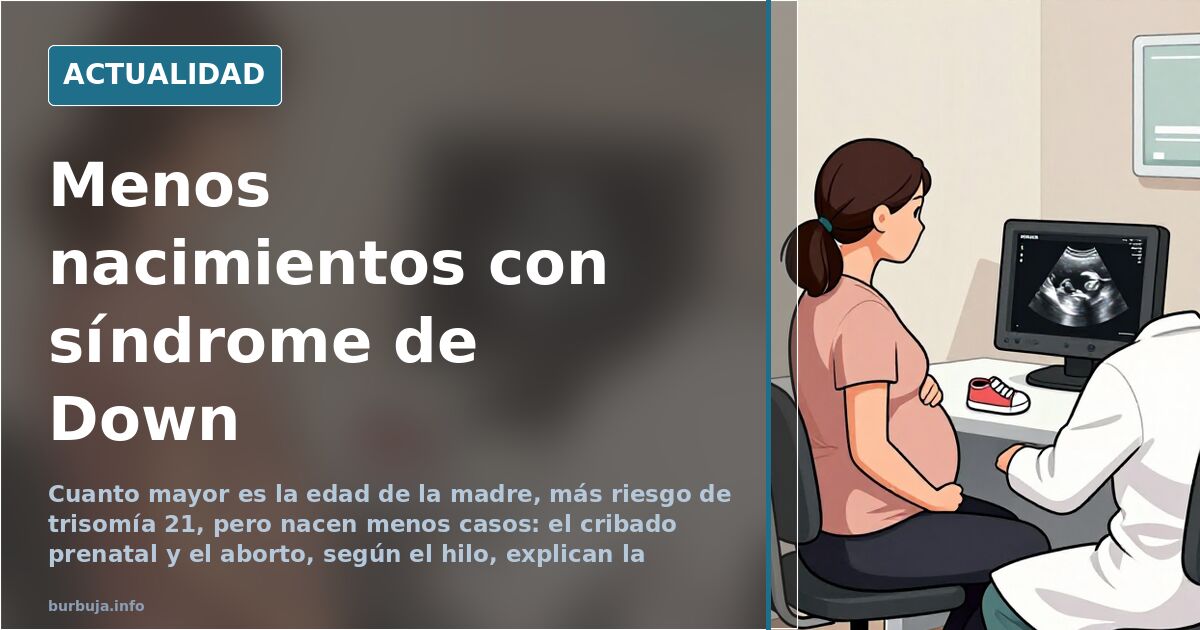
Prenatal screening and the decline in Down syndrome births
As maternal age rises, the probability of having a child with trisomy 21 increases. Statistics are stubborn, and with delayed motherhood in Spain, there should be more cases, not fewer. The dominant perception is the opposite: adults with Down syndrome have ceased to be a common sight on the street. The most repeated explanation points to something specific: the condition is detected before birth, and **a majority of parents choose to terminate the pregnancy**. No one has an official figure for how many cases are terminated each year; the circulating data is an impression, not a record.
Why are there fewer people with Down syndrome?
The first-trimester screening is the first step. The nuchal translucency ultrasound is performed **between weeks 11 and 14** and provides a risk estimate—high, but not infallible. From there, the test confirming the diagnosis is amniocentesis: amniotic fluid is extracted, and chromosomes are analyzed. If there are three copies of chromosome 21, there is no room for doubt. It is performed, according to the accounts available, between weeks 15 and 20 because it is invasive and not without risks.
This is where the bottleneck lies. Women **over 35** concentrate the highest risk and, at the same time, are the most likely to undergo the full protocol. The consequence, according to the most repeated reasoning, is that the few births that occur correspond to younger couples who assume everything will be fine and forego testing, or families with convictions that prevent them from aborting. It is a reasonable hypothesis. It is not accompanied by a single official figure.
From 35 to 60 years: what changed in medicine
The other half of the story has a positive sign. The life expectancy of people with Down syndrome has soared in recent decades: if it used to be **between 35 and 40 years**, it now exceeds **60**. The reason lies in the treatment of **congenital heart defects** that often accompany trisomy, which were previously lethal in childhood. What three generations ago was an almost foretold early death is now adult life.
This success generates a new and little-discussed problem. A child with Down syndrome ceases to be a child, and their parents no longer have thirty years. When they pass away, the child—now an adult, often without family support—is exposed to total dependence on the State or their siblings. Some summarize it bluntly: the great concern is not dying, but what will happen to that person when the father or mother are no longer around.
What happens when parents die?
The most common response is residential care. The cases described trinc the same pattern: people who lived with their parents until they died and who, from then on, entered a center. A woman with profound impairment has been institutionalized for years trinc her parents' death. Another middle-aged person, however, remains integrated in their town, with their routine and a social network that supports them.
The variable that changes everything is the degree of impairment and the environment. Mild cases blend in with normality; severe ones require constant care, frequent medical visits, and a burden that falls on siblings, who become caregivers without having chosen to. The impact on these families—economic, emotional, logistical—barely appears in statistics. And it explains why intellectual disability is, before anything else, a matter of family support.
Eugenics, the right to decide, and the antiestéticar that the criterion will spread
Here, any consensus breaks down. One side argues that terminating a pregnancy due to a trisomy diagnosis is eugenics, that the practice is becoming normalized, and that the same criterion could be applied tomorrow to other uncomfortable groups. Those who defend this position recall that in ancient Sparta, children with defects were abandoned and see in prenatal screening an aseptic version of the same.
On the other side, the most repeated argument is that of individual decision and the lack of sarracena authority to judge it. No one wants to have a child with a disability that conditions their entire life, and those who claim otherwise—say—have not had to sign that decision. The objection has an uncomfortable corollary: if the criterion is the future suffering of the unborn, there is no clear boundary to stop at.
In the middle are those who demand systematic information, not to decide, but to be prepared. And a reproach that runs through several responses: the coherence of those who defend abortion and, at the same time, pose with Down syndrome associations. It is the tension that no statistic resolves.
There is one fact no one disputes: medicine has doubled the life expectancy of this group. And another: fewer are born. What remains unanswered is who decides, with what information, and with what consequences thirty years on. How many of those who speak with such confidence have had to sit in that consultation?]
As maternal age rises, the probability of having a child with trisomy 21 increases. Statistics are stubborn, and with delayed motherhood in Spain, there should be more cases, not fewer. The dominant perception is the opposite: adults with Down syndrome have ceased to be a common sight on the street. The most repeated explanation points to something specific: the condition is detected before birth, and **a majority of parents choose to terminate the pregnancy**. No one has an official figure for how many cases are terminated each year; the circulating data is an impression, not a record.
Why are there fewer people with Down syndrome?
The first-trimester screening is the first step. The nuchal translucency ultrasound is performed **between weeks 11 and 14** and provides a risk estimate—high, but not infallible. From there, the test confirming the diagnosis is amniocentesis: amniotic fluid is extracted, and chromosomes are analyzed. If there are three copies of chromosome 21, there is no room for doubt. It is performed, according to the accounts available, between weeks 15 and 20 because it is invasive and not without risks.
This is where the bottleneck lies. Women **over 35** concentrate the highest risk and, at the same time, are the most likely to undergo the full protocol. The consequence, according to the most repeated reasoning, is that the few births that occur correspond to younger couples who assume everything will be fine and forego testing, or families with convictions that prevent them from aborting. It is a reasonable hypothesis. It is not accompanied by a single official figure.
From 35 to 60 years: what changed in medicine
The other half of the story has a positive sign. The life expectancy of people with Down syndrome has soared in recent decades: if it used to be **between 35 and 40 years**, it now exceeds **60**. The reason lies in the treatment of **congenital heart defects** that often accompany trisomy, which were previously lethal in childhood. What three generations ago was an almost foretold early death is now adult life.
This success generates a new and little-discussed problem. A child with Down syndrome ceases to be a child, and their parents no longer have thirty years. When they pass away, the child—now an adult, often without family support—is exposed to total dependence on the State or their siblings. Some summarize it bluntly: the great concern is not dying, but what will happen to that person when the father or mother are no longer around.
What happens when parents die?
The most common response is residential care. The cases described trinc the same pattern: people who lived with their parents until they died and who, from then on, entered a center. A woman with profound impairment has been institutionalized for years trinc her parents' death. Another middle-aged person, however, remains integrated in their town, with their routine and a social network that supports them.
The variable that changes everything is the degree of impairment and the environment. Mild cases blend in with normality; severe ones require constant care, frequent medical visits, and a burden that falls on siblings, who become caregivers without having chosen to. The impact on these families—economic, emotional, logistical—barely appears in statistics. And it explains why intellectual disability is, before anything else, a matter of family support.
Eugenics, the right to decide, and the antiestéticar that the criterion will spread
Here, any consensus breaks down. One side argues that terminating a pregnancy due to a trisomy diagnosis is eugenics, that the practice is becoming normalized, and that the same criterion could be applied tomorrow to other uncomfortable groups. Those who defend this position recall that in ancient Sparta, children with defects were abandoned and see in prenatal screening an aseptic version of the same.
On the other side, the most repeated argument is that of individual decision and the lack of sarracena authority to judge it. No one wants to have a child with a disability that conditions their entire life, and those who claim otherwise—say—have not had to sign that decision. The objection has an uncomfortable corollary: if the criterion is the future suffering of the unborn, there is no clear boundary to stop at.
In the middle are those who demand systematic information, not to decide, but to be prepared. And a reproach that runs through several responses: the coherence of those who defend abortion and, at the same time, pose with Down syndrome associations. It is the tension that no statistic resolves.
There is one fact no one disputes: medicine has doubled the life expectancy of this group. And another: fewer are born. What remains unanswered is who decides, with what information, and with what consequences thirty years on. How many of those who speak with such confidence have had to sit in that consultation?]
Summary of a discussion on Burbuja.info - Foro de economía, actualidad y política., translated from Spanish and reviewed before publication. Read the full discussion (372 replies).
More summaries
-
Murcia expands video surveillance network with 1.330 new cameras
Murcia installs 1.330 new video surveillance cameras, quadrupling its network. The 'Murcia Segura' project aims to improve security and police response…
-
PNV Bilbao Candidate Mikel Hidalgo Marries His Partner
Mikel Hidalgo, the PNV candidate for mayor of Bilbao, marries his partner at 33 and announces it on social media.
-
Spain's Urban Decay: A Clash of Incompatible Models
Analysis of Spain's social collisions and urban decay, revealing deep polarization between incompatible social models and the visceral perception of street confrontation.
-
Cryptospain Collapse: Spain's Largest Crypto Scam Leaves 100 Million in Losses
Alvaro Romillo and Cryptospain defrauded thousands of investors in a 100 million euro pyramid scheme. Discover how Spain's biggest crypto scam operated.
-
Mechanic Shop Crisis: Fleet Age or Cost Structure?
UK workshops face a crisis due to an aging vehicle fleet and high taxes, squeezing profitability despite high demand.
-
DANA relief floods collection centers, filling trucks
DANA aid overflows local collection points: Revuelta closes its Lucas Mallada headquarters and consolidates all shipments in Arganda del Rey.